It doesn’t start in a data center. Not in the dark web. Not with a sophisticated exploit.
It starts in a hotel lobby.
Or at an airport gate.
A place where people are tired, distracted, running on low battery—both mentally and physically. A place where convenience matters more than caution. Where a stable WiFi connection feels like relief.
And that’s exactly what makes this attack so effective.
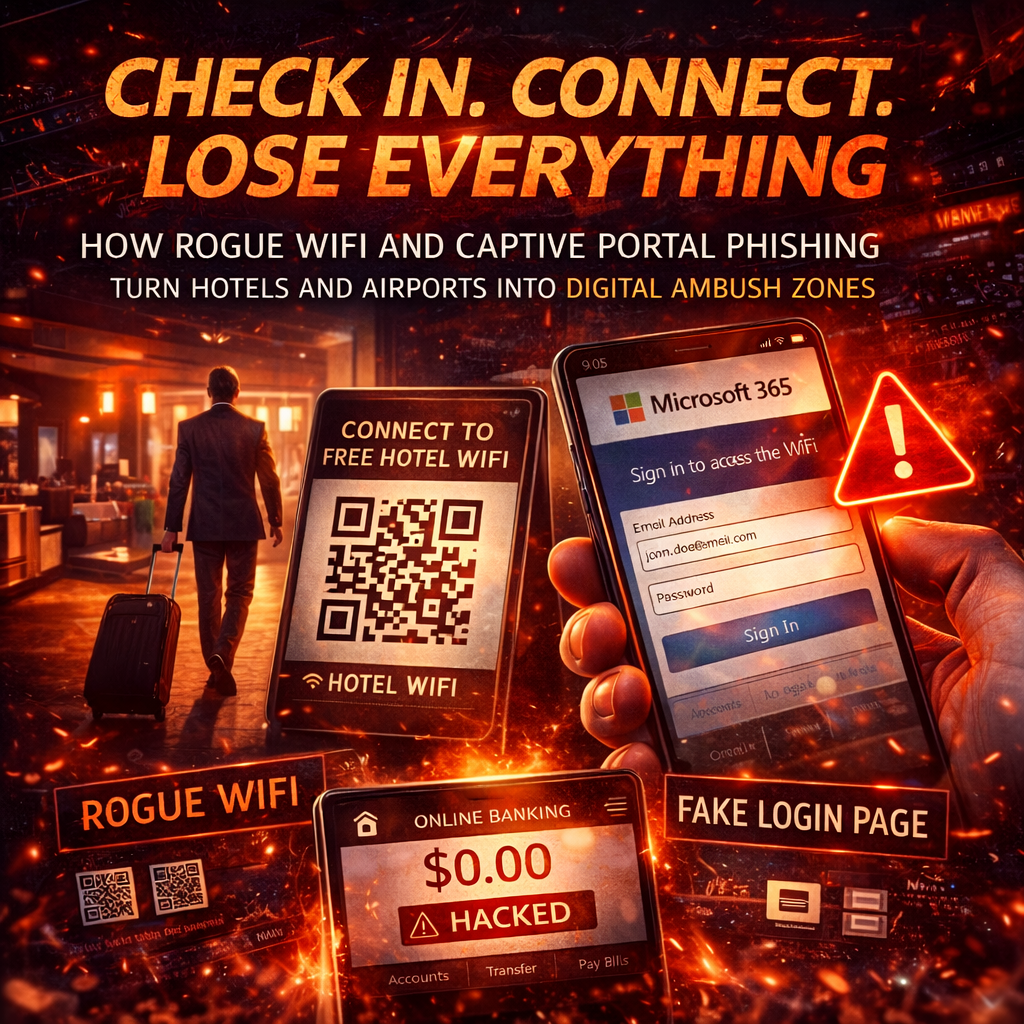
The traveler arrives. Maybe after a long-haul flight. Maybe late at night. Maybe with an early meeting the next morning. The phone automatically searches for networks. A sign on the wall reads: “Free Hotel WiFi – Scan here.” A sleek QR code sits next to it. At the airport, a display offers: “Tap your phone for faster connection.” NFC enabled. Frictionless. Modern.
It feels efficient. It feels safe.
It isn’t.
This is Rogue WiFi combined with Captive Portal Phishing—and it’s not just about fake networks. It’s about staging trust. Perfectly.
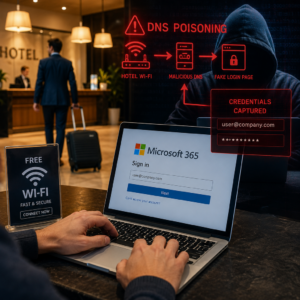
The attacker sets up a network that looks identical to the real one. Same name. Same branding. Sometimes even the exact same SSID. Your device connects automatically, choosing the strongest signal. No warning. No friction.
Then comes the portal.
A login page appears. Clean. Professional. Familiar. Maybe it looks like Microsoft. Maybe Google. Maybe the hotel’s own branded login screen. It asks for a quick verification. A simple sign-in. A security confirmation.
Everything looks normal.
And that’s the trap.
The user enters their email.
Then their password.
Maybe even a second factor.
A one-time code.
A quick approval request.
It feels like routine.
But it’s not a login.
It’s a funnel.
The credentials don’t go to Microsoft.
They don’t go to Google.
They go straight to the attacker.
And that’s where the real attack begins.
Because modern WiFi phishing isn’t about stealing one password—it’s about unlocking everything behind it.
Once the attacker has access to the email account, the entire digital identity becomes vulnerable. Email is the control center. It’s the reset key for everything: banking, SaaS platforms, cloud storage, internal company systems, even personal accounts.
And then the chain reaction starts.
First the email account.
Then password resets.
Then additional services.
Then session tokens.
Then payment systems.
Then data exfiltration.
Then full compromise.
And suddenly, it’s not just a login anymore.
It’s total access.
Imagine the scenario.
A business executive checks into a hotel after a long day. Alone. Tired. Focused on the next meeting. On the desk in the room: a welcome folder with a QR code labeled “Connect to Guest WiFi.” He scans it.
The page opens. It requests a Microsoft 365 login to “secure access.”
The branding is perfect. The timing makes sense. The process feels familiar.
He enters his credentials.
A moment later, an MFA request appears. He approves it. After all, he just initiated the login, right?
Within seconds, access is granted.
But not to him.
To the attacker.
He puts the phone down. Takes a shower. Orders food. Prepares for the next day.
Meanwhile, in the background, everything starts to unravel.
The attacker logs into the Microsoft account. Reads emails. Identifies contacts. Reviews documents. Finds invoices. Sees internal communication. Maybe even ongoing negotiations or financial approvals.
Password resets are triggered.
Access expands.
Systems open.
Nothing looks wrong—yet.
Maybe the first sign appears the next day.
Or two days later.
Or when a client calls asking about a strange email.
Or when transactions appear that were never authorized.
By then, it’s already over.
Because this attack doesn’t rely on breaking systems.
It relies on breaking moments.
Moments of fatigue.
Moments of routine.
Moments where convenience overrides scrutiny.
And that’s why it works