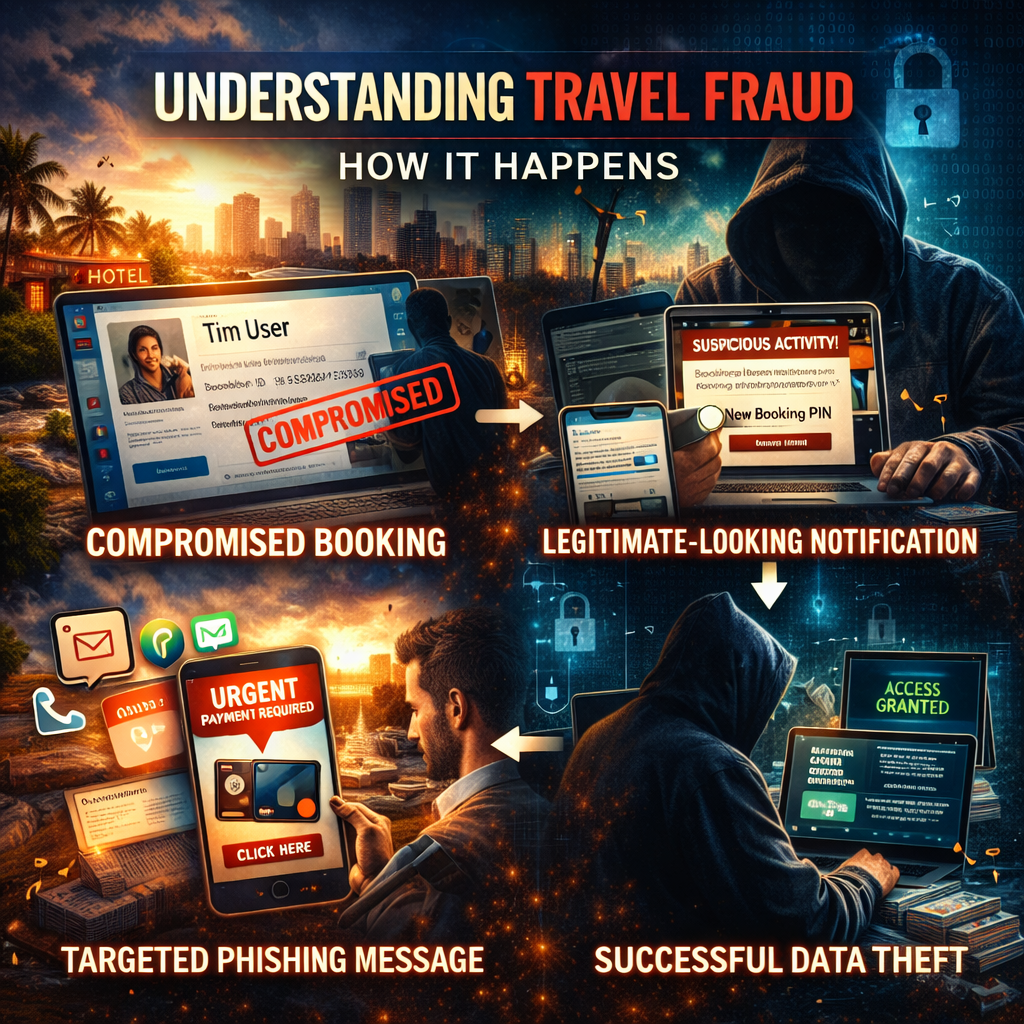
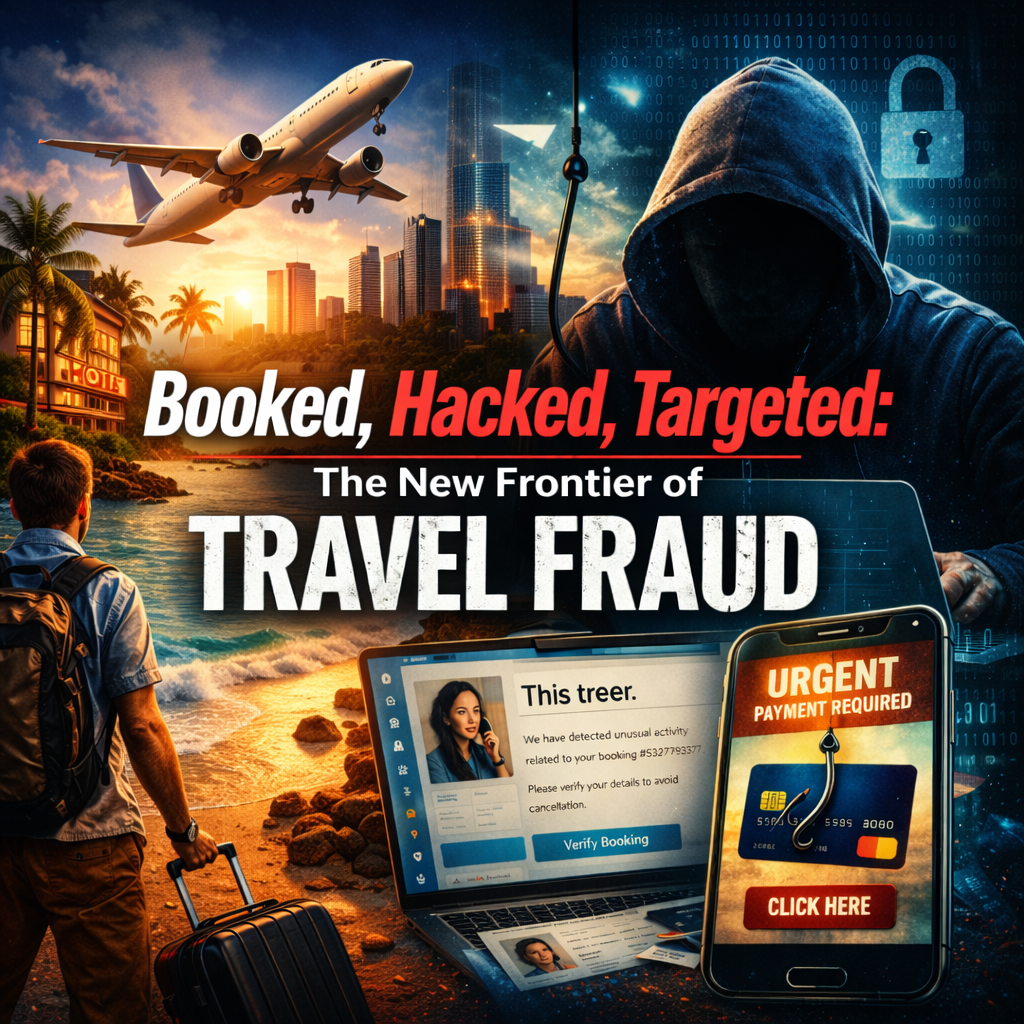
We operate Darkgate and regularly travel ourselves, often in the context of executive-level business trips. That means we are used to structured planning, professional bookings and relying on established platforms. Which makes it all the more interesting when you suddenly become part of a scenario you would normally only analyze from the outside. Recently, we made a completely standard hotel booking. Shortly after, we received a message that looked legitimate, well written, aligned with the platform’s tone and directly referencing the booking. It stated that suspicious activity had been detected and that certain booking-related data may have been accessed by unauthorized third parties. Names, email addresses, phone numbers and booking details. At the same time, the booking PIN was changed and a warning was issued to be cautious about any further communication. This is exactly the point where the real story begins.
What happened here is not a classic credit card breach and not a direct compromise of financial accounts. It is part of a new category of attacks best described as context-driven fraud. The attacker does not need full system control. Access to relevant data is enough. That data can originate from compromised hotel systems, third-party providers, poorly secured integrations or internal access points at smaller accommodations. In fragmented industries like hospitality, security standards vary widely and often lag behind major platforms. This creates a weak link. The vulnerability is not necessarily the platform itself, but the extended ecosystem connected to it.
Once an attacker gains access to a specific booking, the quality of the potential fraud changes completely. This is no longer about generic phishing sent to thousands of random recipients. This is targeted communication. The attacker knows a trip is coming up. They know the guest’s name, the travel period and potentially the exact property. That creates a different level of credibility. Messages sent under these conditions no longer feel like spam. They feel legitimate. This is the key shift. Trust is no longer built through design or wording alone, but through context.
In practice, the next step is often direct outreach. Email, SMS or WhatsApp. The content is usually harmless on the surface, something like a payment confirmation, a failed transaction or a security check. In many cases, subtle pressure is applied by suggesting that the booking may be canceled if no action is taken. At that moment, the user is often already in a travel mindset, distracted, time-constrained and more likely to react quickly. That is exactly what these attacks are designed to exploit. This is not about technical sophistication, it is about timing and psychology.
What we are seeing here is part of a broader shift. Traditional mass phishing is becoming less effective as users become more aware and filtering improves. Instead, attackers are moving toward personalized scenarios. Data becomes the key enabler. With context, attacks become precise. Travel is a particularly attractive environment because communication is expected. Hotels, check-in instructions, transfers, changes in reservations. All of these are legitimate reasons for interaction. That expectation is being weaponized.
It becomes even more relevant when combined with modern technologies. Attackers are increasingly using automated systems to process data and generate highly tailored messages. Going forward, this will be amplified by AI. Content will become more personalized, more natural in tone and more aligned with individual behavior. The distinction between legitimate and malicious communication will continue to blur. Users will no longer be able to rely on obvious warning signs. The decision point becomes more difficult, and the attack surface expands.
For businesses and especially for decision-makers who travel frequently, this creates a real risk. Not necessarily in the form of immediate financial loss, but in terms of information exposure. Responding to such a message can lead to further data being shared, opening the door for follow-up attacks or becoming part of a larger chain. In a business context, this can quickly escalate if travel plans, contacts or internal processes are indirectly exposed.
The most effective response in these situations is surprisingly simple. Keep all communication within the original platform. Do not click on external links. Do not provide payment details outside of the established booking process. Most importantly, understand that legitimate data does not automatically mean legitimate communication. That assumption is exactly what these attacks rely on.
For us, this case is a clear example of how threat landscapes are evolving. Not loud, not dramatic, but precise and subtle. It is no coincidence that travel platforms are increasingly becoming a target. They combine personal data, time-sensitive situations and a high willingness to engage. From an attacker’s perspective, it is an ideal setup.
Looking at the bigger picture, travel fraud is no longer a niche issue. It is an emerging segment within modern cyber threats. The combination of data access, contextual awareness and targeted communication makes this type of fraud highly effective. And for that reason, it will continue to grow. Not as an isolated trend, but as part of a new generation of attacks that rely less on breaking systems and more on manipulating behavior.
In the end, the key is not the individual booking or the single message. It is the understanding that security is no longer just about protecting systems, but about correctly interpreting situations. Those who understand this have a clear advantage. Those who ignore it risk becoming part of an ecosystem that is getting increasingly effective at exploiting trust.