
It starts the same way in almost every organization. Not with a breach, not with a visible failure, but with a decision. A new tool is introduced, a new layer of protection is added, and a new vendor promises better visibility, faster detection, and more control. It feels like progress. In many cases, it is progress. But only when viewed on its own. And that is exactly where the real problem begins.
Modern security environments are rarely designed as one coherent structure. They grow over time. Quarter by quarter, budget by budget, solution by solution. Endpoint protection gets upgraded, a SIEM is introduced, firewall vendors are changed, identity platforms are expanded, and cloud security layers are added on top. Each of these steps makes sense in isolation. Each tool addresses a real need. But very few organizations pause long enough to ask the uncomfortable question: what does this environment actually look like as one complete system?What often emerges is not a system at all. It is a patchwork.
A landscape of powerful, expensive, individually optimized tools that are only partly connected, only partly integrated, and in some cases even overlapping in confusing ways. Somewhere in the middle of all that technical strength, visibility starts to break apart. It does not disappear entirely. That would almost be easier to deal with. Instead, it becomes fragmented. And fragmented visibility is one of the most dangerous conditions a security team can face, because it creates the impression that everything is under control when in fact the organization is only seeing pieces of the story.
Dashboards are active. Alerts are firing. Reports are being generated. The entire environment looks busy, responsive, alive. But activity is not the same as understanding. And understanding is the thing that matters when a real attack unfolds.
Modern attacks do not respect the boundaries of tools. They do not stay neatly within endpoint telemetry, or within the firewall, or within identity systems. They move across layers. They enter through one point, expand through another, hide behind legitimate behavior, and evolve over time. Every step may be technically visible somewhere, but not necessarily in one place, and not necessarily in a way that creates immediate meaning.
One system sees the login. Another sees unusual traffic. Another logs endpoint behavior. Another records an access request. Viewed separately, none of this may look serious. Viewed together, it can represent a breach already in motion. And that is exactly where many organizations fail. They do not lack tools. They lack connection between tools. They lack context between events. They lack a single operational understanding of what is actually happening.This is what makes the illusion of control so dangerous.
Security teams are not blind. In most cases, they are overwhelmed. They are not missing products. They are surrounded by them. They are not short on data. They are drowning in it. And when teams operate under those conditions, decision making changes. It becomes reactive. It becomes selective. It becomes shaped by pressure rather than clarity. Alerts are filtered, deprioritized, and triaged at speed, not because they are irrelevant, but because there are simply too many of them to handle properly.This is not just a technology issue. It is a structural issue.And it becomes painfully visible during real incidents.
A company invests heavily over several years. It builds what looks like a strong and modern security architecture. It passes audits. It satisfies compliance requirements. Internal stakeholders feel reassured because the organization has clearly spent money, adopted serious tools, and built something that appears mature from the outside. Then a breach occurs. Not in a dramatic Hollywood moment, but quietly and gradually.
A compromised account logs in. No major alert, because the credentials are valid. Access to an internal system follows. Still not critical, because the action is technically allowed. Data is queried. Movement begins. Permissions are tested. The attacker expands carefully and patiently.Days can pass like this.
Every relevant action leaves traces somewhere. Each tool sees a fragment. Logs are written. Signals are captured. Alerts may even be generated. Yet no one sees the entire picture. And when the incident is eventually discovered, often through indirect signs or external notification, the post-incident analysis reveals the most frustrating truth of all: the information was there the whole time.
The signals existed. The evidence existed. The story was already present across the environment. But it was never assembled into something the team could understand quickly enough to act.That is the defining weakness of many modern security stacks. Not absence, but disconnection.
Too many tools, but not enough integration. Too much data, but not enough clarity. Too many alerts, but not enough prioritization.
Behind this is often a deeper problem at the decision level. Tool sprawl rarely happens by pure accident. It usually develops because different teams solve different problems at different times with different budgets and different priorities. One team buys for visibility. Another buys for compliance. Another buys for cloud risk. Another buys for identity. Each decision can be rational on its own, but taken together they create an environment that is increasingly difficult to operate as one unified defense.The result is complexity without cohesion.
And unmanaged complexity eventually turns into risk.
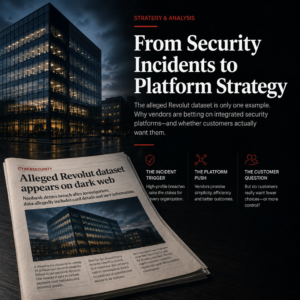
This is precisely why vendors like Splunk, Fortinet, and Palo Alto Networks are so well positioned around this discussion. Their value is not only in the individual capability of a single platform or product. Their value increasingly lies in the promise of connection, context, and operational alignment. They speak directly to the reality that organizations are not suffering from a lack of tools. They are suffering from a lack of coherence.
That is where the real struggle in cybersecurity now exists. Not only at the perimeter. Not only at the endpoint. But in the space between systems, where context is either created or lost.
More organizations are beginning to recognize this. The conversation is slowly changing. It is moving away from “What else do we need to buy?” and toward “Why do our existing systems not work together the way we assume they do?” That is a much more mature question. It reflects a shift away from endless expansion and toward real operational effectiveness.Because the real goal is no longer maximum coverage at any cost. It is maximum clarity.
And clarity requires discipline. It requires integration. It requires simplification where possible, alignment where necessary, and the willingness to challenge previous decisions. It means treating security not as a warehouse of products, but as an operating model that has to function under pressure, in real time, when conditions are messy and incomplete.
In the end, the uncomfortable truth remains the same. An organization can own every major tool category, run every dashboard, invest in every layer, and still fail to detect what matters. Not because the tools themselves are worthless, but because tools alone do not create security. Systems do. Processes do. Context does.That is also where the opportunity lies.
The answer is not blindly adding more technology. It is building stronger relationships between the technology already in place. It is turning fragmented signals into a coherent operational story. It is making sure that when the next suspicious login, unusual endpoint event, or abnormal data movement appears, the organization can understand not just the event itself, but what it means in the bigger picture.
For companies willing to face that honestly, this is where security becomes more than a collection of products. It becomes something stronger, more deliberate, and far more resilient.Not perfect, but controlled.