
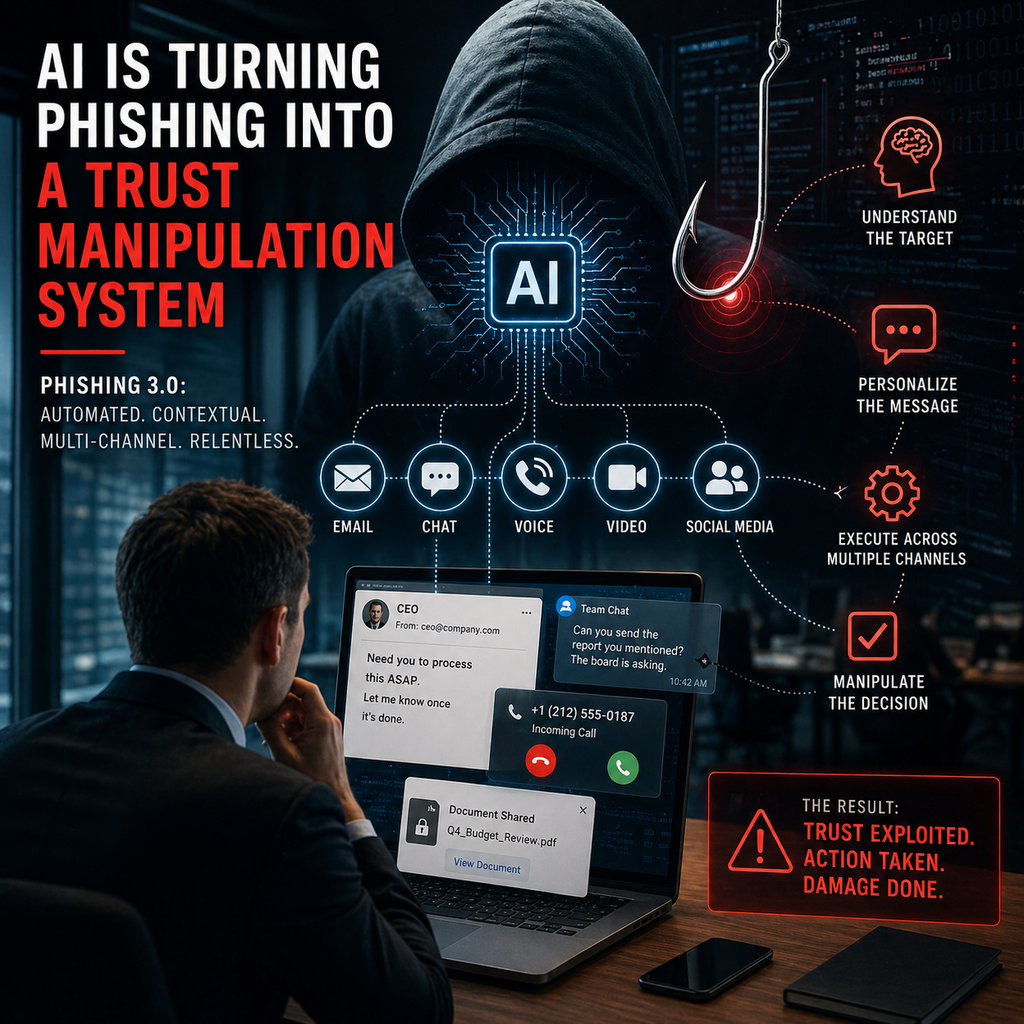
The way phishing is still discussed in many organizations is rooted in an outdated mental model. Suspicious emails, poorly written messages, strange domains — these are the classic indicators that have shaped how teams think about phishing risk. But this model is starting to break down. What is emerging in the current threat landscape is not an incremental evolution, but a structural shift in how attacks are designed and executed. AI is not just increasing efficiency — it is redefining the nature of phishing itself.
In a recent discussion with Dark Reading, Eyal Benishti, CEO of IRONSCALES, described this transformation as “Phishing 3.0.” The term reflects a new operational reality in which attacks are no longer isolated events, but orchestrated, multi-step campaigns — automated, context-aware, and increasingly independent of human control.
The critical shift lies not only in the technology, but in the objective of these attacks. Traditional phishing aimed to bypass technical defenses. Today, the focus is shifting toward influencing human behavior. The question is no longer whether a message looks malicious, but whether an interaction can trigger a specific action. In other words, phishing is no longer just about deception — it is about decision manipulation.
AI enables this shift at scale. Modern systems can process vast amounts of contextual data, including communication patterns, organizational hierarchies, timing, tone, and behavioral signals. The result is highly personalized, adaptive attack scenarios that are almost indistinguishable from legitimate communication. A call that sounds exactly like a senior executive, a video message with a familiar face, or a perfectly timed internal chat request — these are no longer edge cases. They are becoming operational tactics.
This fundamentally changes the dynamics of an attack. Phishing is no longer a single touchpoint, but a sequence. An initial email may be followed by a voice call, reinforced by a message on another channel, and validated through contextual references that increase credibility. These multi-channel, multi-step approaches do not just improve success rates — they create psychological pressure, accelerating decisions and reducing critical thinking.
For organizations, this creates a structural challenge. Most existing security architectures are built around the detection of known patterns. Indicators of compromise, signature-based detection, and static rule sets all depend on repeatability. AI-driven phishing removes exactly that. When every attack is dynamically generated and context-specific, the concept of known indicators begins to lose relevance.
This does not make existing security solutions obsolete, but it does expose their limitations. Defense models must evolve from static detection toward dynamic interpretation of behavior. It is no longer enough to analyze content — organizations must understand interactions, intent, and anomalies in context.
Speed is another factor that is often underestimated. AI allows attackers not only to scale campaigns, but to continuously refine them. Real-time feedback loops enable rapid optimization: which approach works, which roles respond, which timing increases engagement. Phishing becomes a learning system — one that improves with every interaction.
At the same time, traditional boundaries between attack categories are dissolving. Phishing, fraud, and social engineering are no longer clearly separated domains. They are merging into hybrid attack models that operate across functions and systems. For defenders, this creates friction, especially in organizations where responsibilities are fragmented across IT security, fraud prevention, and compliance teams.
The logical consequence is a shift in perspective. If attacks are targeting trust, then defense must be designed around understanding and protecting trust. This requires more than new tools — it requires a different mindset. Employees are no longer just potential vulnerabilities; they become active components of the security model. At the same time, systems must be capable of identifying risky interactions before they lead to critical actions.
AI will play a central role on the defensive side as well — not as an optional enhancement, but as a foundational capability. Just as attackers leverage AI to scale and adapt their operations, defenders must use AI to detect behavioral anomalies, anticipate threats, and support decision-making. The competitive advantage will not lie in whether AI is used, but in how effectively it is integrated into security operations.
For many organizations, this shift is only beginning to surface. Early incidents that go beyond traditional phishing scenarios are raising awareness. But the real challenge is not individual attacks — it is the long-term transformation of the threat model itself. Phishing is evolving from a clearly identifiable threat into a diffuse, embedded risk that operates within everyday communication processes.
The most important takeaway is simple, but profound: trust itself is becoming the attack surface. Every digital interaction is built on implicit assumptions — that the sender is legitimate, that the request is valid, that the context is real. AI is now systematically exploiting these assumptions.
For security leaders, this means moving beyond the idea that phishing is primarily a technical problem. It is a strategic issue that affects processes, organizational structure, and technology alike. Those who continue to rely solely on traditional defenses risk addressing a threat that has already fundamentally changed.
At Darkgate, this development is not viewed as an isolated trend, but as part of a broader shift. AI is not just enhancing attack techniques — it is redefining the balance between attackers and defenders. The ability to simulate, scale, and manipulate trust will become one of the defining factors in the next phase of cybersecurity.
The question is no longer if organizations will face these attacks — but when, and how prepared they are to respond.