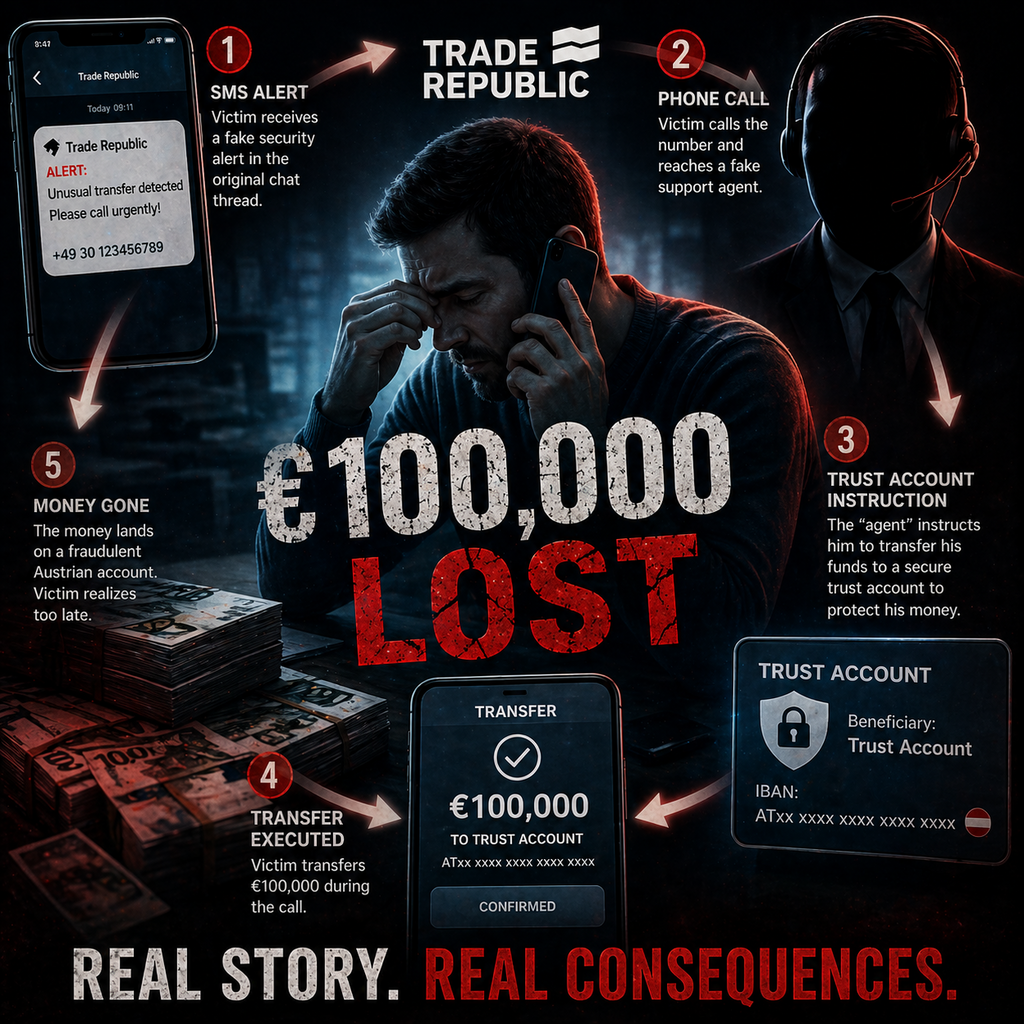

It never starts with panic. It starts with trust. That is what makes this type of financial fraud so dangerous. Darkgate has now become aware of another case in which a male victim lost approximately €100,000. No classic phishing link, no badly written spam email, no obvious red flags. Instead, it began with a text message that appeared exactly where it would be most convincing: inside the existing message thread of Trade Republic.
For the victim, it did not feel like an attack. It looked like a normal security warning from his financial platform. The message warned of a suspicious transfer or unusual account activity that had allegedly been detected. The wording was calm, professional, and similar to the kind of fraud alert users of modern fintech platforms are used to receiving.
What made the case especially dangerous was that the SMS appeared inside the same conversation history as previous legitimate Trade Republic notifications. For the victim, this became the strongest proof of authenticity. When a fraudulent message appears in the same thread as real login confirmations or account alerts, the normal defensive instinct weakens. It feels like an existing conversation with a trusted provider.
The second stage began with a phone number included in the message and an urgent request to contact the security department. What followed was not a chaotic scam call, but a structured conversation with an alleged security representative speaking calmly and confidently. There was technical language, internal process logic, and enough operational detail to make everything sound legitimate.
The fraudsters often do not claim that the money is already gone. They say the opposite. They explain that a suspicious transfer was detected and stopped by internal security systems. Sometimes they even refer to AI-driven fraud detection to make the story sound more professional. This creates relief before fear. Only after that comes the real trap.
The victim was told that his current account could no longer be considered secure. To protect his assets, the funds had to be moved temporarily to a so-called secure trust account. In this case, the destination account was linked to an Austrian IBAN, which added credibility. No obvious offshore account, no suspicious high-risk destination, but a seemingly legitimate European account combined with the powerful label of a trust account.
That removed the final hesitation. The victim did not believe he was sending money away. He believed he was protecting it. In the end, approximately €100,000 was transferred.
This is not a traditional hack. It falls into a category known as Authorized Push Payment Fraud, or APP fraud. From the system’s perspective, the transaction appears legitimate. The account holder authorizes the payment, approves the steps, and completes the transfer through the normal banking process. The money is not stolen through a technical breach. It is released under carefully engineered deception.
For victims, the financial damage is often only part of the problem. Many also struggle with self-blame because they believe they should have known better. But these attackers do not rely on simple tricks. They use behavioral manipulation. They build trust, create controlled urgency, and make the victim feel involved in an active security response.
From a Darkgate perspective, this case shows why fraud defense is changing. Through one of the most established Cybersecurity Recruiting agencies with strong exposure to financial services, fintech environments, and banking infrastructures, it is becoming increasingly visible that companies are no longer focused only on traditional Fraud Analysts or Fraud Specialists. There is growing demand for Human Risk Specialists who understand how trust is manipulated, how people make decisions under pressure, and how behavioral attack chains can be interrupted before money moves.
Modern attacks no longer focus only on infrastructure. They focus on perception. Systems become stronger, controls improve, multi-factor authentication becomes standard, and attackers shift toward the one layer where influence is still possible: the human layer.
The most important defensive rule remains brutally simple. No legitimate financial provider will ever ask you to move your own money into a so-called safe account or trust account in order to protect it. The moment someone tells you to transfer your funds for security reasons, you are no longer inside a protection process. You are inside the attack.
This new €100,000 case is not just another scam story. It shows that the frontline of modern cybersecurity has moved into the space between trust and deception. The attacker no longer needs to break into the platform if he can perform the platform convincingly enough to make the victim act on his behalf. The moment security asks you to move your money somewhere else, you are no longer being protected. You are being played.