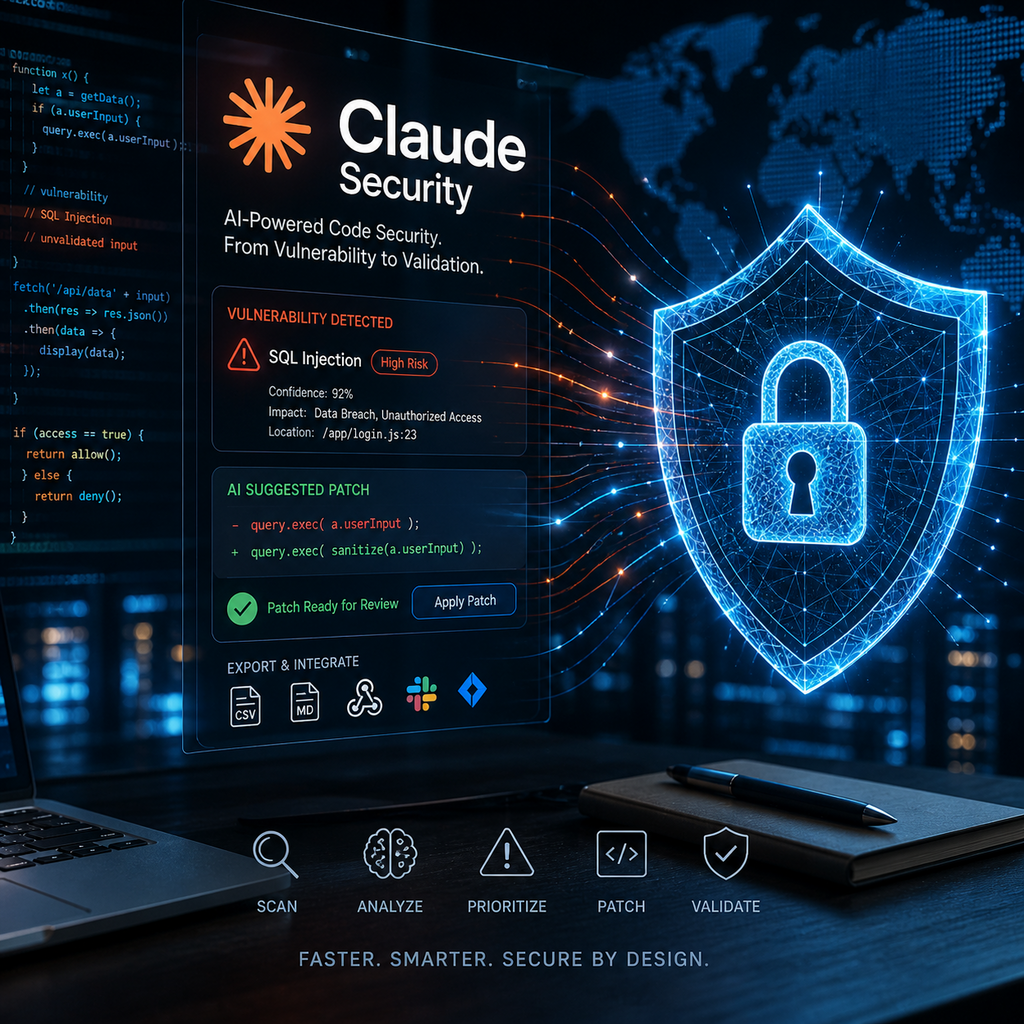
While many companies are still discussing how generative AI can be integrated into sales, support, or internal workflows, the cybersecurity market has already moved to the next level: AI is no longer just an assistant, but is beginning to actively prepare security-relevant decisions. With the public beta of Claude Security, Anthropic has made that shift visible in the enterprise market. The product analyzes source code for vulnerabilities, evaluates risks, suggests concrete patches, and integrates directly into existing development and audit processes. Technically, this may sound like an evolution of traditional security scanners. Strategically, it is far more significant.
The key change is not that AI can identify vulnerabilities. Security tools have been doing that for years. The difference lies in the ambition to move beyond signatures and known patterns and instead understand relationships across modules, files, and data flows. Anthropic intentionally describes the model as functioning like an experienced security researcher who does not simply raise an alert, but provides context: How critical is the vulnerability really? Which systems are affected? How can the issue be reproduced? And which patch is operationally realistic?
For CTOs, this creates an immediate productivity promise. Security reviews that previously consumed days or even weeks between development teams, security departments, and external auditors could become significantly faster. In complex enterprise environments with multiple releases, compliance requirements, and constant audit pressure, time is often more expensive than technology itself. If vulnerability analysis and patch recommendations can move into a single working session, it changes not only speed, but the entire budget logic behind application security.
For CISOs, however, the issue is much more sensitive. The more AI begins preparing security-relevant decisions, the more difficult the governance question becomes. Who carries responsibility if a recommended patch creates new operational risks? Who is accountable if an AI model misjudges the severity of a critical vulnerability? Security has traditionally been a control function built around clear human decision chains. With systems like Claude Security, that structure begins to shift—not fully autonomous, but significantly closer to automated risk prioritization.
System integrators and consulting firms are also entering a new pressure zone. Many partners still sell security assessments, code reviews, and architecture validation as project-based services with high consulting margins. If customers increasingly perform that first layer of analysis through AI-driven systems, the value model changes. The question is no longer who finds vulnerabilities, but who can strategically interpret, prioritize, and implement fixes under real business conditions. Consulting moves from detection to interpretation.
This transition is slower in the DACH market than in the UK or the Netherlands, but it is no less relevant. German enterprises traditionally invest more cautiously in new security models, especially when regulatory accountability and liability questions remain unresolved. While UK and US organizations are often more willing to test vendor-driven innovation early, the dominant question in DACH remains: Who signs off on the risk? This budget mentality slows adoption, but also protects against blind hype.
Vendors such as CrowdStrike, Microsoft, Palo Alto Networks, and SentinelOne are watching this closely because it directly affects partner programs, platform strategies, and long-term customer retention. Whoever embeds security analysis into their own platform increases not only product value, but also lock-in effects. When vulnerability management, detection, patch recommendations, and audit workflows all run inside a single vendor architecture, the exit path for customers becomes significantly more complex.
For smaller system integrators, this also creates a real risk of overload. Technical complexity often rises faster than margins. More presales effort, more architecture work, more training requirements, and growing SLA pressure create operational strain that does not automatically translate into higher revenue. Especially for companies with 50 to 150 employees, the question becomes highly practical: Is this a strategic revenue driver, or simply a resource-heavy vendor push that customers are not actively demanding?
The recruiting market is already responding. Demand is gradually shifting away from pure implementers toward Security Architects, Governance Specialists, and Senior Consultants who combine technical depth with business and risk understanding. Companies are looking less for tool operators and more for professionals who can moderate complex decisions between technology, compliance, and operational reality. This does not automatically mean more hiring, but it clearly signals the need to requalify existing teams.
At the same time, it remains unclear whether Claude Security and similar products will still be seen as a real market transformation in twelve months, or whether they will remain primarily part of a vendor-driven narrative. Many enterprise customers care less about the technical elegance of a model and more about one simple question: Will this measurably improve our security posture—and will the business actually be willing to pay for it?
That is where the future of AI security will be decided. Not by the model itself, but by operational reality inside the customer environment. Between the demo and productive deployment, the biggest challenge is rarely technology. It is trust.