
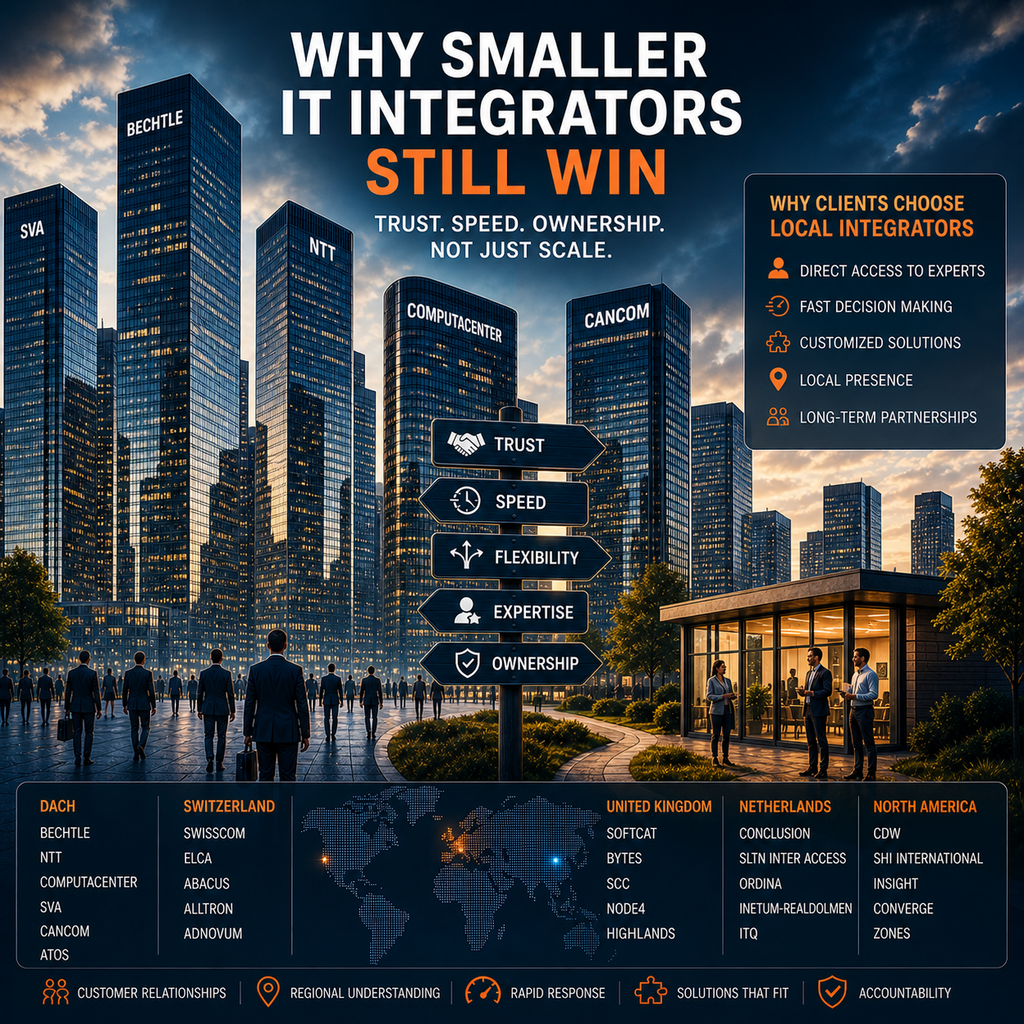
On paper, the market should have been decided long ago. Large players like Bechtle, NTT DATA, Computacenter, SVA System Vertrieb Alexander, Cancom, and Atos operate with international delivery structures, enormous vendor influence, global purchasing power, and nearly unlimited scalability. In Switzerland, companies like Swisscom and Elca dominate major enterprise projects, while in the United Kingdom, integrators such as Softcat, Bytes Technology Group, and SCC are deeply embedded in enterprise accounts. In the Netherlands, firms like Conclusion and SLTN Inter Access hold strong market positions, while in North America, integrators such as CDW, SHI International, and Insight Enterprises control significant market share. Looking at this landscape rationally, mid-sized regional players should have disappeared years ago.
Reality looks very different.
Smaller regional IT integrators continue to win projects against global giants. Enterprise clients still deliberately choose against the international corporation and in favor of the 40, 80, or 150-person local integrator. Many of the most profitable customer relationships are still built not through international framework agreements, but through proximity, trust, and operational reliability. The real question is therefore not why the large players are successful. The more interesting question is why smaller firms continue to survive despite all structural disadvantages.
One of the most important reasons is trust. Large integrators sell stability, process, and scale. Smaller integrators sell responsibility. The customer often knows not just the company logo, but the founder, the lead architect, or the senior consultant who will actually answer the phone when things go wrong. In infrastructure projects, cybersecurity transformations, and critical migrations, companies rarely buy technology alone. They buy confidence that someone will take real ownership when operational pressure hits. Many CIOs do not choose the biggest name—they choose the lowest day-to-day risk.
Speed is another major factor. Large integrators naturally operate through layers: sales, presales, architecture, delivery, project governance, escalation management. Everything is structured professionally, but often also slower. Smaller firms make decisions faster. Custom solutions do not need approval through multiple management levels. Clients often speak directly with the technical decision-maker instead of another account management layer. Especially in the midmarket and among owner-led businesses, this creates a serious competitive advantage.
Another underestimated factor is regional presence. Despite remote work, virtual workshops, and global delivery models, local proximity remains a surprisingly strong decision driver even in 2026. Since 2020, much has changed. Projects are planned remotely, architectures are delivered internationally, and presales processes are often handled entirely online. Yet one pattern remains consistent across enterprise accounts: when things become critical, proximity wins. The integrator who knows the customer’s location, understands internal political structures, and has been physically present for years holds a trust advantage that no Teams call can fully replace.
This matters even more in Germany, Austria, and Switzerland than in more Anglo-Saxon markets. The DACH midmarket buys more conservatively. Decisions are driven less by global vendor narratives and more by personal experience. If an integrator has supported a location for ten years, they are far more likely to win the next project—even if the international competitor looks stronger on paper. Remote work has reduced distance, but it has not virtualized trust.
That does not mean regionality is only about physical presence. Often, it is about perceived accessibility. The customer wants to know that when escalation happens, the decision will not be made inside a global ticketing system, but by a real person with accountability. This is exactly where large integrators, despite technical strength, still lose surprisingly often against smaller firms.
Vendors regularly underestimate this dynamic. Many partner programs prioritize revenue size, certification levels, and global scale. That is understandable, but not always aligned with market reality. Many smaller integrators do not control massive budgets, but they control highly loyal customer relationships with strong closing probability. They have been sitting inside customer accounts for fifteen years, understand internal power structures, and often win projects before an official RFP even exists. This invisible market power never appears inside a partner portal, but it drives real revenue.
The important question is how this develops over the next few years. Remote delivery will continue to grow, international project models will become normal, and vendor platform strategies will push further centralization. At the same time, complexity continues to rise. Security, compliance, cloud governance, and hybrid infrastructure create new uncertainty. The more complex the environment becomes, the stronger the demand often grows for personal accountability rather than pure technical scale.
That is why smaller IT integrators are unlikely to disappear. They will evolve, specialize, and sell trust more than size. The global players will remain dominant, without question. But market leadership does not automatically create customer intimacy.
The real strategic question is therefore not whether smaller integrators can survive against global giants. It is whether large integrators can make themselves feel small enough again to create trust on the same level. Because in the end, companies rarely buy infrastructure alone. They buy security – technical, operational, and human.