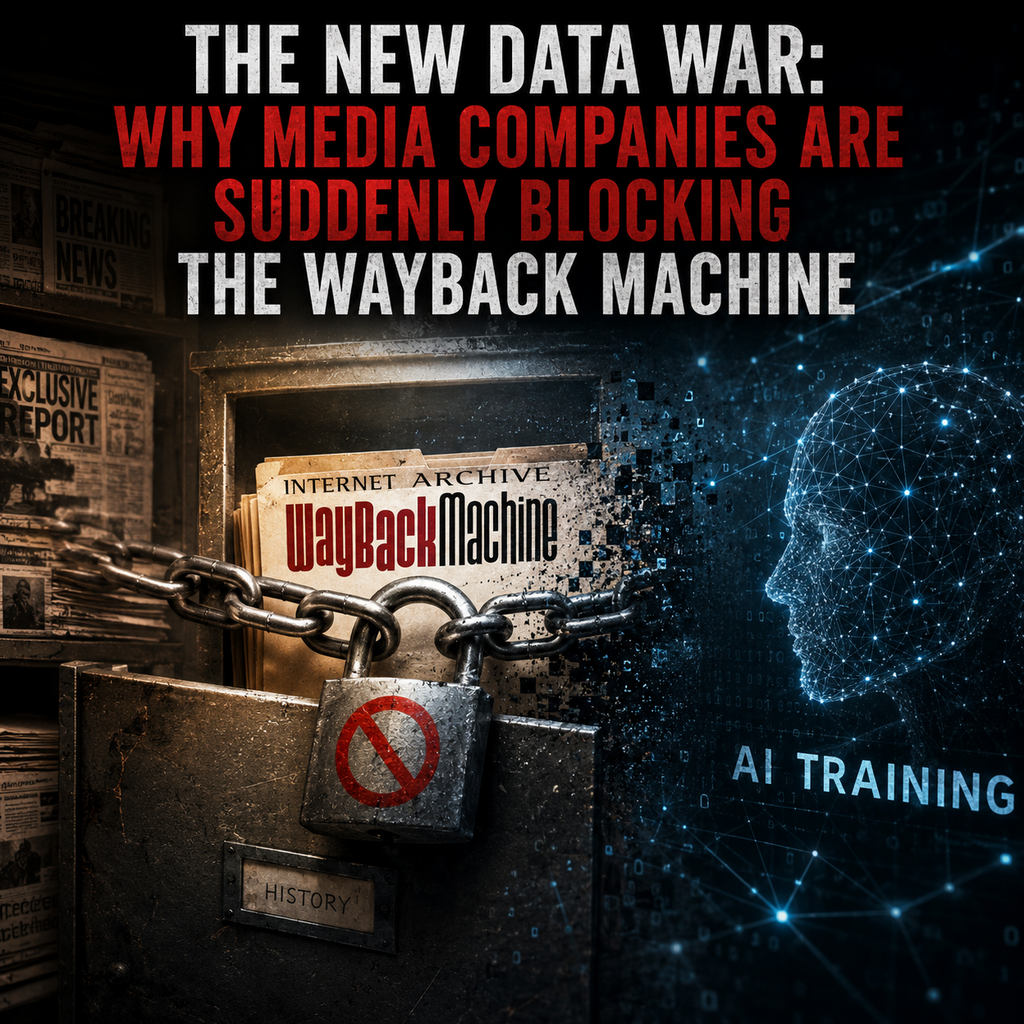
For decades, the Wayback Machine has served as one of the Internet’s most important memory banks. Millions of websites, historical versions of corporate portals, vanished press releases, forgotten login pages, and long-deleted content have been preserved by the Internet Archive. For journalists, historians, security researchers, and incident response teams, it has often been the first stop when investigating the past.Today, that digital memory is increasingly under threat.
A growing number of media organizations are actively blocking the Wayback Machine from archiving their content. While this may appear to be a copyright or business decision on the surface, it is actually part of a much larger conflict: the battle for data in the age of artificial intelligence.
The concern among publishers is understandable. As AI vendors invest billions into developing increasingly capable large language models, they require enormous amounts of training data. News articles, industry analysis, investigative reporting, and editorial content represent some of the most valuable sources available.
Even when organizations block AI crawlers directly, another potential pathway remains. Archived content may still be accessible through third-party repositories and historical archives. As a result, the Wayback Machine has become an unexpected casualty in the growing war over data ownership.Historical information is suddenly becoming a strategic asset.
What was once viewed as public knowledge now carries measurable commercial value. Every article, report, and analysis has the potential to contribute to future AI systems. Consequently, companies are becoming increasingly aggressive in controlling access to their historical content.
From a cybersecurity perspective, however, the issue extends far beyond AI.
For Digital Forensics and Incident Response teams, the Wayback Machine is much more than a historical archive. It is often an invaluable investigative resource.
Security analysts frequently use archived websites to identify old login portals, trace former employee information, uncover forgotten subdomains, and reconstruct historical infrastructure. In many cases, archived snapshots reveal legacy systems, outdated technologies, and previously exposed services that have long disappeared from current websites.These historical records often provide critical context during security investigations.What systems were publicly accessible five years ago?
Which technologies were deployed before a migration?What information was exposed over extended periods of time?
Which attack surfaces existed long before the breach was discovered?Answers to these questions can significantly improve threat hunting, vulnerability assessments, and post-incident analysis.
If organizations continue to restrict large-scale archival efforts, the consequences may extend far beyond AI training datasets. Security researchers, threat intelligence teams, digital investigators, and incident responders could lose one of their most valuable sources of historical visibility.This creates a fascinating dilemma.On one side are organizations seeking to protect intellectual property, content rights, and commercially valuable information. On the other side are researchers, archivists, journalists, and security professionals who rely on historical transparency to understand how digital systems evolve over time.The fundamental question is no longer whether the Wayback Machine should archive websites.
The real question is:How much digital memory should survive in the age of artificial intelligence?
As AI systems consume ever-larger volumes of data, many organizations are simultaneously attempting to erase or restrict access to their historical footprint.The result may be a paradox.Never before has humanity generated so much information. Yet future generations may have significantly less access to the historical evolution of the Internet than researchers have today.The battle over AI training data is rapidly becoming a battle over digital memory itself.And that makes this story far bigger than a debate about robots.txt files, web crawlers, or copyright enforcement.It is the next front in the global struggle for data, knowledge, visibility, and control.