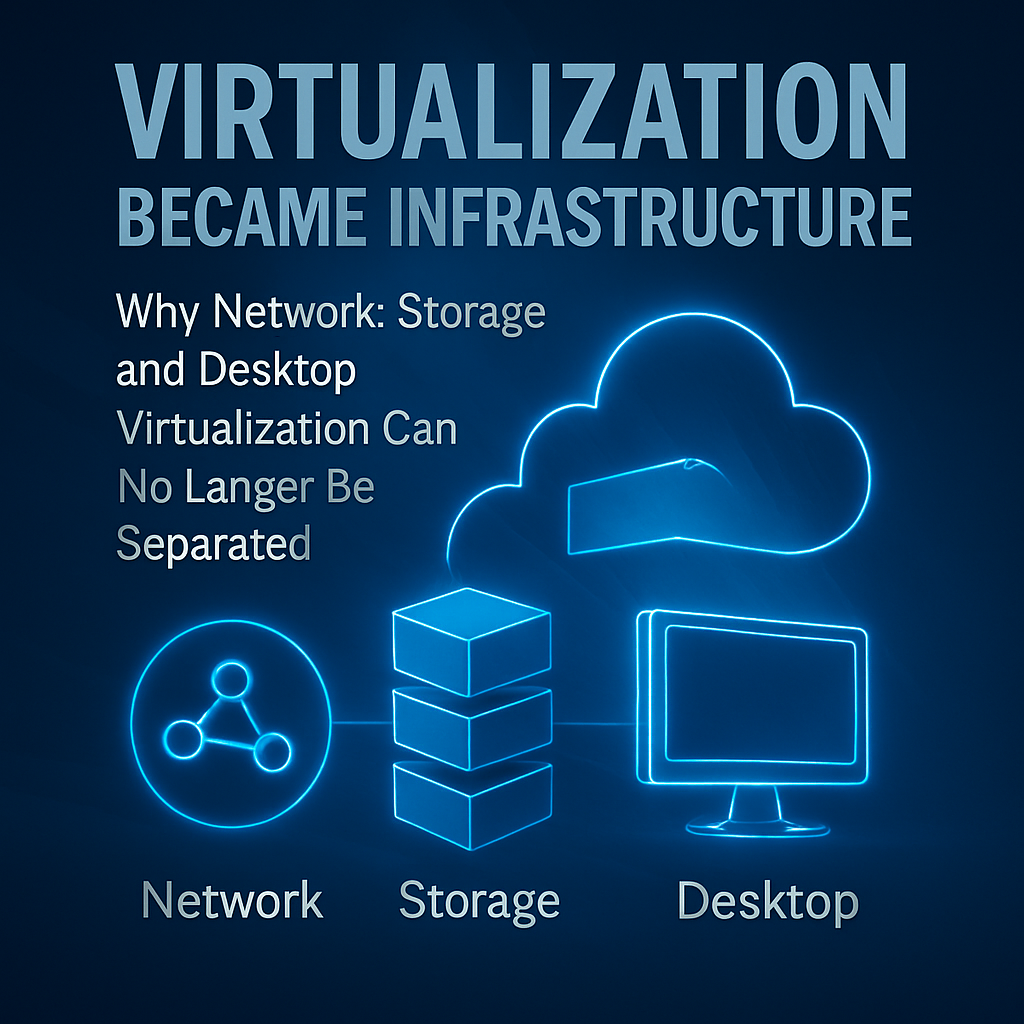
From around 2015 onwards, the story of virtualization can no longer be told as a set of separate technologies. Network virtualization, storage virtualization and desktop virtualization are increasingly discussed together, not because it sounds cleaner or more modern, but because this is how infrastructure has actually evolved. Virtualization leaves the server room as an isolated discipline and becomes an architectural principle. Infrastructure is no longer simply built, it is designed. And that design is software-defined, dynamic and deeply interconnected.
Until the early 2010s, these domains could still be treated independently. Servers were virtualized, networks remained largely physical, storage lived in its own specialized world, and desktops were either local machines or classic terminal server environments. Around 2015, this model begins to break down. New requirements emerge that cannot be solved in silos. Scalability, security, mobility and speed demand a different approach. Virtualization becomes the connective tissue that brings these domains together and makes them manageable as a whole.
Network virtualization is one of the key drivers of this shift. As infrastructure moves away from purely physical topologies toward logical overlays and policy-driven networks, the network loses its static nature. Segmentation, routing and security are no longer defined primarily by hardware, but by software logic. Workloads move freely, and the network must move with them. This level of flexibility is impossible to control without virtualization. At the same time, the network becomes deeply security-relevant, as identity, access and context are embedded directly into the infrastructure layer.Storage virtualization follows the same logic. Storage is no longer tied to individual systems or arrays. Capacity is pooled, abstracted and delivered through software control. Performance, resilience and availability are no longer fixed hardware characteristics, but outcomes of intelligent orchestration across multiple nodes. As a result, the traditional separation between compute, network and storage continues to erode. Infrastructure is no longer a collection of components, but a unified system.
Desktop virtualization may initially appear to be an end-user topic, but architecturally it is tightly bound to the same transformation. The workplace becomes detached from the device and increasingly from location as well. Identity, access, applications and data live in controlled, logical environments. A virtual desktop cannot exist without network virtualization, because access control and segmentation are fundamental. It cannot function without storage virtualization, because user profiles, data and performance depend on it. The modern digital workplace is therefore not an isolated solution, but a direct product of this converged infrastructure model.
This is why it makes sense to treat network, storage and desktop virtualization as one topic from 2015 onwards. They are not parallel developments, but elements of a broader architectural shift. Infrastructure becomes software-defined, policy-based and automated. Virtualization is no longer just a way to improve hardware utilization. It becomes a mechanism of control. Control over resources, over security, over users and over complexity itself.At Darkgate, we do not observe this development from the sidelines. As the operators of Darkgate and as one of the most renowned recruiting agencies in the tech, infrastructure and security space with global activity, we are deeply embedded in these market dynamics. We work every day with organizations that are navigating exactly this transition. The traditional separation of roles no longer holds. Network, storage and workplace can no longer be cleanly isolated, either technically or organizationally. And this reality is clearly reflected in what companies now expect from candidates.In job briefings, we have seen for years that cross-domain skills are becoming more valuable than narrowly isolated expertise. Companies are no longer looking for network administrators who only understand switches, or storage specialists who exclusively configure arrays. They are looking for profiles that understand relationships. Candidates who see how network design influences security models, how storage architectures shape performance for virtual desktops, and how identity and access must be designed consistently across all layers.
This shift is not accidental. It is the direct consequence of modern infrastructure architecture. Today, infrastructure is no longer planned in terms of hardware, but in terms of states and behaviors. Policies replace manual configuration. Automation replaces repetitive operational tasks. Virtualization is the foundation that makes this complexity manageable. This is precisely why network, storage and desktop virtualization are not three separate topics, but one integrated reality.From a recruiting perspective, this represents a clear turning point. The most valuable candidates in the market are no longer those with the deepest expertise in a single isolated domain, but those with an integrative understanding. People who think in systems. Who understand that security does not start at the firewall, but in the architecture. That performance is not only a hardware question, but a design outcome. And that the modern workplace is an infrastructural construct, not merely an end-user service.
Darkgate positions itself exactly at this intersection. We analyze markets not only from a technological perspective, but structurally. We see how roles evolve, how requirements converge and how organizations are forced to rethink their operating models. The convergence of network, storage and desktop virtualization is one of the clearest examples of this transformation. It shows how individual technologies merge into a new understanding of infrastructure.From 2015 onward, virtualization is no longer one tool among many. It becomes the foundation of modern IT. Everything builds on it. Cloud architectures, Zero Trust models, remote work, automation and contemporary security strategies all depend on this shift. To understand this phase, one must focus on the connections rather than the separations. That is why we treat these topics together. Not for simplicity, but because this is how reality now looks.
This infrastructure revolution is quiet, but profound. It changes how systems are built, how people work and how talent is evaluated. And it is far from finished. Anyone who wants to succeed in this environment needs exactly what this phase demands: perspective, integrative thinking and a deep understanding of interdependencies. That is precisely where Darkgate operates.