Darkgate is not a traditional media platform. We operate one of the most internationally connected recruitment organizations in the fields of IT, security and platform technologies. We speak daily with CTOs, CISOs, cloud architects, platform leads, legal experts and executive decision makers across Europe, Asia and the United States. We do not only observe technologies. We observe structures, dependencies and power shifts before they become visible in mainstream debates. Over the past five years, cloud and cloud security have evolved from technical topics into strategic factors. First it was about scalability, then about cost, then about speed. Today it is about control. And this is where cloud security becomes a question of power.
The silent loss of control
Many companies believe they control their IT because they have administrative rights. Because they configure systems, assign permissions and design architectures. In reality, they control only their usage inside platforms they do not own. They no longer own infrastructure, they no longer have physical control, and they no longer have full legal control. They operate inside environments whose rules are defined by others. Cloud is not only a technical outsourcing model. It is a structural transfer of control.This transfer is not loud, not political and not democratically negotiated. It happens quietly, driven by efficiency, convenience and economic logic. Hyperscalers now define global architectural standards in practice. They decide which services exist, how they behave, how they are secured and when they are deprecated. Organizations adapt. Not because they are forced to, but because there are no realistic alternatives.
Platforms as new power centers
In classical IT models, power followed infrastructure. Whoever owned the servers controlled the systems. Whoever operated the networks controlled access. Cloud dissolves this link. Infrastructure becomes abstract, global and interchangeable. Power shifts from operators to platform providers. Control is no longer exercised through ownership, but through architecture, interfaces, dependencies and standards.A platform provider does not need to issue commands to exercise power. It is enough to design systems in a way that makes alternatives unattractive, expensive or risky. Proprietary APIs, proprietary services, proprietary automation. Not as malicious intent, but as business logic. Dependency is not a failure of the cloud. It is its economic foundation.
Law overrides architecture
Cloud security is therefore not only technical security, but legal positioning. Data does not exist in a vacuum. It exists in jurisdictions. Access is not only technically regulated, but legally enforceable. National laws such as the CLOUD Act or the Patriot Act do not apply to customers, but to providers. Whoever controls the platform controls the legal reach.This creates a fundamental tension between technical globalization and legal fragmentation. European companies operate on platforms subject to US law. Data protection, confidentiality, compliance and state access rights no longer align on the same layer. Control becomes not only technical, but political.Cloud security therefore also becomes sovereignty management. Not in a nationalist sense, but in a functional one. If you do not control under which legal conditions your data exists, you do not control your data.
From security to agency
Security has long been understood as protection against attacks. Today, security is the ability to remain capable of action. Capable in the face of technical failures, legal interventions, political tensions and economic dependencies. An organization that cannot change its platform without threatening its business model is not independent. It is structurally bound.This binding is rarely consciously chosen. It emerges gradually. First one service, then another, then a third. At some point it becomes unclear where the organization ends and the platform begins. Control becomes diffuse. Responsibility becomes shared. Dependency becomes normal.
Cloud security as a strategic discipline
At this point, cloud security becomes a strategic discipline. Not in the sense of more tools, but in the sense of more awareness. Awareness of dependencies, power relations, legal environments and structural risks. Security is no longer what prevents attacks. It is what preserves freedom of decision.The central questions are no longer: Is the system secure? But: Who could shut it down? Who could enforce access? Who defines what is possible? Who defines what is acceptable? Who decides what “secure” means?
These questions are uncomfortable because they cannot be answered technically. They touch strategy, law, politics and economics. That is why they are often not asked.
Why this matters to decision makers
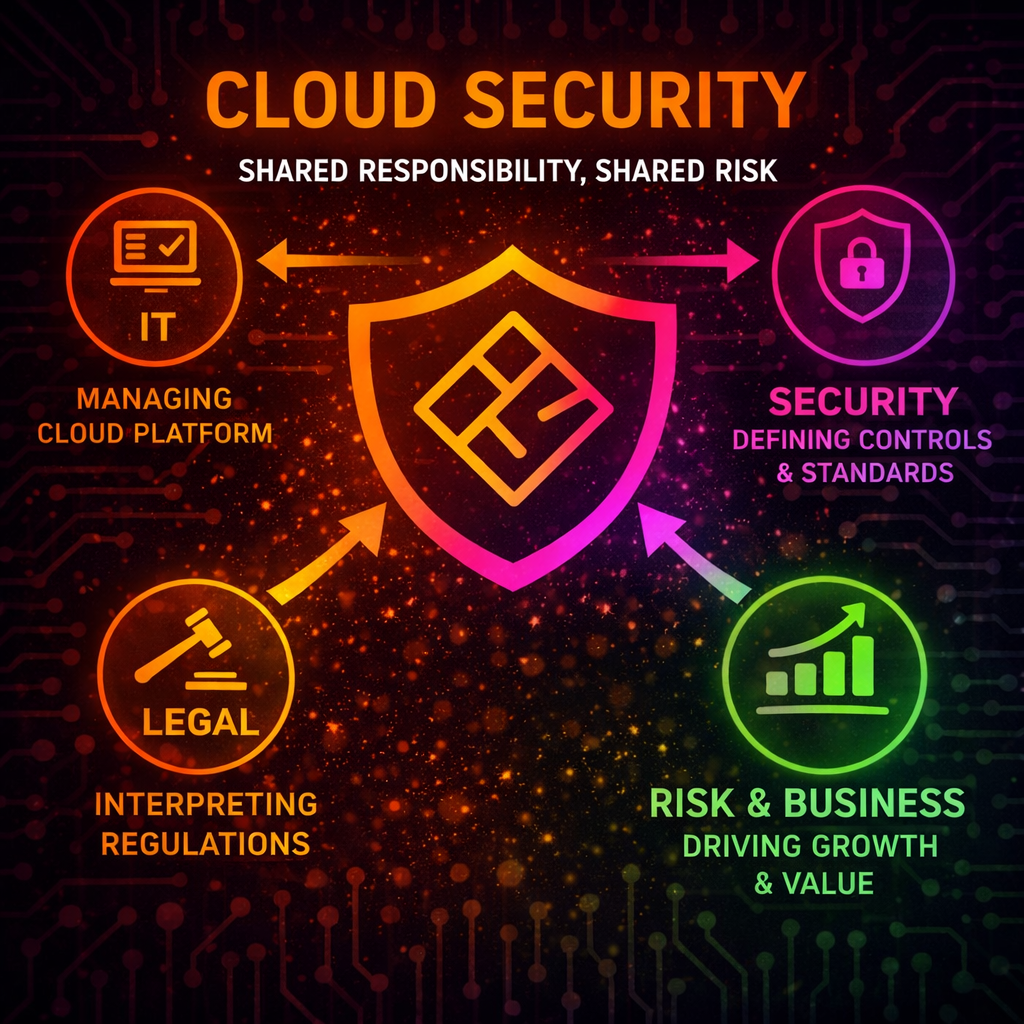
Cloud security is not a topic for IT departments alone. It is a topic for boards, executives, legal teams and strategic planners. Using cloud is not a technical choice. It is a structural one. A choice about dependency, control and long term agency.This does not mean cloud is wrong. It means cloud must be consciously designed. Dependencies must be explicit. Risks must be assessed not only technically, but structurally.
The Darkgate perspective
From Darkgate’s perspective, cloud security is the intersection of technology and power. Of efficiency and control. Of global scalability and local responsibility. It is the point where digitalization becomes political, legal and strategic.If you understand cloud security only as protection, you do not understand it. It is not a protection layer. It is an organizational principle. A principle that defines how much control we give up, how much responsibility we carry and how much agency we retain.
And that is why the central question is not: How do we secure our cloud?