At DarkGate we do not look at cybersecurity from the outside. We live inside the environments that matter. We run a magazine, yes, but we also operate one of the most respected cybersecurity recruitment agencies on the planet. The people we place work where failures are measured in millions and where security is not a service but an operating condition. These teams defend global supply chains, high-value infrastructure and critical industries with no room for hesitation. This perspective is the foundation of what you are reading now.We recently wrote about Threat Management, the discipline that identifies danger early enough to stop it before it becomes real. It is the smoke detector, the early alarm, the system that reads patterns before they turn to flames. But security is never complete if we remain only in prevention. There is a moment that no one likes to speak about. The moment when the breach is already happening. When systems freeze, when data is locked, when productivity collapses and the board is one phone call away from a public crisis. That moment has a name. Crisis Response.
Threat Management aims to avoid disaster. Crisis Response begins when disaster has already entered the room.Unlike early detection, Crisis Response is not theoretical. It operates under pressure, under time loss, under uncertainty. You cannot pause an attack. You can only move faster than it expands. Privilege escalation, lateral movement, data exfiltration, ransomware encryption, persistence — when those terms describe current activity instead of hypothetical risk, there is no time to discuss frameworks. The only question is whether the organisation can act with clarity.A few months ago we spoke with the CTO of a global integrator that employs over four thousand security engineers. We were discussing a senior incident response role when he quietly interrupted. He said he could continue the call, but only for twenty minutes. They were in an active crisis and one of their automotive customers was offline. He said it like he would state the weather, without drama and without panic, because he had no time for either.The breach began with something small. A compromised authentication token in a Microsoft 365 environment. A password that should not have had privileges, yet did. A login that went unnoticed. The system should have flagged it, and under ideal Threat Management it would have. Multi-factor would have triggered, access would have been revoked, forensic sweeps would have followed. But detection came late. The intruder was already inside. Reconnaissance. Movement across hosts. Permission escalation. Domain control. Shortly after, product data management was offline, code repositories encrypted, production stopped, backup systems infected. The cost of every hour was enormous.
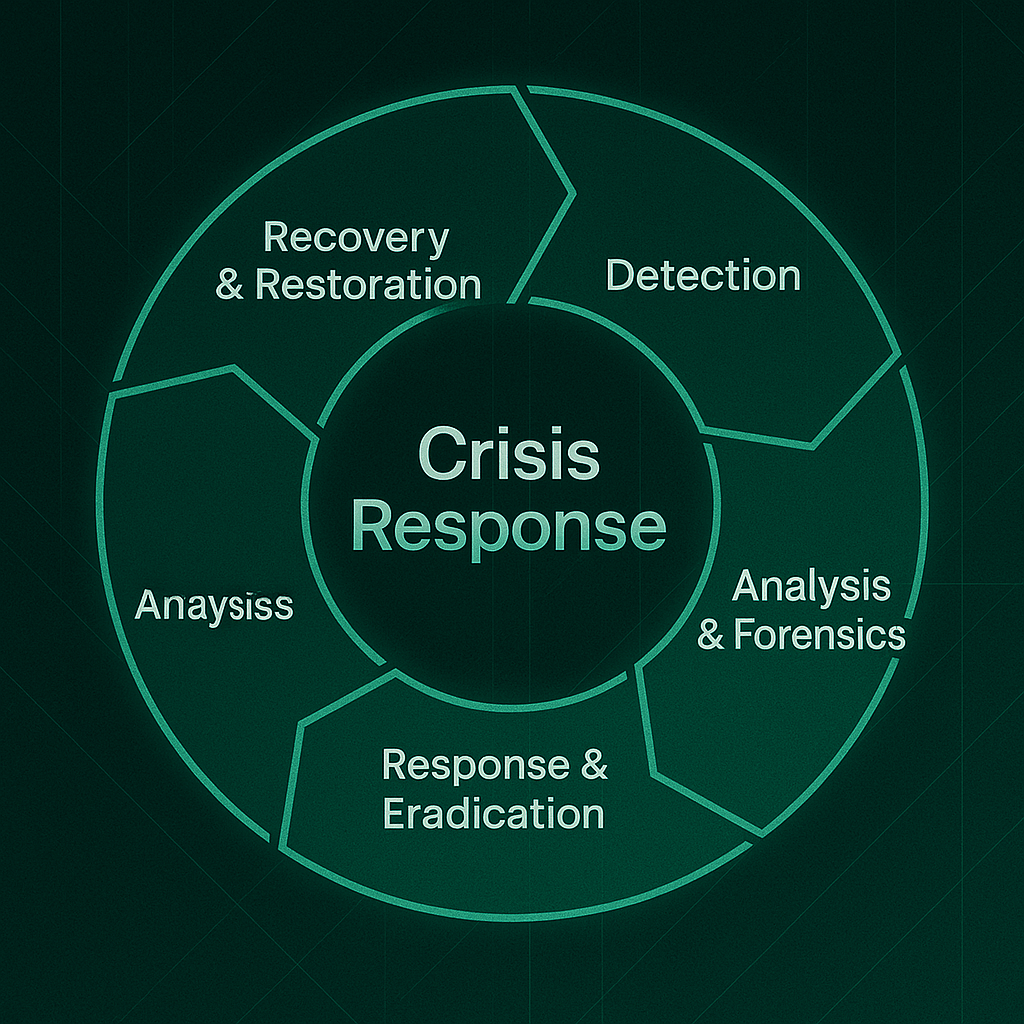
This is where Crisis Response takes over.Containment first. Segmentation. Access revocation. Emergency shutdown of administrative accounts. EDR analysis in real time. Memory dumps. Live IOC sweeps. Forensics for later legal work. A mandatory GDPR report within seventy two hours. Communication to the executive team, to customers, to supply networks. The outside world sees downtime. Inside, it is a life-saving procedure on a system that is still burning.
Threat Management prevents fires. Crisis Response extinguishes them. Prevention saves money. Response costs money. Sometimes it costs reputation. Sometimes it costs market position. Sometimes it costs the future of a company. The difference between survival and collapse is rarely technology. It is readiness. It is decision making. It is discipline in chaos.Recruiting trends prove this shift. Companies used to ask for firewall administrators. Now they ask for Crisis Response Leads, for digital forensics and incident response specialists, for breach coordinators, for legal compliance officers, for communication experts who can speak when everyone else is afraid to. Security is no longer a product category. It is resilience in living form.We will continue to write about this. Not from textbooks but from conversations with the people who face live breaches while others sleep. Where manufacturing stops because a single credential leaked. Where an incident commander decides whether the next four hours will save or destroy a brand. Threat Management is the shield. Crisis Response is the last defence when the shield breaks.The next DarkGate piece will ask the harder question: how do companies negotiate during ransomware events, who sits at the table, which decisions cost seven figures, and which mistakes cannot be undone. This topic is far from finished. We will go deeper.