
When people talk about information security, they often imagine firewalls, encryption, and technical defenses against hackers. But in reality, one of the strongest forces shaping modern cybersecurity is not technology at all – it is regulation and compliance. The way organizations secure data, design processes, and hire specialists is deeply influenced by legal frameworks. And these frameworks are anything but global and uniform. Instead, the world of compliance is divided into three very distinct regions: Europe, the United States, and Asia – each with its own philosophy, priorities, and consequences.
At DarkGate, we operate one of the leading high-level recruitment agencies specializing in IT security and digital transformation. Every day we work across borders – with clients and candidates in Europe, the USA, and Asia. Over the years we have seen first-hand how dramatically different these regions approach information security. While the technology stacks may be similar, the expectations placed on companies and professionals are often worlds apart. Understanding these differences is crucial not only for compliance officers and CISOs but also for recruiters, HR departments, and executives trying to build global security teams.
Europe: Compliance as a Formalized Discipline
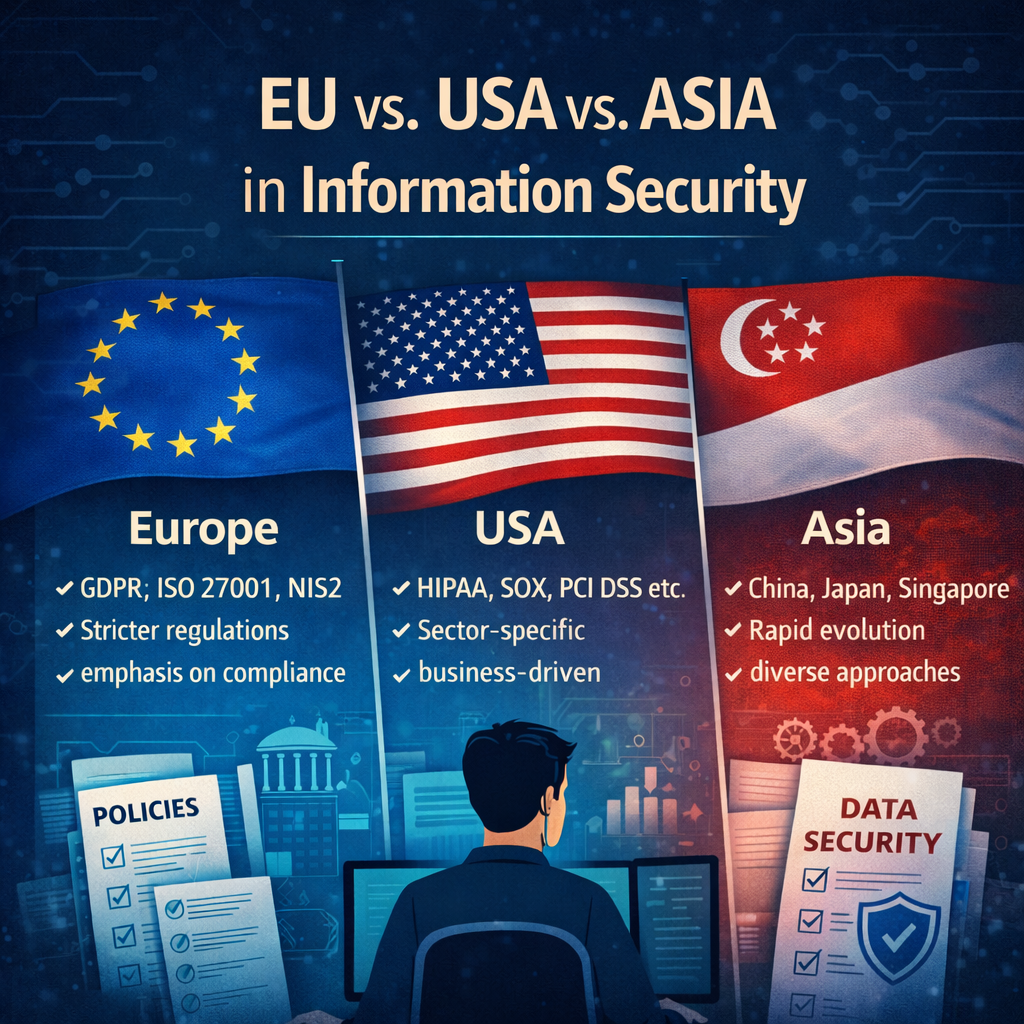
Europe – and especially Germany – represents the most structured, formalized, and regulation-driven approach to information security in the world. The European Union has built an entire ecosystem around data protection and cybersecurity governance. The General Data Protection Regulation (GDPR/DSGVO) is the most famous example, but it is only one element of a much broader system. Frameworks such as ISO 27001, the NIS Directive, and industry-specific standards create a highly codified environment in which organizations must operate.
In Europe, information security is often treated as a legal and organizational discipline first, and as a technical challenge second. Companies are required to document processes, appoint data protection officers, conduct risk assessments, and maintain extensive audit trails. Compliance is not optional – it is a core part of doing business. Failing to follow the rules can lead to severe fines, public investigations, and reputational damage.
This has a direct impact on the labor market. European companies are constantly searching for professionals who understand both the legal and procedural side of security: Information Security Managers, Data Protection Officers, Governance, Risk & Compliance (GRC) experts, and auditors. Job descriptions are full of terms like “regulatory reporting,” “process governance,” “policy frameworks,” and “ISO certification.” The European model is heavily process-oriented, sometimes even bureaucratic, but it creates a high level of predictability and standardization.
From our perspective as recruiters, this means that European clients often focus more on formal qualifications and compliance experience than on purely technical hacking skills. A candidate who deeply understands GDPR, BSI Grundschutz, or ISO 27001 may be more valuable than a brilliant penetration tester with no regulatory background. This is a very European way of thinking.
The United States: Market-Driven and Sector-Specific
Cross the Atlantic, and you enter a completely different compliance universe. The United States does not have a single, overarching data protection law comparable to GDPR. Instead, regulation in the U.S. is fragmented, industry-specific, and often shaped by market forces rather than government mandates.
Key frameworks such as HIPAA (healthcare), SOX (financial reporting), PCI DSS (payment card security), and state-level laws like the California Consumer Privacy Act (CCPA) define the rules – but only for certain sectors. Outside of these domains, companies enjoy far more freedom in how they design their security programs. The American approach is generally more pragmatic, more flexible, and less formalistic than the European model.
In the U.S., information security is traditionally seen as a business risk issue rather than a purely legal compliance topic. Boards of directors and executives worry about breaches mainly because of lawsuits, loss of customer trust, and competitive damage – not because of centralized government enforcement. As a result, American security teams are often more technically oriented and innovation-driven.
For recruiters like us, this creates a very different candidate profile. U.S. companies tend to prioritize hands-on experience: cloud security engineers, threat hunters, SOC analysts, and DevSecOps specialists. Compliance knowledge is important, but usually as one component among many. Certifications such as CISSP, CISM, or GIAC often carry more weight than formal regulatory expertise.
This freedom-oriented model has advantages. It allows companies to move faster, experiment more, and tailor security to their real business needs. But it can also lead to inconsistencies, with security standards varying dramatically between industries and organizations.
Asia: Diversity, Pragmatism, and Rapid Evolution
Asia is the most complex and diverse compliance region of all. There is no single “Asian approach” to information security. Instead, the continent contains a wide spectrum of regulatory philosophies, ranging from highly centralized state control to business-friendly, innovation-first environments.
Countries like Singapore and Japan have developed sophisticated cybersecurity and data protection frameworks that resemble European standards in many ways. China, on the other hand, follows a very state-driven model with strict cybersecurity laws, data localization requirements, and heavy government involvement. India is rapidly building its own regulatory ecosystem, balancing economic growth with increasing attention to privacy and security.
What unites many Asian markets is speed. Digitalization is advancing at an incredible pace, and regulations are often catching up in real time. Compliance requirements may change quickly, and companies must adapt continuously. Compared to Europe, there is often less emphasis on formal documentation and more focus on practical implementation and business enablement.
For global organizations, operating in Asia means navigating a patchwork of local laws, cultural expectations, and technological realities. From a recruiting perspective, we frequently see demand for hybrid profiles: professionals who combine technical security skills with the ability to work across languages, cultures, and legal systems. Flexibility and adaptability are valued more than rigid adherence to formal frameworks.
What These Differences Mean in Practice
For multinational companies, these three compliance worlds create real challenges. A security policy that works perfectly in Germany may be far too restrictive for the U.S. market. A risk-based American approach may be considered insufficiently formal in Europe. Asian subsidiaries may require completely different reporting structures and processes.
This is exactly where our experience comes in. As the operators of DarkGate and an internationally active recruiting partner, we have learned to “translate” between these worlds. We understand that information security roles are not the same everywhere. A “Security Manager” in Munich, New York, and Singapore may need entirely different skill sets.
Europe often demands experts who can navigate regulation, audits, and documentation. The USA looks for problem-solvers and technical leaders who protect the business at high speed. Asia requires adaptable professionals who can operate in fast-changing, heterogeneous environments. Recognizing these nuances is essential when building global teams.
The Future: More Rules, More Complexity, More Global Tension
Looking ahead, it is clear that regulation and compliance will only become more important. In Europe, the trend is unmistakable: stricter laws, more reporting obligations, and deeper government oversight. Initiatives like the EU Cyber Resilience Act and expanded NIS2 regulations will further increase compliance pressure. For many companies, especially small and medium-sized businesses, this can become a heavy burden.
The United States will likely remain more market-driven, but even there we see growing calls for stronger national privacy and cybersecurity standards. Large breaches, geopolitical tensions, and AI-related risks are pushing regulators toward more formalization.
Asia will continue to develop at high speed, with new laws and standards emerging across the region. The balance between economic growth, innovation, and security will shape very different outcomes in different countries.
For organizations operating globally, one thing is certain: there will never be a single, unified compliance world. Instead, companies must learn to live with permanent diversity – and to turn it into a competitive advantage.
Conclusion
Regulation and compliance are no longer side topics in information security. They shape strategies, budgets, technologies, and careers. But they do so in very different ways depending on where in the world you operate. Europe emphasizes structure and legal certainty, the USA prioritizes flexibility and business pragmatism, and Asia combines rapid growth with evolving frameworks.
At DarkGate and in our recruiting work, we see these differences every day. We help organizations find the right talent for the right compliance environment – whether they need a GDPR-focused GRC specialist in Frankfurt, a cloud security architect in California, or a regional security lead in Singapore. Information security has become a truly global discipline, and success depends on understanding its many local faces.
The future will bring even more complexity. But for those who understand the three compliance worlds – and know how to navigate them – it will also bring enormous opportunities.