
Defense is not a field that becomes loud. It is quiet by design, serious by necessity and restrained by responsibility. It is not about visibility, dominance or power, but about stability, protection and the prevention of what must not happen. And that is exactly why artificial intelligence in this domain is not an instrument of escalation, but one of perception. Modern threats no longer emerge where they can be clearly seen. They emerge silently, distributed, fragmented and networked. They appear in movement data, communication patterns, logistics flows and behavioral deviations that look harmless in isolation but become meaningful in combination. The core challenge of modern security is no longer reaction, but early recognition, and this is where AI begins to play its role, not by replacing human judgment, but by extending human awareness into domains and scales that no individual or team could ever fully oversee.
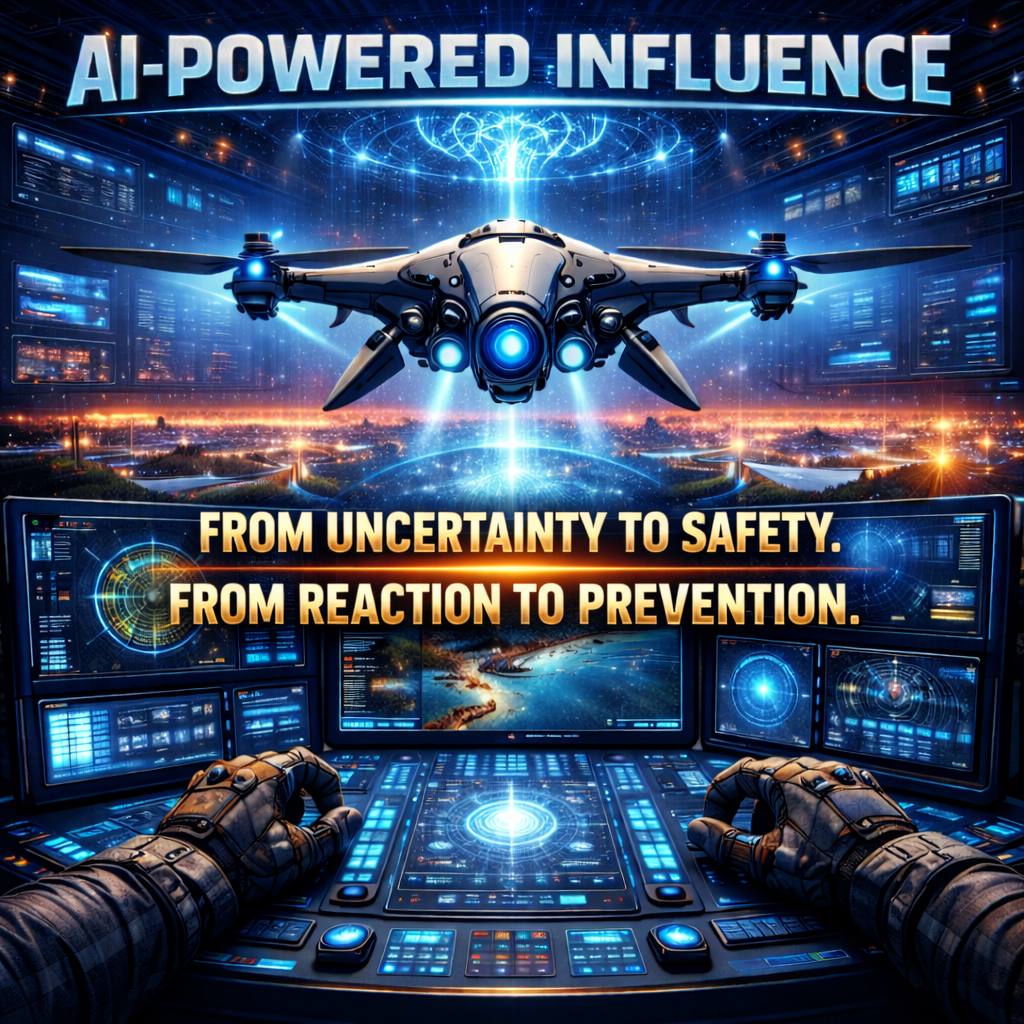
You can see this very concretely in how autonomous systems are used today. A drone no longer simply follows a predefined route. It observes. It learns. It recognizes terrain structures, heat signatures, smoke, unusual objects, abandoned vehicles or groups of people where none are expected. It notices when something does not fit into the normal pattern. It does not search for targets, it searches for deviations. It does not act, it marks. It highlights areas that deserve attention so that humans can look more closely. The drone goes first not to replace people, but so that people do not have to go in blindly, so that they do not have to be the first ones exposed to uncertainty, risk or the unknown.
Imagine a team needing to enter an area after a natural disaster, a fire, or an unknown incident. In the past, someone had to go in first. Today, a drone flies ahead, maps the area in three dimensions, identifies unstable structures, detects heat, movement or potential hazards and sends a detailed picture back to the command center. The responders do not walk into the unknown anymore. They walk into something already partially understood. AI does not protect by force here, but by visibility. It turns uncertainty into orientation and risk into information, giving people the chance to prepare instead of react.
The same logic applies to maritime and airspace monitoring. Autonomous systems observe shipping routes and flight paths, learning what is normal and what is not. They notice when a ship turns off its signals, when a route suddenly changes, when something slows down where it normally would not, or when objects appear where none are expected. Not to intervene, but to alert. Not to accuse, but to notice. AI becomes an early sense of unease in complex systems, a way of saying: something here feels different, something here deserves attention, something here might require a human decision.
Another critical area is the protection of infrastructure. Power plants, pipelines, data centers, hospitals, transport systems and communication networks form the physical backbone of modern society. They are deeply digital and therefore potentially fragile. AI systems continuously observe access patterns, data flows and system behavior, recognizing subtle shifts that may indicate manipulation, malfunction or intrusion. Not with sirens, but with quiet signals. Not as a guard, but as a nervous system that constantly listens to the health of the system itself.
This is especially important in the cyber-physical layer, where digital interference can have physical consequences. A manipulated system does not have to explode to be dangerous. It only has to behave slightly differently than it should. AI notices these differences. It sees when something slowly drifts out of its normal state, when processes start to behave strangely, when small anomalies accumulate into meaningful risk. It does not identify an enemy. It identifies a change, and in doing so it creates the space for humans to intervene before harm becomes visible.
And that is the fundamental shift. Modern defense is no longer primarily about enemies, but about deviations. Not about intentions, but about structures. Not about who, but about what changes in the system. Control rooms today look less like war rooms and more like observatories. Less arrows on maps, more flows. Less alarms, more gradients. Less drama, more awareness, more calm monitoring of complex realities.
Artificial intelligence does not make defense more aggressive. It makes it more attentive. It does not remove human responsibility, it makes responsibility manageable in a world that has become too complex to be overseen by humans alone. It shifts the moment of decision forward, to a time when people can still decide calmly, not only when something has already escalated, when options are already limited and pressure is already high.The strongest defense is not the one that reacts fastest, but the one that sees earliest. And that is the quiet transformation AI is bringing to this domain. Not as a weapon. But as a sense organ. As a silent guardian in a system that only works when it stays calm.