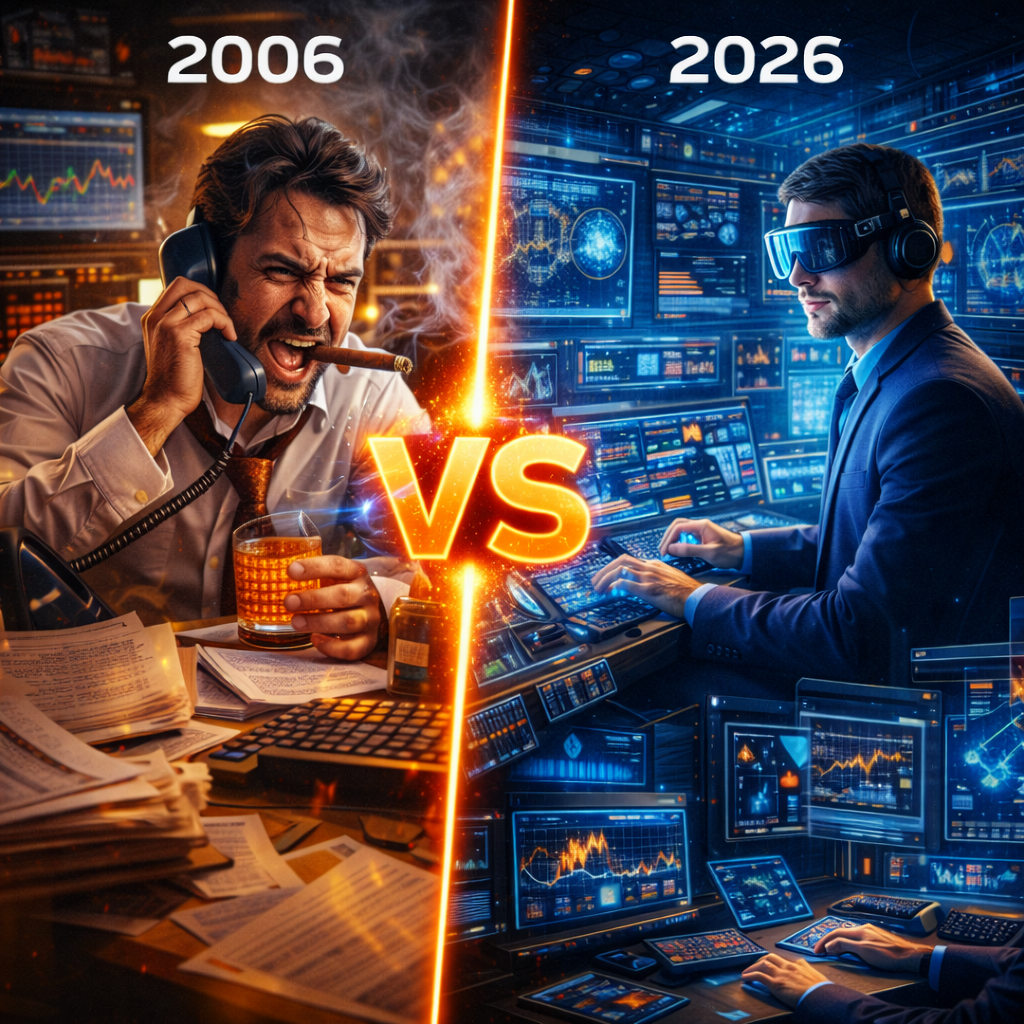

Financial markets are not abstract constructions of numbers and charts. They are living systems that connect expectations with capital, risk with trust and decisions with consequences. Every movement, every price, every trade is an expression of perception, fear, greed, hope and rationality at the same time. Markets are psychological before they are mechanical, and this is precisely why artificial intelligence is transforming them so deeply. Not because it calculates faster, but because it changes perception itself. Where humans once sensed markets through rooms, voices, gestures and intuition, markets now exist as streams of data, too large, too fast and too interconnected to be grasped by human cognition alone.
Not long ago, the market was still a place. A physical environment filled with screens, telephones, conversations and constant tension. Traders observed charts, listened to news, spoke to each other, absorbed the mood of the room and interpreted signals that never appeared explicitly in numbers. Excel models, Bloomberg terminals and economic reports supported this intuition, but they never replaced it. The core skill was not calculation, but sensitivity to context, to sentiment, to what was emerging beneath the surface. Today, that world is quietly dissolving. The market is no longer a place, it is a flow. It no longer exists on screens, but inside networks, infrastructures and algorithmic feedback loops that process millions of signals every second. Orders, prices, payments, credit flows, logistics data, geopolitical events and social sentiment now interact in real time, forming a system that is no longer directly observable, only inferable.
This is where artificial intelligence enters finance, not as a trader and not as a decision-maker, but as a new layer of perception. AI systems recognize patterns in market behavior that are invisible to humans. They detect correlations between assets that appear unrelated, they sense shifts in liquidity before they become visible in prices, they identify structural stress before it becomes crisis. They notice when volatility is not driven by events but by configuration, when instability does not arise from shock but from alignment. What changes is not speed, but awareness. Risk is no longer only measured after it manifests, but sensed while it is forming. Fragility becomes visible before it becomes dangerous. Fraud is not discovered after damage has occurred, but while it is emerging through subtle deviations in behavior, timing, routing and network structure.
Markets are therefore not becoming more automated, they are becoming more sensitive. They are shifting from reactive mechanisms into anticipatory systems that continuously adjust to new information, new instruments, new regulations and new geopolitical realities. But this sensitivity comes with its own form of fragility. When many systems perceive the same signal, they may react simultaneously. Synchronization can stabilize, but it can also amplify. Hyper-rational markets can become just as unstable as chaotic ones. This is why human responsibility remains central. AI delivers signals, not meaning. Patterns, not understanding. Correlations, not causality. Interpretation, judgment and accountability remain human functions, because markets are not just technical systems, they are social ones.
This distinction is already very clear inside banks, private banks and financial institutions. In ongoing exchanges with internal technology, risk and digital transformation teams, the discussion is no longer about whether artificial intelligence will be used, but about how it should be embedded responsibly. Not as a replacement for human decision-making, but as an extension of human awareness. The future financial environment does not look louder or more aggressive, it looks calmer. Trading floors become quieter spaces with fewer phones, fewer interruptions and less noise. Instead of dozens of fragmented screens, there are integrated situational views. Risk landscapes replace raw price feeds, liquidity maps replace adrenaline, stress indicators replace gut feeling. The trader becomes less a hunter of opportunities and more a curator of systemic stability, less reactive and more reflective, less driven by speed and more by foresight.
Capital begins to flow not only toward return, but toward resilience. Toward markets that are transparent, interpretable and robust. Toward systems that can be sensed rather than simply exploited. In this sense, artificial intelligence is not the engine of finance, it is its sensory system. It does not move the market, it makes the market perceptible again in a world where complexity has outgrown human perception. And that is why its influence is so profound. Not because it acts, but because it enables seeing in a system that has become too complex to be seen by humans alone.