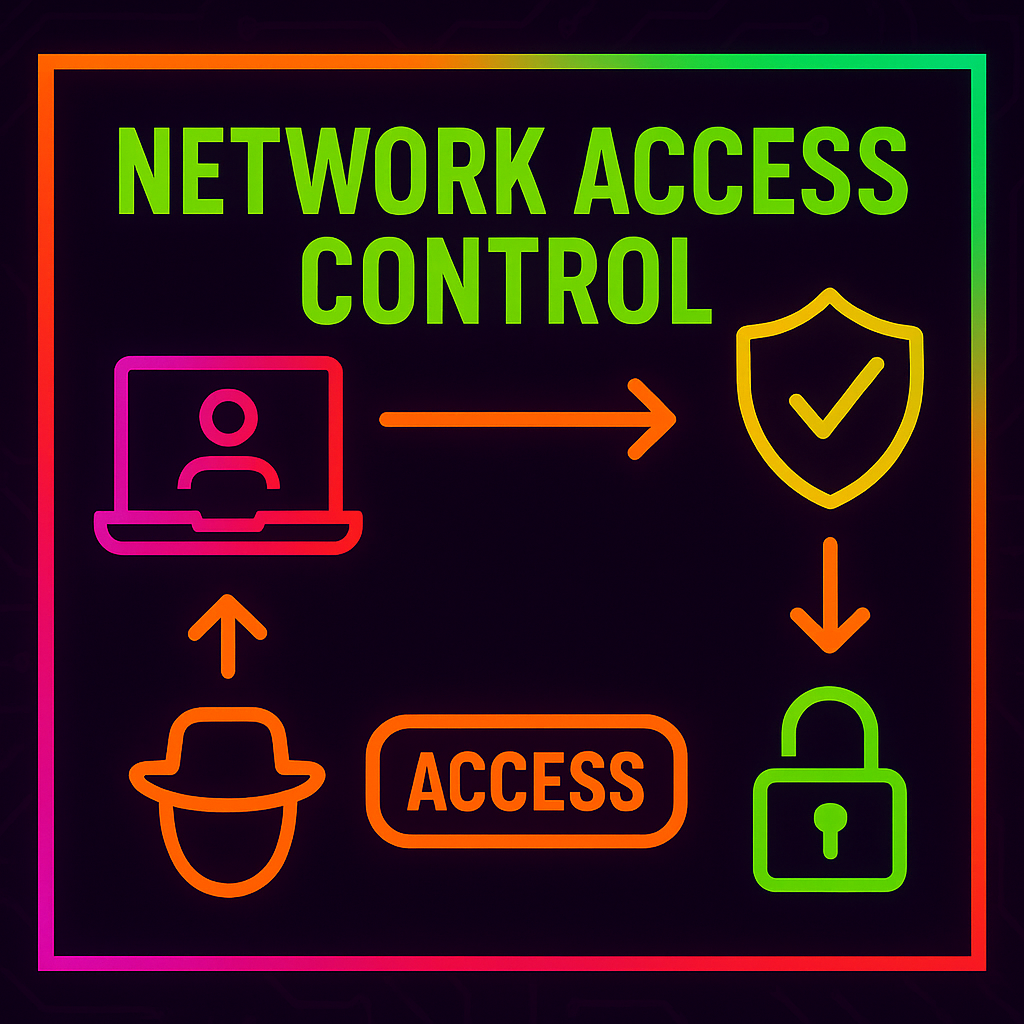
Network Access Control rarely appears in neon lights. It is not marketed als das „Next Big Thing“. It does not promise autonomous threat hunting or AI-driven anomaly prediction. NAC does one thing, and it does it with absolute clarity: it decides whether a device may enter the network or not. Before a firewall evaluates rules, before a SIEM correlates incidents, before an EDR agent analyzes behavior, NAC stands at the front door. And the one standing at the door defines trust. Not through intention or gut feeling, but through identity, posture and compliance. NAC allows access only to devices that deserve it. Everything else stays outside.
At DarkGate we have seen this technology surface again and again in recruitment processes over the years – and not as a footnote, but as a core requirement for high-value roles. Most prominently in Senior Network Security Architect and Lead Network Engineer positions for one of the most established IT integrators in the German-speaking region, a company deeply rooted in large enterprise networks, carrier infrastructure and industrial environments. NAC there was never „nice to have“. It was baseline. Interviews almost always included questions around onboarding workflows, RADIUS chains, posture checks, guest access logic, segmentation policies. NAC competency was a filter – both for endpoint access and for candidate selection. Those who truly understood NAC architecture usually operated on a more senior level. Those who only configured switch ports did not.
The interesting part is how NAC remained quiet while the cybersecurity field around it became noisy. Zero Trust, behavioral analytics, autonomous SOC, cloud-native identity platforms. Many of these overshadow NAC in marketing conversations. Yet Zero Trust does not start with AI. It starts with a fundamental question: Who are you, what device do you bring, and why should you be permitted to enter this network at all? Without that gate, later layers of security become cosmetic. NAC is often reduced to 802.1X authentication, but that is merely one facet. NAC is not port control. NAC is network admission logic. It evaluates OS posture, patch levels, certificate binding, compliance with MDM, AV-status, domain-join validation, policy tags, VLAN assignments. NAC doesn’t just decide if you enter, but how deeply you are allowed inside.Technically the NAC market is dominated by a few major players. Cisco ISE remains a heavyweight, especially in large enterprises where identity-driven policy trees, PSN design and dynamic segmentation are required. Aruba ClearPass counters with strong profiling and contextual decisioning, appealing particularly to mobility-heavy environments and heterogenous device fleets. Forescout has long positioned itself as the agentless specialist, widely used in healthcare and OT networks where unmanaged devices are the norm. Smaller vendors and extensions exist, but the rivalry worth watching is ISE vs. ClearPass – two different philosophies, one with deep integration into Cisco ecosystem identity logic, the other more flexible and context-focused with strong profiling engines. Both work. Both scale. They simply require different ways of thinking. In DACH we see ISE more often simply because Cisco network stacks dominate the region, but ClearPass gains momentum wherever Wi-Fi and IoT complexity replace classical LAN-first architecture.
Where NAC is deployed is more of an answer than a question: anywhere devices cannot be trusted blindly. Universities segmenting students from research networks. Hospitals isolating monitoring equipment from administrative systems. Manufacturing floors separating OT and corporate IT. Enterprise WLAN environments onboarding thousands of unknown devices every year. NAC keeps BYOD from touching core assets. NAC isolates vendors and external consultants into guest zones. NAC applies different VLANs and permissions depending on certificates, hardware fingerprints, compliance scores, risk posture. NAC refuses to assume trust. It enforces it.The more distributed infrastructures become, the more relevant NAC remains. Cloud adoption does not eliminate NAC; it simply shifts enforcement closer to the edge. Hybrid remains standard. Wi-Fi remains default access layer. IoT grows faster than any patch cycle can handle. Every device with a MAC address becomes a threat unless verified. NAC solves a primitive but fundamental security requirement: you may not enter until we know who you are and what state you are in. And if you change state, your trust level changes accordingly. This isn’t optional. It is survival logic.
In recruitment this distinction became extremely visible. NAC separated administrators from architects. Administrators configure. Architects define trust. When a candidate at DarkGate could explain why posture checks matter more than static VLAN assignment, or how guest onboarding, RADIUS flows, CoA evaluations and profiling engines interact, it showed not just skill – but maturity. NAC skill signals depth. NAC skill signals network literacy. NAC skill signals an understanding of identity not as a login, but as a continuous condition.Network Access Control does not protect by shouting loudly or promising predictive defense. It protects by deciding who may speak, and from where. It is the bouncer not for people, but for endpoints. And unlike human bouncers, NAC does not care how confident a device looks. It cares about certificates, patches, compliance, and posture. Networks are more distributed than ever, but one thing has not changed: access is always the first weakness or the first defense.As long as networks exist, NAC will remain relevant. As long as devices connect without guarantee, NAC will remain necessary. And as long as trust must be verified rather than assumed, NAC will remain the technology that separates order from breach.