
It doesn’t start with an attack. It starts with a condition. A condition that builds slowly over time, across months, often years. More systems, more tools, more data, more expectations. Every decision makes sense in isolation. Every addition feels like progress. Every investment is justified. And yet, beneath all of that, something quietly emerges that few organizations openly acknowledge: structural overload.
Modern security teams are not operating in a controlled environment. They are operating in constant pressure. The volume of signals has exploded. Logs, alerts, anomalies, behavioral deviations, access patterns, cloud events, identity changes. Everything is captured. Everything is stored. Everything appears visible. But visibility is not control. In many cases, it creates the exact opposite. The more data exists, the harder it becomes to identify what actually matters. And that is where the real weakness begins to take shape.Because overload is not a side effect. It is an attack surface.
Attackers understand this better than most organizations do. They know that security teams are not working in ideal conditions. They know that alerts must be prioritized, that time is limited, that context is often incomplete. And they adapt their behavior accordingly. Modern attacks are no longer designed to be invisible. They are designed to be unimportant.
A login at an unusual time. A system access that feels slightly out of place. A small deviation in user behavior. None of these events demand immediate escalation. None of them trigger panic. And that is exactly the point. Attacks are no longer defined by single critical events. They are defined by sequences of low-intensity actions. Each one explainable. Each one easy to dismiss. Together, however, they form a clear pattern. A pattern that only becomes visible when someone has the time, the context, and the focus to connect it.That is exactly what most environments lack.
A typical day inside a SOC reveals the reality. Hundreds, sometimes thousands of alerts. Multiple systems running in parallel. Tickets that must be processed. Reports that must be delivered. Meetings that cannot be ignored. Decisions must be made constantly. What is critical? What can wait? What can be ignored for now? These are not theoretical questions. They determine whether an attack is stopped early or allowed to develop.And this is where a dangerous mechanism takes hold.
Everything that is not clearly critical moves down the priority chain. Not because it is irrelevant, but because it does not demand immediate attention. That distinction matters. Because modern attackers operate precisely in that space. They are not loud enough to reach the top of the queue, but they are active enough to cause real damage.A realistic scenario makes this painfully clear.
An attacker gains access to a user account. The login is recorded, but not flagged as critical because the credentials are valid. Shortly after, the attacker begins exploring the environment. Systems are queried. Permissions are tested. Data structures are analyzed. Every step generates logs. Some generate alerts. But none of them look urgent enough to disrupt ongoing operations.
At the same time, the security team is fully engaged. Alerts are being processed. Tickets are being closed. Priorities are being managed under pressure. The volume of signals forces constant selection. Anything that does not clearly stand out is delayed. And that is the moment where the attack begins to grow.
The attacker continues. Lateral movement begins. Privileges are escalated gradually. Additional systems are accessed. Each step stays below the threshold that would trigger immediate escalation. The environment produces signals, but those signals remain fragmented and under-prioritized.Days pass.
Control increases. The attacker understands the environment, identifies weaknesses, and moves with intent. Only at a later stage does the attack become visible in a meaningful way. Unusual data movement. Access to sensitive systems. External communication patterns. Now the signals are clear. Now the response begins.But by now, it is already too late.
The post-incident analysis always reveals the same pattern. The data was there. The signals were present. The alerts existed. But they were never understood as a connected threat. Not because the tools failed, but because the system as a whole was overwhelmed.That is the critical point.
Security teams do not fail because they lack technology. They fail because of the complexity created by that technology. Every additional tool introduces new data, new alerts, new dependencies. Without strong integration and prioritization, the system becomes harder to operate, not easier. It sees more, but understands less.
This overload does not appear in reports. It does not show up in architecture diagrams. It only becomes visible in real operations. In delayed responses. In missed signals. In decisions made under pressure. And that invisibility is what makes it so dangerous.
Because while organizations believe they are strengthening their defenses, they are often increasing internal friction. More tools create more complexity. More complexity creates more blind spots. And more blind spots create more opportunities for attackers.
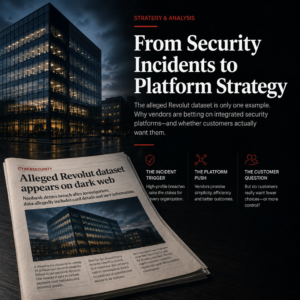
This is exactly where the conversation shifts from tools to systems.
Vendors are no longer just selling features. They are addressing operational breakdown. Integration, correlation, context, automation, and prioritization are not just technical improvements. They are responses to a reality where human capacity is limited and signal volume is not.
But technology alone does not solve the problem.
This is also a question of mindset. Security cannot be treated as a collection of tools. It must be treated as a system that has to function under pressure, in real time, with incomplete information. That means overload itself must be recognized as a risk. Not a temporary issue, but a structural vulnerability.For many organizations, that is an uncomfortable realization.
It means the biggest weakness is not external. It is internal. It exists in how decisions are made, how priorities are set, how systems interact, and how teams are expected to operate under constant pressure. But this is also where the opportunity lies.
Organizations that recognize this dynamic can respond differently. They can reduce complexity, improve integration, strengthen context, and create clearer decision structures. They can relieve pressure on their teams while increasing effectiveness.
Because in the end, security is not about seeing everything.It is about recognizing what matters.
And that is where the difference is made. Attackers understand this. They exploit it. And as long as overload remains part of the operational reality, it will remain one of the most effective attack vectors.The good news is that this can be addressed.
Not by adding more tools, but by building better systems. Not by collecting more data, but by creating more context. And most importantly, by acknowledging that security is not just a technical challenge, but a question of resilience.
Because in a world where attacks are becoming quieter and more complex, the advantage does not go to the organization that sees the most.It goes to the one that can still understand what it sees