
At Darkgate Magazine we explore the world of leading technology vendors, their strategies, partnerships and innovation cycles. As the operators of one of the most recognized international IT recruiting agencies we are in daily contact with CTOs, CEOs, engineers, architects and consultants across Europe, Asia and the United States. Every day we hear the same familiar names: Fortinet, Palo Alto Networks and Juniper Networks. These vendors are part of almost every job briefing, interview and hiring discussion. Certifications from them often decide whether a candidate qualifies for a certain project or senior engineering position.
Yet one question rarely gets asked. How big are these companies really?
We constantly read about their products, acquisitions and market moves but seldom about the human scale behind the brand. How many people actually build and secure the technology that shapes the digital world?
After reviewing the most recent annual reports and filings we found clear numbers.
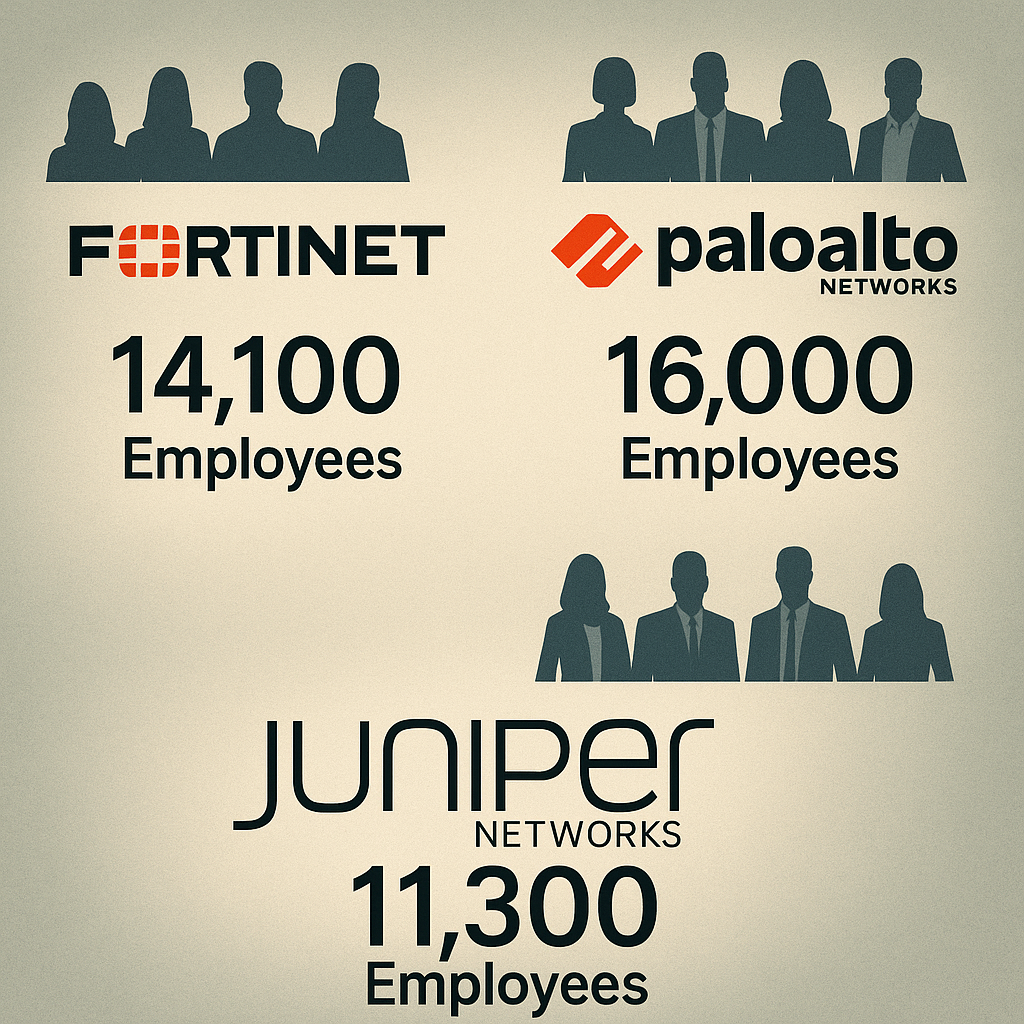
Fortinet employs around 14,100 people as of late 2024.
Palo Alto Networks has about 16,000 employees as of mid 2025.
Juniper Networks counts around 11,300 employees as of late 2024.
(Sources: Annual Reports 2024/2025, stockanalysis.com)
At first glance these figures look modest compared to a diversified giant like Cisco Systems with more than 85,000 employees. But such a comparison is misleading. Cisco covers many segments from collaboration and data center to AI and cybersecurity, while Fortinet, Palo Alto and Juniper are pure specialists. They operate highly efficient software driven organizations that rely on automation and global service structures rather than massive staff numbers.What stands out is that these three companies, despite very different origins, have reached a similar scale. Palo Alto Networks, founded in 2005 by Nir Zuk, grew from one firewall product into a global cybersecurity platform. Over the past five years its workforce has almost doubled as it expanded into cloud security, endpoint protection and AI based threat detection. The rapid hiring in engineering, customer success and cloud infrastructure shows how demand for hybrid environments drives the entire security industry. Fortinet, founded in 2000 by Ken and Michael Xie, represents steady organic growth. It is one of the few major cybersecurity vendors that avoided constant restructuring or mass layoffs. Each year its workforce grows as the company expands its partner ecosystem, regional support centers and operational technology security offerings. Fortinet’s R&D hubs in California, Canada, France and Singapore illustrate how the company scales through technical depth rather than headcount inflation.
Juniper Networks, long established in networking and routing, is evolving into a secure networking and AI infrastructure company. Its acquisitions such as 128 Technology and investments in Mist AI reflect a clear direction: combining routing, automation and security in one platform. With about 11,300 employees the company maintains a stable and mature structure that focuses on long term innovation rather than constant expansion. The reason these three vendors operate with comparable team sizes lies in structural efficiency. Cybersecurity is not labor intensive in the traditional sense. The core value creation happens through research, software development and cloud operations where automation replaces manual effort. Delivering SASE services or managing global security operations centers requires advanced platforms and channel networks, not huge headcounts.
A second reason is global talent distribution. Fortinet, Palo Alto and Juniper all maintain engineering and operations hubs in countries such as India, Malaysia and Poland. This allows them to stay agile and cost efficient while still maintaining strong local presence in the Americas and Europe. From a recruiter’s point of view these numbers tell another story. Professionals certified in Fortinet NSE, Palo Alto PCNSE or Juniper JNCIE remain among the most in demand profiles worldwide. Their expertise travels easily between countries and integrators, which explains why the vendors themselves grow moderately while their surrounding partner ecosystems explode in size. The momentum lies not only within the vendors but also in the thousands of engineers who implement and maintain their technologies across the world. In conclusion, the leading network and security vendors may differ in culture and approach but they share the same core DNA: focus, technical excellence and global collaboration. Their influence is not measured by headcount but by the reach of their technology and the strength of their ecosystems. Each of these companies, with roughly eleven to sixteen thousand employees, operates as a tightly coordinated and globally distributed powerhouse that keeps the digital world running and secure.
(Sources: Annual Reports 2024/2025, stockanalysis.com, Darkgate Research)