
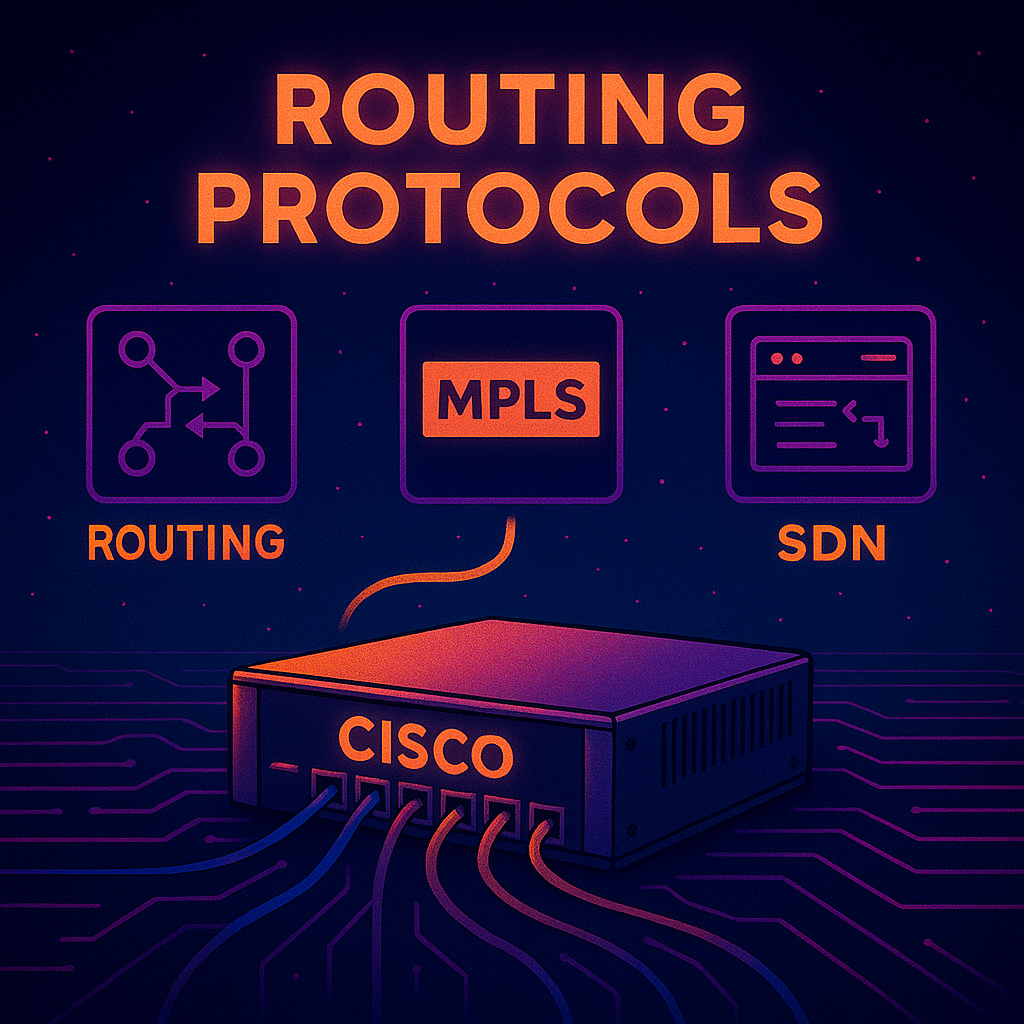
When professional routers had secured their place in the world’s data centers at the end of the 1990s, the internet had finally become stable. But stability alone was no longer enough. Data traffic grew faster than any plan, companies expanded globally, providers connected continents, and applications became more complex, more sensitive, more critical. Networks no longer just had to work. They had to anticipate. This is the moment when routing protocols truly became the intelligence of the internet. Routers stopped being simple forwarding machines and turned into decision-makers. They began to exchange information, evaluate paths, detect failures, and react within seconds. The network started to organize itself. OSPF became the internal compass of enterprise networks, deciding which path was the fastest, most stable, and most secure. BGP, on the other hand, became the diplomatic nervous system of the global internet. At this level, routing was no longer just technology, it was politics. Who connects with whom, which paths are allowed, which routes are expensive, which are strategically protected. The internet was no longer switched. It was negotiated.
With BGP, data paths were no longer neutral. National networks, global carriers, cloud providers, and content giants became part of a system of mutual dependence. Routing turned into power. At the same time, economic pressure on network operators increased. Classic IP routing was stable but inflexible. Every new service meant new structures, new hardware, new risk. This was the moment when MPLS entered the stage, quietly but radically. MPLS changed not the language of packets but the way they were guided. Data received fixed virtual paths through physical infrastructures, with guaranteed bandwidth, defined latency, and controlled prioritization. Voice, video, transactions, all could suddenly be directed with precision, independent of classic IP logic. Providers no longer built open roads. They built controlled highways. MPLS became the invisible transport layer behind banks, mobile networks, and global enterprise connectivity.
But every layer of control creates new dependency. The larger networks became, the harder they were to manage. Configurations grew into tens of thousands of lines. Errors became expensive. Outages became spectacular. Networks were powerful, but slow to adapt. Then the cloud arrived. Suddenly networks were no longer bound to buildings. Workloads moved dynamically. Servers became virtual. Applications scaled within minutes instead of months. The perfectly planned, static network model no longer fit this new world. Around 2012, the next rupture happened: Software Defined Networking. For the first time, decision logic was cleanly separated from hardware. Routers and switches became executing units. Intelligence moved into centralized controllers. Networks became programmable. Rules were no longer applied device by device but defined as global logic. This was not just a technological change. It was a cultural break. Networks were no longer configured. They were developed. APIs replaced consoles. Automation replaced manual work. DevOps collided with infrastructure. The classic network administrator became an architect or disappeared.At the same time, overlays, virtual routing, and software-based segmentation reshaped security. Zero Trust was no longer a vision. It became a structural consequence of distributed systems. And yet, a familiar pattern returned. The more intelligence moved into software, the greater the dependency on a handful of platforms. Large vendors, large clouds, large ecosystems. The openness of early routing gave way to controlled architectures. Programmability brought speed, but also new forms of dominance.
Today, in the age of SDN, fabric networks, and cloud-controlled infrastructure, routing is more strategic than ever. Data decides markets. Networks decide states. Latency decides billions. MPLS still carries the backbone of the world. BGP still determines whose routes the internet follows. SDN orchestrates modern platforms at machine speed. Everything exists at the same time. Old and new. Hardware and software. Stability and acceleration. Control and dependency. Routing is no longer just a technical discipline. It has become a power structure. That is exactly why it remains one of the most invisible and, at the same time, one of the most dangerous layers of the digital world.