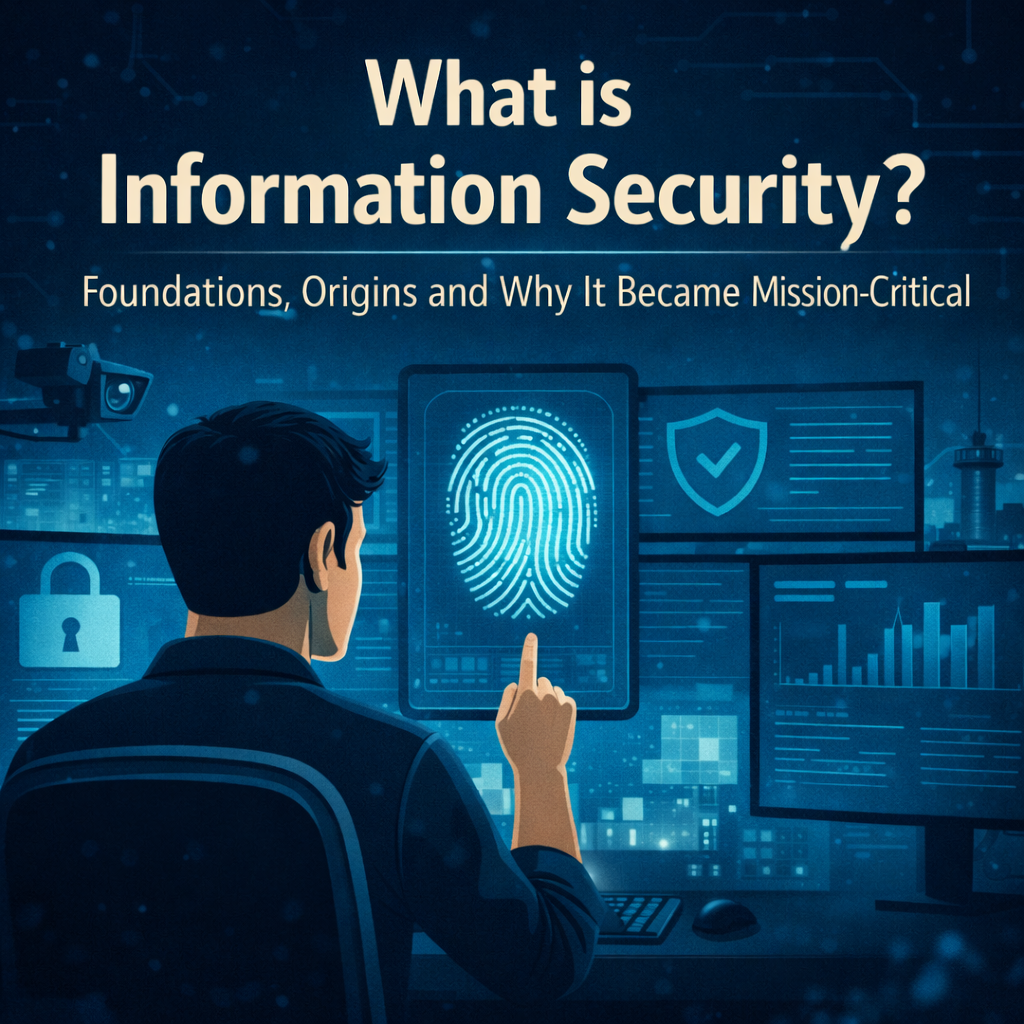
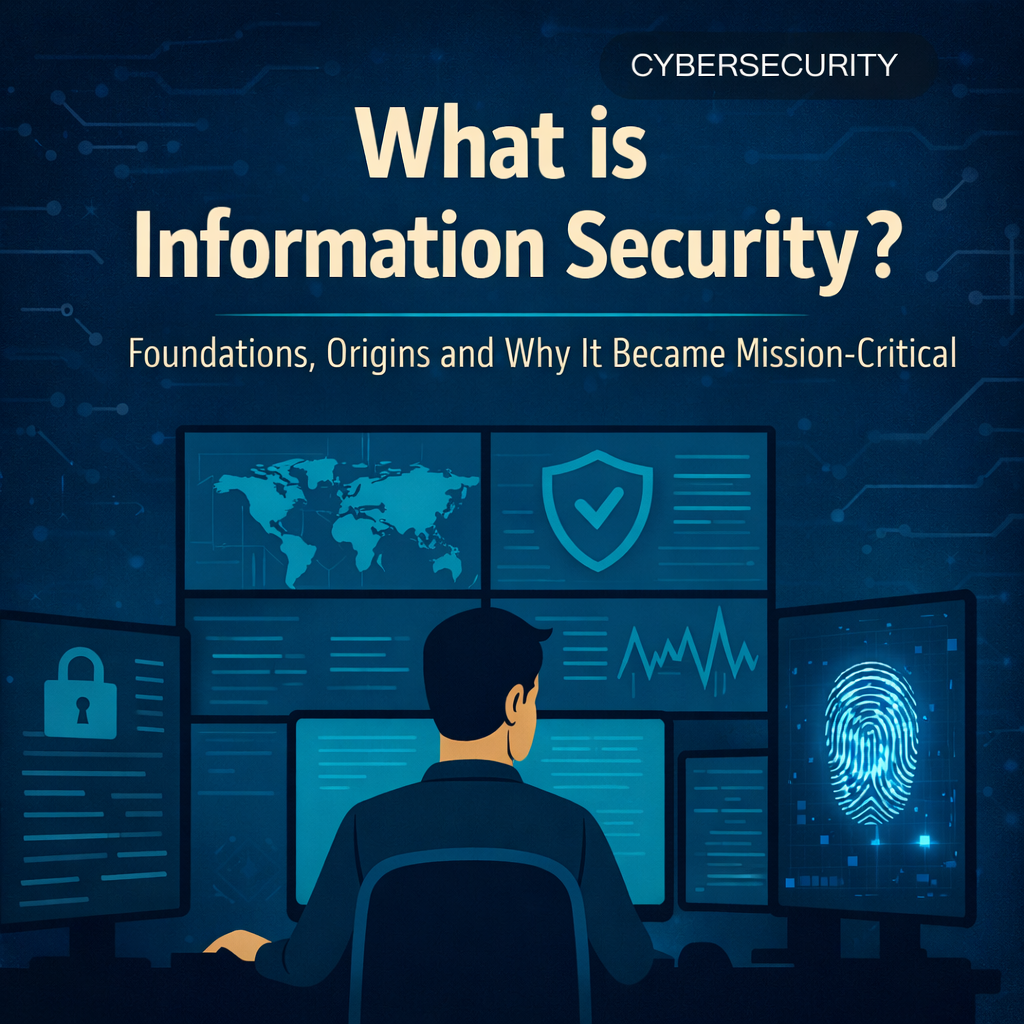
Information Security is one of those terms almost everyone has heard at some point, yet very few people truly understand in depth. For many, it sounds like a technical topic dominated by firewalls, passwords, and complex IT systems. But at its core, Information Security is something far more fundamental: the systematic protection of information. It doesn’t matter whether that information is stored digitally, written on paper, or simply exists in the knowledge of employees. Information Security is built around three central principles – confidentiality, integrity, and availability. These principles may sound abstract, but today they form the backbone of the entire digital economy.
The idea of protecting information is, of course, much older than computers or the internet. Throughout history, knowledge has always been a strategic asset. Governments, military organizations, and businesses have long understood the value of controlling access to sensitive information. However, the modern discipline of Information Security, as we know it today, largely emerged in the United States. Early on, the U.S. military, intelligence agencies, and large technology companies began to realize that digital information required new forms of protection. During the 1960s and 1970s, as mainframe computers and early networks appeared, it became obvious that electronic data created entirely new types of risk. Terms like “Computer Security” and “Data Protection” started to appear, laying the groundwork for what would later evolve into Information Security.
The 1980s marked another turning point. With growing connectivity between systems and organizations, new threats began to surface. Computer viruses, unauthorized access, and data breaches slowly became real and tangible problems. What was once primarily a concern for governments and large corporations started to affect a much broader range of industries. At the same time, it became increasingly clear that technical measures alone were not enough. Installing antivirus software or setting up a firewall could not fully address the complexity of protecting information in modern organizations. This realization marked the transition from classic IT security toward the broader and more holistic concept of Information Security.
For many years, security had been seen almost exclusively as a technical discipline. The focus was on encryption, network protection, and system hardening. But information does not only live inside databases and servers. It exists in emails, contracts, business plans, conversations, presentations, and even on handwritten notes. Information Security therefore had to become more than an IT function – it had to turn into an organizational and strategic discipline. Protecting information suddenly meant protecting processes, behaviors, and human interactions as much as protecting technology. This shift in perspective is what ultimately defined the modern understanding of Information Security.
A major milestone in the professionalization of the field came in the 1990s – this time driven largely by Europe. In the United Kingdom, the standard BS 7799 was developed, which later evolved into the globally recognized ISO 27001 framework. For the first time, organizations had a structured and internationally accepted approach to building an Information Security Management System. Concepts such as risk assessments, security policies, clearly defined responsibilities, and formalized processes became best practice. Information Security slowly transformed from a niche technical topic into a core management responsibility. Dedicated roles such as Information Security Officers and CISOs began to appear across industries.
Despite these developments, Information Security remained relatively specialized until the early 2010s. The true breakthrough came between 2010 and 2020, when several powerful trends converged at the same time. Cloud computing, mobile devices, social media, digital business models, and globally interconnected supply chains changed the way companies operated. Organizations became more dependent on data and IT systems than ever before – and therefore more vulnerable. At the same time, cyberattacks became increasingly sophisticated and professional. High-profile breaches, ransomware incidents, and massive data leaks suddenly dominated the headlines. Information Security was no longer just an internal IT concern; it became a board-level priority.
In Europe, the introduction of the General Data Protection Regulation (GDPR) in 2018 played a particularly decisive role. Data protection and Information Security turned into legal obligations with real consequences. Heavy fines, strict regulatory oversight, and new compliance requirements forced companies to take security seriously. Additional regulations such as NIS, KRITIS, and sector-specific standards like TISAX in the automotive industry further increased the pressure. Especially in the European Union and in Germany, Information Security became deeply compliance-driven. While the United States often relies more on market forces and liability considerations, Europe has chosen a path based on formal standards, structured processes, and regulatory frameworks. These different cultural approaches continue to shape how Information Security is implemented around the world.
One important point is that Information Security today is truly cross-industry. It is not limited to technology companies. Financial services, healthcare, manufacturing, energy, logistics, e-commerce, and even small and medium-sized businesses are all affected. A hospital must protect patient records, an industrial company must secure intellectual property, and an online retailer must safeguard customer data and payment information. The specific challenges may differ, but the fundamental principles remain the same across sectors.
As the operators of Darkgate and as one of the most renowned recruiting agencies in the IT environment, we have witnessed this transformation first-hand. Especially from 2018 and 2019 onwards, Information Security became an increasingly dominant topic in our daily work. Companies suddenly started to search aggressively for security specialists. Entire departments were built from scratch, new roles emerged, and budgets for cybersecurity grew rapidly. Projects around ISO certifications, Identity and Access Management, Cloud Security, Zero Trust architectures, and risk management turned into strategic priorities. What used to be a peripheral issue became one of the hottest and most dynamic fields in the entire IT job market.
Modern Information Security today consists of many interconnected building blocks. It includes governance and risk management, technical protection mechanisms, employee awareness programs, incident response planning, identity and access management, and continuous monitoring. It is a discipline that requires both deep technical expertise and strong organizational skills. That is why the market no longer demands only system administrators and network engineers, but also consultants, auditors, architects, compliance experts, and strategic advisors who can bridge the gap between technology and business.
Looking ahead, the relevance of Information Security will only continue to grow. Cloud platforms, artificial intelligence, the Internet of Things, and hybrid working environments create new opportunities – but also new attack surfaces. European regulations such as NIS2 and DORA are raising the bar even higher, forcing organizations to professionalize their security posture. At the same time, the global shortage of qualified security professionals is becoming more severe every year.
From our perspective, Information Security has evolved far beyond a technical necessity or a compliance checkbox. It has become a key competitive factor, a foundation of trust, and an essential requirement for any sustainable digital strategy. This is exactly why we at Darkgate have decided to dedicate significant attention to this field. We want to explore Information Security not only from a technical angle, but also from the perspectives of regulation, compliance, career development, and market dynamics.
Our mission is to make Information Security understandable, practical, and engaging – for decision-makers, IT professionals, candidates, and anyone interested in how modern organizations protect their most valuable asset: information. Because one thing is certain: in an increasingly digital world, Information Security is not a temporary trend. It is the core foundation on which the future of business and technology will be built.