
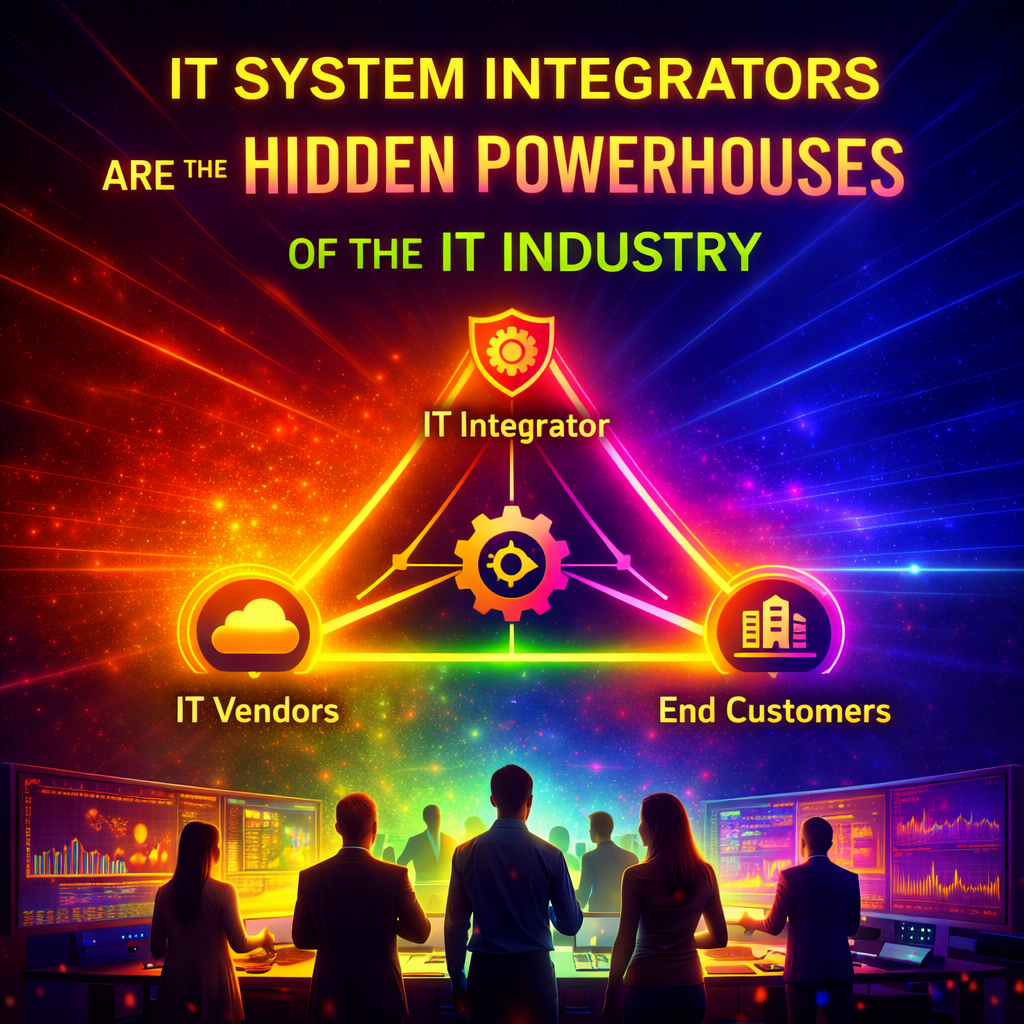
Some time ago, in another category at Darkgate, we already explored the relationship between IT vendors and IT system integrators and explained why this ecosystem is so critical to the modern technology landscape. In this Business and Careers category, we want to revisit the topic from a different angle. Not from a technology perspective and not from a product perspective, but from the viewpoint of market mechanics, value creation, and career development. Because it is exactly here that it becomes clear why IT system integrators are among the most underestimated, yet strategically most important players in the entire IT industry.Anyone looking at the IT market from the outside usually sees the large, well known names. Global vendors, cloud hyperscalers, cyber security brands, and software companies with enormous visibility. What is rarely seen is the fact that these technologies would have very limited practical impact without system integrators. Vendors build products. End customers have requirements. In between stands the system integrator. And this “in between” is not a small space. It is the place where technology becomes real solutions.
System integrators are the ones who turn individual products into working architectures. They understand vendor portfolios, combine them, adapt them, and embed them into real IT environments. They speak the language of vendors and at the same time the language of customers. They understand technical depth while also understanding the organizational and operational realities inside companies. This ability places them in a unique and strategic position within the value chain of the IT industry.
From our daily work at Darkgate, acting as an interface between leading system integrators, renowned vendors, and enterprise customers, we repeatedly see that this is exactly where the most complex projects, the most demanding challenges, and the most exciting careers are created. Vendors often think in product logic. End customers often think in internal structures and constraints. System integrators operate in both worlds simultaneously. They are closer to the practical reality of IT than most other market participants.In conversations with decision makers from system integrators, one sentence appears again and again. We do not sell products. We sell working IT. This captures the essence perfectly. A vendor sells a firewall. Another sells a cloud platform. Another sells a monitoring tool. The system integrator sells the architecture in which all these components work together. They sell integration, adaptation, and operational capability. They sell solutions.
For the market, this means that system integrators play a central role in nearly every major IT project. For vendors, they are strategic partners because they provide access to customers and understand real requirements. For customers, they are trusted advisors because they think across vendors and are not locked into a single product perspective. This position between the worlds is what makes system integrators hidden powerhouses of the IT industry.At the same time, this is where a career environment emerges that many professionals do not initially consider. When people think about IT careers, they often think about vendors or large end customers. Hardly anyone first thinks about system integrators. Yet this is exactly where technical expertise, consulting, business understanding, and communication skills come together in a way that is rarely found elsewhere.
A network engineer in a system integrator does not work on just one infrastructure. They see many different customer environments, architectures, and challenges. A presales consultant does not speak about a single product, but about solution approaches that combine multiple technologies. A service account manager does not only manage contracts, but accompanies companies over many years in their technological development. A key account manager does not sell licenses, but complex transformation projects in close coordination with vendors and enterprise decision makers.
This variety is what makes careers in system integrators so exceptional. Professionals operate permanently at the intersection of technology and business. They learn to understand architectures, translate customer requirements, combine vendor solutions, and ensure that projects work in practice. It is a unique environment for developing a holistic understanding of IT.From a recruiting perspective, we repeatedly see that professionals who have spent several years in leading system integrators develop a particular level of market maturity. They understand not only technologies, but also processes, decision making structures, budget dynamics, and the relationship between vendors and customers. They develop advisory skills that go far beyond pure technical expertise. This is exactly why these profiles are so highly valued in the market, both by vendors and by large end customers.
Another reason why system integrators are so strategically important is their role as innovation drivers. New technologies rarely move directly from vendors into broad practical use. In many cases, system integrators are the ones who test new solutions, implement them in pilot projects, adapt them, and make them practically usable. They turn innovation into operational reality.
For vendors, strong system integrators are therefore indispensable. They are multipliers, implementation partners, and trusted advisors to customers. For customers, they are strategic partners who help interpret technological developments and use them in a meaningful way. This double trust position is a powerful lever in the market. At Darkgate, we witness this dynamic every day. We speak with account managers who manage complex enterprise customers in close collaboration with multiple vendors. We speak with solution architects working on critical infrastructure projects where several technologies must fit together perfectly. We speak with service account managers who act as central interfaces between technology, operations, and business. These insights repeatedly show that system integrators are far more than resellers or service providers. They are strategic architects of modern IT landscapes.
This is precisely why, in this Business and Careers category, we deliberately place a strong focus on this role. Anyone who wants to understand the IT industry must understand the importance of system integrators within this ecosystem. And anyone looking for a career that combines technology, consulting, communication, and strategic thinking will find extraordinary opportunities in this environment.System integrators are rarely loud. They are not often in the spotlight. They do not have spectacular product launches or global marketing campaigns. But they are present in nearly every relevant IT project. They are the ones who turn technology into working reality. And that is exactly what makes them the hidden powerhouses of the IT industry.
For us at Darkgate, as long standing recruiting partners of leading system integrators, this understanding is fundamental. We see every day how decisive this role is for the market and how attractive this environment can be for professionals. This insight forms the foundation for many of the upcoming articles in this category. Because anyone who understands the relationship between vendor, system integrator, and end customer also understands where the most exciting business dynamics and the most interesting careers truly develop.