
If you speak with IT system integrators today, you quickly notice that something fundamental has changed. The classic role models that once appeared clear and well defined no longer reflect reality. In the past, it was simple. There was Sales, there were Consultants, there were System Engineers, and there were Project Managers. Each role had a clearly defined scope, a neat job description, and a fixed place in the organizational chart. Today, these boundaries are dissolving at a speed that many HR departments simply cannot keep up with.As a globally active recruitment agency deeply embedded in the integrator market, the team behind Darkgate is in daily exchange with integrators, vendors, technical departments, sales leaders, and decision makers. Over the last five years, one pattern has become increasingly obvious. The profiles that system integrators actually need today do not exist in any formal job description. They cannot be neatly categorized. They are combinations of multiple roles, multiple disciplines, and multiple perspectives in one person. And these hybrid profiles are now the deciding factor for project success, customer relationships, and entire business models.
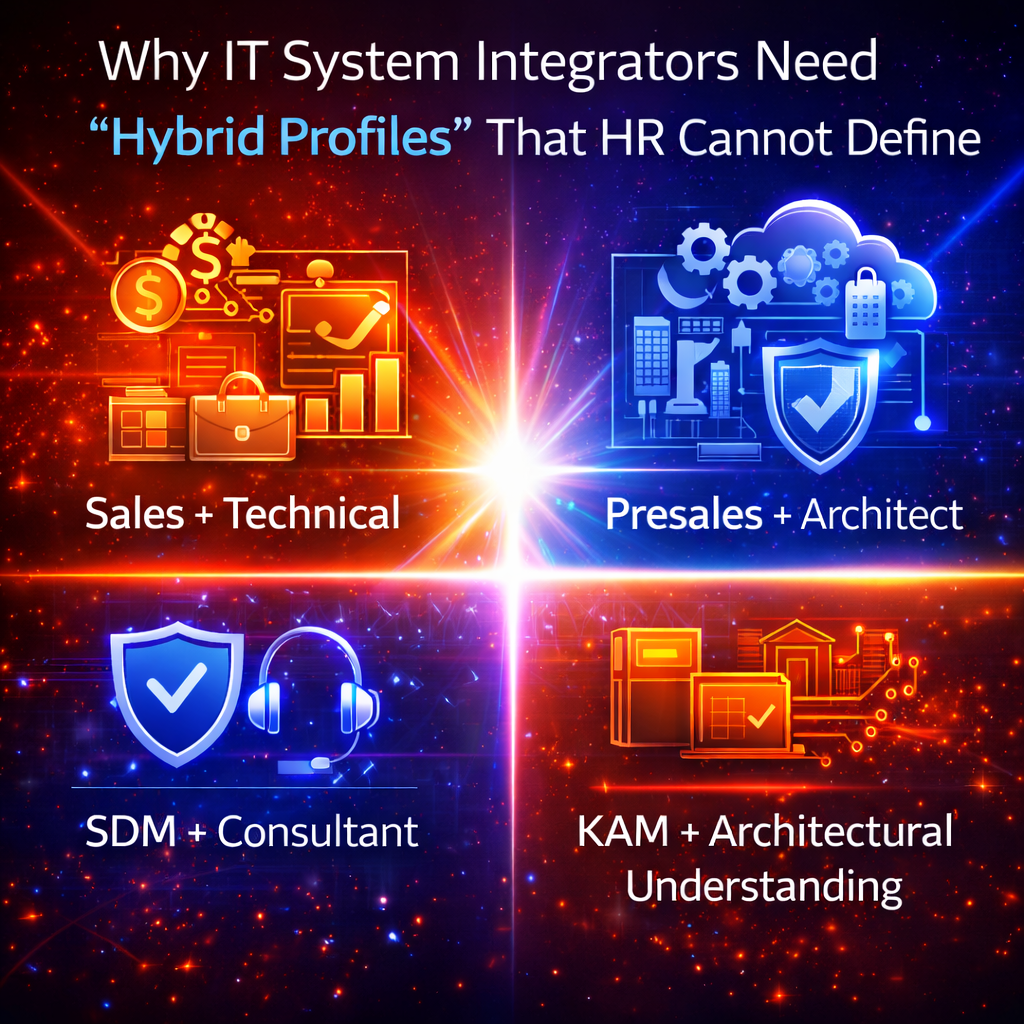
The problem is not that these people do not exist. The problem is that HR cannot define them.A classic example is Sales plus Technical. The pure salesperson who only writes offers and negotiates prices is no longer sufficient in complex IT environments. At the same time, the highly technical engineer who cannot translate technical value into business relevance is equally insufficient. What integrators truly need are people who can discuss architecture, security, cloud, or network topics with a customer at eye level and at the same time understand how this translates into business opportunities. This profile does not appear cleanly in any job posting. Either an Account Manager is searched for, or a System Engineer. In reality, what is needed is something in between.
Or consider Presales plus Architect. In many companies, Presales is still defined as a sales-support role. Creating presentations, preparing concepts, supporting tenders. In reality, these people are already acting as architects. They design complete infrastructures, define security concepts, influence vendor strategies, and provide strategic advice to customers. Yet internally they still carry the title Presales and are evaluated by traditional Presales criteria. The definition no longer matches the actual responsibility.Even more obvious is the combination of SDM plus Consultant. A Service Delivery Manager is often perceived as an operational role, coordinating tickets, organizing meetings, and creating reports. In modern managed services environments, this role has evolved dramatically. These individuals continuously advise customers, optimize services, identify new demands, and moderate both technical and strategic topics. They function as consultants with an operational perspective. Again, the classic definition is too narrow.
Another strong example is KAM plus Architectural Understanding. Key Account Managers are traditionally seen as commercial customer caretakers. In reality, they now sit in meetings with CIOs, IT managers, and departments where cloud strategies, security architectures, and compliance requirements are discussed. Anyone who does not understand the technical context immediately loses credibility. At the same time, these individuals are not engineers. They must understand architecture without implementing it.This is where recruiting gold begins. These profiles are rare, extremely valuable, and extremely difficult to find. They do not emerge from linear career paths. They develop from people who have worked across multiple roles for years, who have experienced both technical depth and customer interaction, both project business and service operations.
And these are exactly the profiles that system integrators urgently need today to evolve their business models. The shift from project business to managed services, the increasing complexity of cloud and security, and the growing demand for advisory and long-term customer relationships all require people who can build bridges. Between technology and business. Between projects and services. Between sales and architecture.HR departments often face a dilemma here. They work with job descriptions, role definitions, and internal career structures. But market reality has long outgrown these frameworks. When a department says they need a “highly technical account manager with presales understanding and architectural knowledge,” this simply does not fit into a predefined box. So either a sales profile is advertised or a technical profile. Both approaches miss the actual need.
Integrators who understand this development no longer search for titles. They search for combinations. They no longer ask whether someone is a Consultant or an Engineer. They ask whether this person understands technology, customers, processes, and business.From daily market interaction, it is clear how dramatically these requirements have evolved over the past five years. In the past, roles were separated. Today, they overlap. In the past, specialization was key. Today, translation capability is key. In the past, depth in one area was enough. Today, connecting multiple areas is crucial.
These hybrid profiles are the real bottleneck in the market. Not the pure engineer. Not the pure consultant. Not the pure salesperson. But the individuals who can combine several of these worlds.And this is why this topic is strategically important for system integrators. Those who recognize, define, and deliberately search for these profiles build a significant competitive advantage. Those who continue thinking in outdated role definitions lose time and opportunities.
The team behind Darkgate sees this development every single day. We speak with departments that know exactly what they need but cannot clearly express it. We speak with HR teams that formulate job postings that do not match market reality. And we speak with candidates who possess exactly these hybrid capabilities but often fall through traditional recruitment processes because their CV does not fit neatly into a single category.This is where modern recruitment must step in. It is no longer just about finding profiles. It is about translating needs. Between departments and HR. Between companies and candidates. Between outdated role models and new realities.These hybrid profiles are not a trend. They are the logical consequence of how IT system integrators have evolved toward advisory, managed services, cloud, security, and long-term customer relationships. And they will become even more important in the future.System integrators who start today to systematically identify, develop, and deploy these profiles will be significantly more successful in the coming years than those who continue to rely on rigid role definitions. Because the future of IT integration does not belong to specialists of one discipline, but to the connectors of multiple disciplines.





