Cybersecurity has spent years talking about ransomware, zero-day exploits, and highly sophisticated malware campaigns. But the real reality of 2026 often looks far less spectacular — and that is exactly why it is more dangerous. The next major million-dollar loss will not begin with a technical exploit, but with a convincing message, a credible Zoom call, or what appears to be a legitimate business contact. While many companies still build their security strategies around firewalls, SIEM platforms, and endpoint detection, nation-state actors have already understood that trust is the cheapest attack surface.
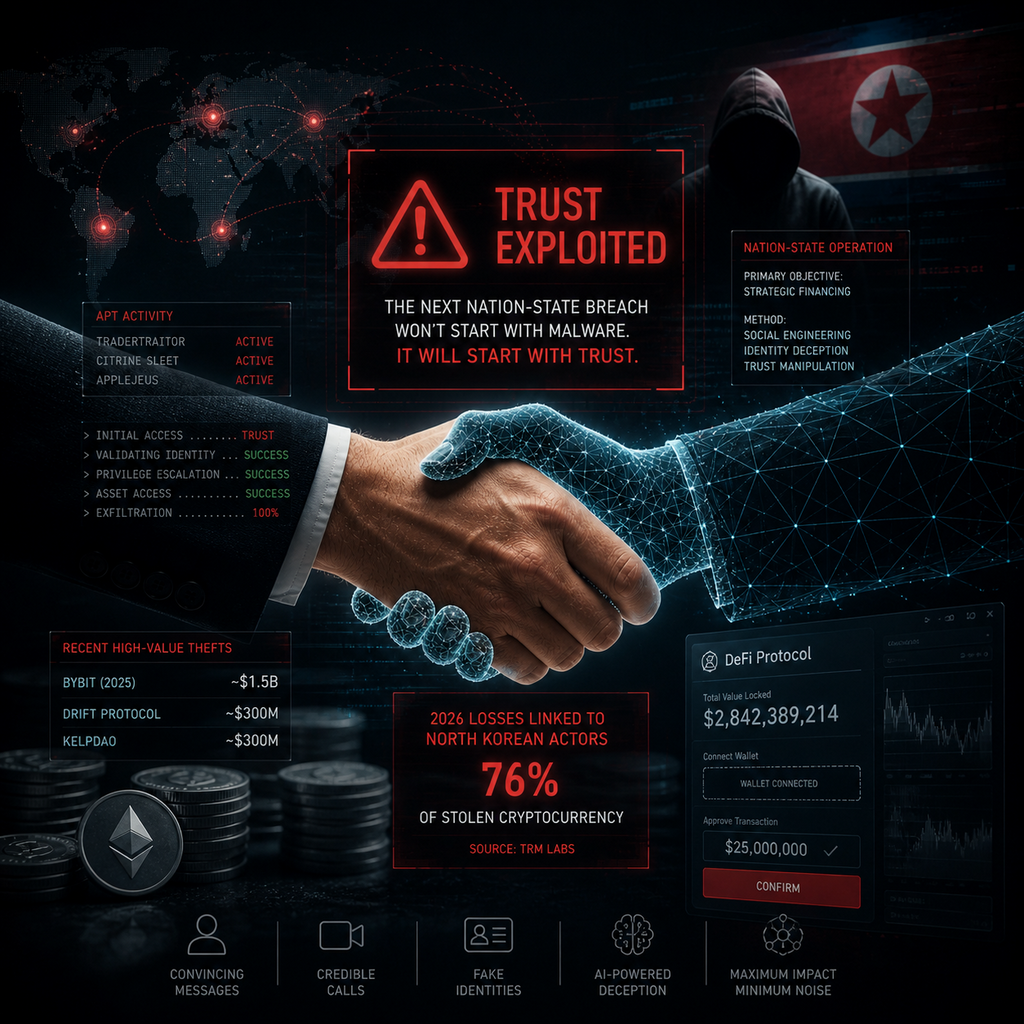
North Korea is currently the clearest example of this. According to recent analysis from TRM Labs, around 76 percent of all stolen cryptocurrency in 2026 has already been linked to operations carried out by North Korean threat actors. That does not mean they are responsible for most attacks. Quite the opposite. Their strategy is surgically precise: fewer attacks, maximum reward. Two individual incidents involving DeFi platforms like Drift Protocol and KelpDAO each generated nearly $300 million. In 2025, the attack against Bybit set a historic record with approximately $1.5 billion in stolen Ethereum.
Darkgate Deep Access reveals the real operational truth here: the problem is not primarily North Korea. The real problem is an infrastructure protecting billions of dollars with security mechanisms that often resemble startup architecture rather than system-critical financial institutions. DeFi projects manage value at nation-state scale, but often without reliable trust validation, without real provenance controls, and without governance structures prepared for high-pressure incident response. When a traditional banking system detects a suspicious transaction, it can stop, verify, and block it. In many crypto ecosystems, that exact capability is ideologically unwelcome.
This creates a dangerous paradox: technological freedom becomes the ideal attack model for state-sponsored APT groups. Groups like TraderTraitor, Citrine Sleet, and AppleJeus have long understood that they no longer need traditional attacks. They do not need complex exploit chains when a highly convincing social engineering process gets them there faster and far cheaper.
This is where AI enters the equation. Many companies still discuss artificial intelligence primarily as a productivity tool for sales, marketing, or development. On the attacker side, AI has already become operational infrastructure. Language barriers disappear. Fake identities become more convincing. Phishing becomes personalized. Reconnaissance becomes automated. Open-source intelligence that once required days of analyst work can now be processed in minutes. The difference is brutally simple: the cost of building a convincing attack has collapsed.
The most dangerous development is therefore not AI itself, but the democratization of professional deception. What once required highly disciplined state actors is now increasingly scalable through generative models. For North Korea, this means more than just higher success rates — it represents a strategic funding model. Cryptocurrency theft is no longer a side product of cybercrime. It has become part of geopolitical state financing.
Many CISOs still respond to this reality with traditional security budgets: more tools, more alerts, more dashboards. But Darkgate Deep Access sees a very different pattern in practice. Most organizations do not fail because of missing technology. They fail because of the illusion of control. Tool sprawl does not create security. SIEM deployments do not create resilience. Awareness training does not stop highly personalized trust-based attacks when governance and decision-making structures are operationally weak.
The real question is no longer: Do we have good security tools?
The real question is: Where do single points of human trust exist inside our organization? Who can approve high-value transactions? Who controls wallet infrastructure? Who verifies supplier identities? Who can bypass process controls through credibility alone?
Because that is exactly where the next nation-state breach begins.
Not with malware.
Not with a zero-day.
But with trust.
And that is why modern cybersecurity is no longer just a technical discipline. It is organizational design, governance, and power control. Those who fail to understand that will continue investing millions in security – and still lose billions.