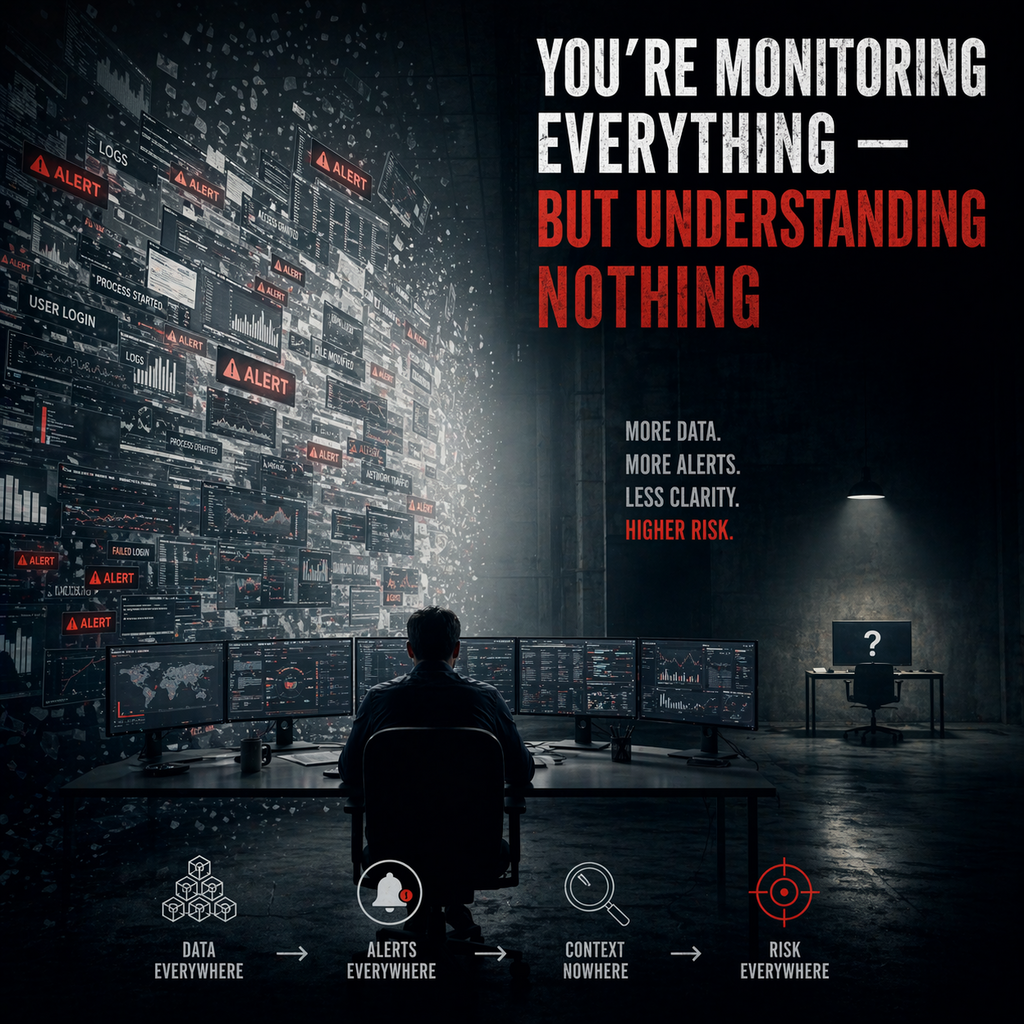
It often begins with a sense of progress. Systems are expanded, new data sources are connected, additional dashboards are introduced. The environment grows, visibility increases, and with every new integration there is a growing belief that the organization is getting closer to reality. Logs from across the infrastructure are centralized, events are captured, correlations run continuously in the background. The architecture appears modern, complete, and under control. And this is exactly where one of the most dangerous illusions in cybersecurity begins to form. Visibility is mistaken for understanding.As the volume of data increases, one critical question remains largely unanswered. What does any of this actually mean in the moment it matters. What is relevant, what is critical, and what is simply noise. Modern systems generate information at a depth and scale that would have been unimaginable just a few years ago. Yet this abundance of data does not automatically lead to clarity. In many cases, it creates a new form of uncertainty that is less visible, but structurally far more dangerous.A growing number of organizations are operating in exactly this state. They have invested heavily in visibility. SIEM platforms ingest logs from countless sources, endpoint systems produce continuous telemetry, cloud environments add even more layers of data. The infrastructure works. The data exists. The question is no longer whether something is being seen. The question is whether what is being seen can still be meaningfully interpreted.This situation is not accidental. It is the result of a market that, for years, has promoted a simple narrative. More data leads to more security. More transparency leads to more control. Every additional signal, every new integration, every expanded data source increases the chance of detecting threats early. This narrative is not wrong, but it is incomplete. It fails to address what happens when the volume of information grows faster than the or
Subscribe or
log in to read the rest of this content.
This article is part of Darkgate Feature Articles - Deep Access.
Strategic insight. Executive-level analysis.
Real infrastructure intelligence - beyond surface-level reporting.