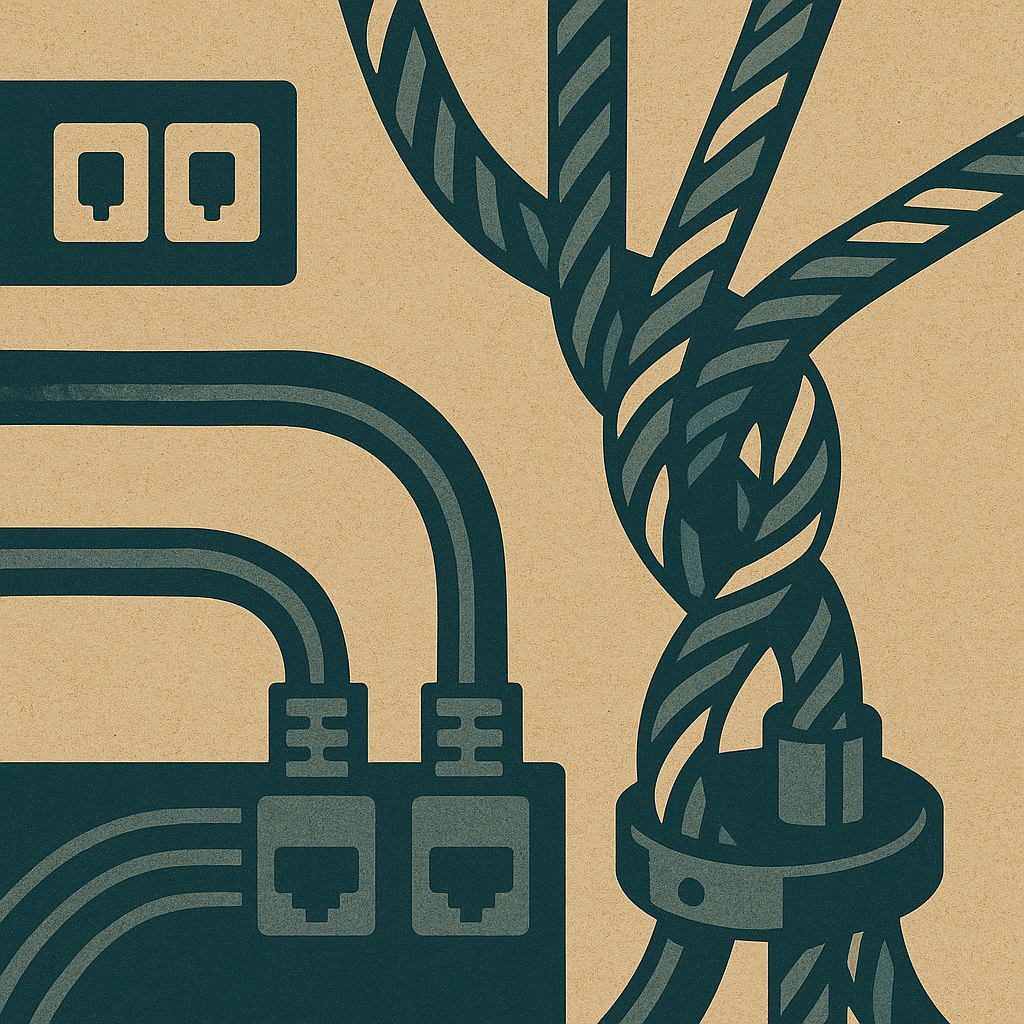

When the first corporate networks emerged in the early 1980s, infrastructure was above all one thing: improvised. Thick coaxial cables wound their way through offices, were daisy-chained from computer to computer, connected with T-connectors, poorly documented and barely secured. If a single connection failed, half the network often went down with it. And yet, it was precisely in this imperfect phase that the evolution of physical IT infrastructure began — a development that would fundamentally change companies, productivity, and, later on, entire business models.
Coaxial cables dominated the early days of local networks. Robust, prone to interference, difficult to install but at the time, there was no real alternative. The early Ethernet standards of the 10Base2 and 10Base5 era enabled stable data transmission over short distances in office environments for the first time. This was a quantum leap. For the first time, multiple computers within a company could communicate directly with one another. Files no longer had to be transported by diskette. Printers were shared. Applications became networked. IT slowly began to detach itself from the isolated world of single machines and move into the everyday workflow of employees.
But these early networks had systemic weaknesses. Coaxial networks were bus structures. All devices shared a single line. Every disruption affected everyone. Troubleshooting was laborious, outages unpredictable, scalability practically non-existent. With every new workstation, the risk of instability grew. Companies quickly realized that if networks were to become more than a technical toy and truly business-critical, a new technical foundation would be required.That foundation emerged in the 1990s with the transition to twisted-pair cabling and structured cable management. Instead of a single long line, star-shaped point-to-point connections were now used. Every workstation had its own dedicated cable. Patch panels replaced loose plug connections. Server rooms emerged as clearly defined infrastructure hubs. What sounds like mere technical progress was, in truth, an organizational and economic turning point.
With structured cabling, network infrastructure became predictable for the first time. Cables were documented. Ports were numbered. Capacities were calculated. Maintenance became possible without shutting down operations. Faults could be localized instead of guessed. Above all, something entirely new emerged: scalability on the physical level. Companies could grow without tearing out their entire cabling. Workstations could be moved flexibly. Departments could be reorganized. IT became mobile in the most literal sense of the word.
At the same time, a new type of room emerged that now seems self-evident but was revolutionary at the time: the server room. While in the 1980s computers were often still distributed across individual departments, companies now began to concentrate their systems in centralized locations. Air conditioning, power supply, uninterruptible power, and fire protection suddenly became critical issues. Server rooms became the physical heart of digital processes. And they demanded a new way of thinking: IT no longer as a supporting tool, but as critical infrastructure.This development also transformed the working world. Networks became faster, more stable, more reliable. Applications could be used jointly. Data was no longer stored only on individual machines, but on servers. Team collaboration took on a new dimension. Enterprise software such as ERP systems, email servers, and databases only became truly viable on a large scale through this physical infrastructure. IT moved from the experimental periphery into the very center of value creation.
At the same time, new dependencies emerged. As networks grew in importance, their physical stability became a business risk. A mispatched connection, a defective cable, or an overheated server room could suddenly bring entire departments to a standstill. This gave rise to a new professional role: the network administrator, who not only understood systems, but also cable routes, distribution frames, power supply, and room technology. Infrastructure became tangible, visible, measurable and at the same time indispensable.
By the late 1990s, this development reached a new level of maturity. Gigabit-capable cabling, standardized patch panels, professional racks, structured documentation. Networks were no longer simply built they were designed. Buildings were already being planned with IT infrastructure in mind. New constructions without structured cabling were almost unthinkable. Physical infrastructure had definitively arrived in the engine room of organizations.What this made possible only became fully visible with the turn of the millennium. Data centers emerged. Internet connections became powerful. Companies increasingly shifted their business processes into digital systems. Without the physical evolution of the 1980s and 1990s, none of this would have been conceivable. No hosting. No e-commerce. No distributed locations. No early forms of cloud. No global digital collaboration.
What is remarkable is how invisible this development has become today. Hardly anyone thinks about patch panels, cable trays, or server rooms in everyday life. And yet, this physical foundation is the prerequisite for modern digital architectures to function at all. Fiber optics, hyperscalers, edge computing all of them rest on the foundation that was built in the 1980s and 1990s.This era is also still present in today’s IT recruiting. Terms like structured cabling, racks, server rooms, network topologies, or physical redundancy appear less frequently in glossy job ads, but they remain decisive in technical discussions. Anyone who truly understands infrastructure knows that the cloud does not begin in a hyperscaler’s data center, but in the cable duct of an office building. Those who have never understood this physical layer will never fully grasp virtual architectures either.The evolution of physical infrastructure was not a glamorous revolution. It was quiet, dirty, shaped by construction sites, cable chaos, and improvised server rooms. And yet, it was one of the most important prerequisites for the digital economy as we know it today. Coaxial cables became structured networks. Loose computers became centralized systems. IT experiments turned into business-critical infrastructure.
Between 1980 and 2000, not only did technology change, but so did the relationship between companies and digitalization itself. IT evolved from a tool into a supporting pillar. And every modern network, however virtual it may appear today, still carries this physical history within it.