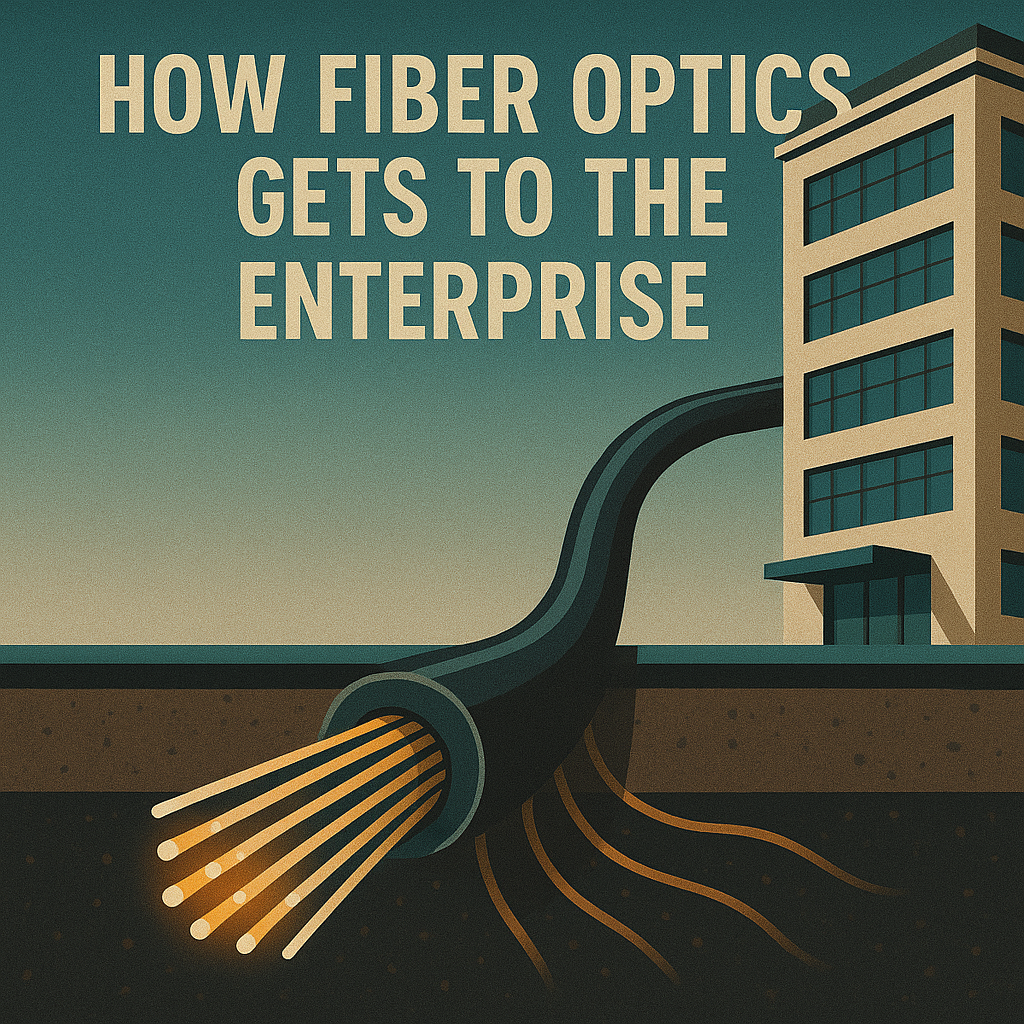

When fiber optics first entered corporate networks in the early 2000s, it still felt like a technology from a distant future. Copper cabling was everywhere, server rooms ran reliably on twisted pair, and gigabit Ethernet seemed fast enough for almost any business application. But beneath the surface, something fundamental was shifting. Data volumes were exploding faster than any infrastructure roadmap could anticipate. Applications were growing heavier, files larger, locations more distributed. What had once been considered high performance suddenly became a bottleneck. Fiber did not arrive as a marketing trend. It arrived as a technical necessity.
The basic principle of fiber optics is far older than most people realize. Experiments with light transmission began as early as the 1970s. The real breakthrough came when signal losses inside the glass could be drastically reduced and optical amplifiers became commercially viable. For the first time, near light speed data transmission over long distances became realistic. In the early 2000s, this technology migrated from telecom backbones into enterprise data centers.At first, fiber was reserved for the innermost core of IT infrastructure. Core switches, storage systems, central server clusters. This was where extreme bandwidth was immediately required. Databases were growing at unprecedented rates, virtualization was gaining momentum, the first storage area networks emerged. Copper simply could not keep up. Fiber delivered not only speed, but a new level of stability. Electromagnetic interference became almost irrelevant. Distances could be bridged on an entirely new scale. Data centers could suddenly be separated physically without latency destroying performance.
During the 2010s, the second major phase began. Fiber moved from the core out into the enterprise campus. Not just between servers, but into distribution layers, across buildings, and eventually even to individual workspaces. At the same time, the global hyperscaler backbones were built. Google, Amazon, Microsoft and others started deploying their own privately owned global fiber networks. Not as a dependency on public providers, but as a strategic asset. Fiber was no longer just an IT medium. It became a geopolitical instrument of economic power.The impact on enterprises was profound. Networks did not merely become faster, they became predictable. Latency dropped to levels that enabled entirely new classes of applications. Real time backups, cross site replication, high availability clusters, globally distributed production networks, decentralized database architectures. None of this would have been practical without fiber. Business models changed. Location lost relevance. When data can be transported across continents in milliseconds, architecture matters far more than geography.
At the same time, competition acquired a new invisible dimension. Companies with modern fiber infrastructure could automate faster, scale faster, and respond faster. Those stuck on outdated copper structures lost not only speed, but strategic freedom. This invisible infrastructure became a direct competitive factor. Rarely communicated externally, but decisive internally.What continues to make fiber so extraordinary to this day is not only its raw performance, but its physical superiority. Light encounters minimal resistance. Kilometer long distances inside enterprise campuses are trivial. Bandwidth is no longer measured in megabits or gigabits, but in terabits. And all of this with a stability copper could never offer. Glass ages slowly, is immune to electrical interference, and provides an investment horizon measured in decades.Why does fiber still feel modern in 2025, even though it is no longer a new technology. Because its performance reserves remain largely untapped. As applications push into new dimensions, from AI clusters to real time simulations to global edge computing, fiber continues to scale with demand. Not because it is constantly reinvented, but because its physical principle was so far ahead of its time that even today’s requirements struggle to reach its limits.
With the rise of cloud computing, fiber acquired yet another strategic role. Without stable high speed connectivity, hyperscaler data centers would be nothing more than isolated islands. Only fiber transforms them into global machine rooms. Every cloud migration, every hybrid architecture, every multi cloud strategy ultimately rests on light. Enterprises speak of virtual servers, software as a service and platforms. Technically, all of these abstractions terminate again and again in the same medium. Glass.Daily business perception has shifted accordingly. Networks used to be seen as utility. Today, they are the foundation of nearly every strategic decision. Collaboration platforms, video conferencing, distributed development teams, international production chains, remote maintenance, digital twins. None of these would be economically viable without fiber. Not because they would be theoretically impossible, but because their quality would fall short of business expectations.This transformation is clearly reflected in today’s recruiting landscape. Fiber is rarely advertised explicitly, yet it underpins almost every modern infrastructure role. Network engineers, data center architects, cloud specialists, security experts. All of them rely implicitly on fiber as the physical substrate. Anyone discussing zero trust, high availability or global redundancy is already thinking in fiber architectures even if the term itself is no longer explicitly mentioned.
One of the most remarkable aspects of fiber’s revolution is its near invisibility. Fiber runs underground, through shafts, inside racks, across trays, buried deep in the machine rooms of digital society. Hardly anyone photographs it. Hardly anyone talks about it. And yet it is precisely this infrastructure that makes the illusion of permanent availability possible. When an enterprise deploys globally within seconds today, the magic is not marketing. It is light pulses traveling through glass.
From the first internal enterprise fiber connections of the early 2000s, through the campus networks of the 2010s, to today’s hyperscaler backbones, a clear line can be drawn. Fiber was never a short lived trend. It was a long term infrastructural commitment to a world that would become faster, more connected and more dependent on data than anyone could have predicted at the time.
The real revolution of fiber therefore lies not in spectacular speed records or benchmark charts, but in its quiet inevitability. It works. It scales. It endures. And that is precisely why it still feels like future technology in 2025. Not because it is new, but because it continues to carry everything that the digital world keeps placing upon it.