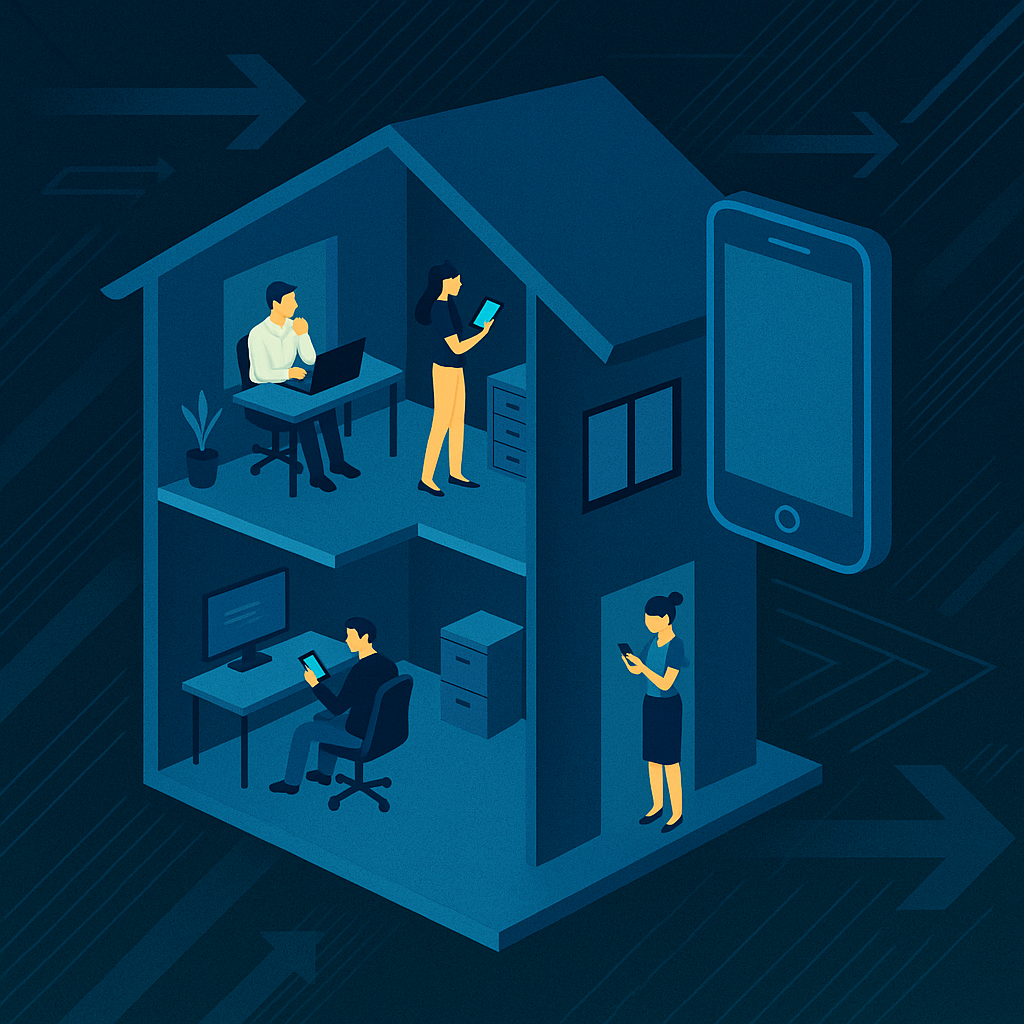
AI is no longer a promise of the future. It is reality. And it is reshaping IT operations faster than many teams expected. Yet the real cultural rupture inside the enterprise did not begin with artificial intelligence. It began a decade earlier, in 2015, when companies finally accepted that work was no longer bound to cables, ports, and fixed desks. Mobile First was not a feature update. It was a shift of power – from infrastructure to movement.
According to an IDC survey, by 2016 already 58 percent of European enterprises were using mobile devices as the primary work tool for a growing share of their workforce. Smartphones, tablets, and later ultra-mobile notebooks displaced classical desktops faster than many IT departments were willing to admit. Work was no longer carefully planned around fixed locations. It simply happened. On trains, in elevators, on factory floors, in home offices, in cafés. And the network had to follow, whether it was ready or not. Only a few years earlier, rigid campus designs dominated enterprise architecture. WLAN was considered supportive, not foundational. Serious work happened at the port. In 2015 that logic collapsed almost overnight. Mobile devices no longer arrived as exceptions. They arrived as a flood. BYOD became reality long before security models were prepared for it. Apple firmly established itself in the enterprise, Android followed, and suddenly IT teams no longer had full control over the devices entering their networks – yet they still carried full responsibility for the risk.
A former campus architect at a European industrial corporation recalls that moment clearly: “We could no longer predict which devices would enter the network. But we still had to guarantee that everything worked. That was the moment WLAN shifted from a convenience feature to mission-critical infrastructure.” Mobile First did not merely change endpoints. It reshaped architecture itself. Networks were no longer designed around ports, but around motion. Users moved across zones, buildings, and floors and expected their sessions to continue seamlessly. Telephony, collaboration, and business applications ran in parallel, wirelessly, without interruption, without tickets. Roaming was no longer a specialized discipline. It became a baseline requirement. Radio cells no longer just needed to “cover.” They had to carry density, absorb load, and remain stable under pressure. At the same time, identity began to replace topology. Who a user was became more important than where a device was plugged in. Early NAC structures emerged, often fragmented and painful to implement, but the turning point was set: trust began to detach from physical location.With mobility came the moment of operational seriousness. Not only white-collar work shifted into wireless space. Industry, logistics, and healthcare followed. Scanners, machine interfaces, mobile nursing stations, autonomous transport systems, and IoT sensors began to ride on WLAN. Wireless networks started to carry processes whose failure was no longer inconvenient but existential. At the same time, device density exploded. What was considered demanding in 2015 – ten devices inside a single radio cell turned into hundreds within a few years. Voice, video, collaboration, and cloud workloads ran simultaneously, all over wireless. For many enterprises, this was the moment WLAN finally lost its reputation as an unstable accessory.Security, however, lagged behind. Mobile First created freedom, but also a massive attack surface. Devices left protected zones, crossed networks, and shifted between private and corporate contexts. Classical VPN concepts suddenly felt heavy and brittle. A Forrester study in 2018 showed that more than 42 percent of enterprises considered mobile endpoints their largest unresolved security gap. Yet mobile expansion continued without restraint. Many security models remained backward-looking, segmentation static, trust still largely defined by location. A CISO at a European financial services group later described this phase bluntly: “At first, we underestimated Mobile First as a comfort topic. Only when the first attacks entered through compromised endpoints did we realize that we actually needed a completely new security model.” That realization later flowed directly into what today is described as Zero Trust in the campus.
But Mobile First was never purely a technical revolution. It was cultural. Work lost its fixed spatial binding. The desk became an option rather than a prerequisite. Leadership had to accept that control could no longer rely on visibility. IT teams had to accept that standards were no longer enforceable through homogeneous hardware. Employees, on the other hand, began to expect the network to follow them – not the other way around. Many of today’s debates around hybrid work, remote leadership, resilience, and digital sovereignty trace their origin back to this very moment.
What began in 2015 as a cultural shift has now become structural reality. The multi-dominant enterprise WLAN landscape between 2022 and 2026 is not accidental. It is the direct outcome of that transformation. Cisco remained the backbone of global structures. Aruba shaped the modern campus generation. Juniper introduced controlled precision. Extreme dominated public wireless infrastructures. Fortinet anchored security directly into wireless access. Ubiquiti and MikroTik shaped broad semi-professional environments. This diversity could not have emerged without Mobile First. It was the mobile pressure that forced the market to break away from monolithic WLAN worlds. It was the new usage behavior that created room for specialization.
With WiFi 6 and WiFi 6E, this evolution has reached technical maturity. Wireless networks today carry the same expectations once reserved for backbone infrastructures. Low latency, extreme density, parallel workloads, stable quality of service. For many users, the distinction between wired and wireless has effectively vanished. The network no longer exists as a visible object. It has become space.
Mobile First is completed and yet it is not over. Its effects continue to ripple. It enabled Zero Trust. It paved the way for the new maturity of enterprise WLAN. It detached physical infrastructure from digital identity. And it continues to raise fundamental questions that remain unresolved. How much mobility can security tolerate? How much comfort can control endure? How much trust can automation absorb without turning into a black box? One thing is certain: Mobile First was never a trend. It was the moment when the network began to follow the human – not the other way around. And what grows out of that shift is far from fully written.