After 2022, Enterprise WLAN is no longer shaped by a single technological revolution, but by a new market order. Wireless is established, accepted, deeply embedded in working environments, production sites, educational institutions and public infrastructures. While WLAN continues to evolve functionally, the vendor landscape shifts at the same time. What was once a two-pole world becomes a multi-dominant market in which several strong players expand their own territories side by side.
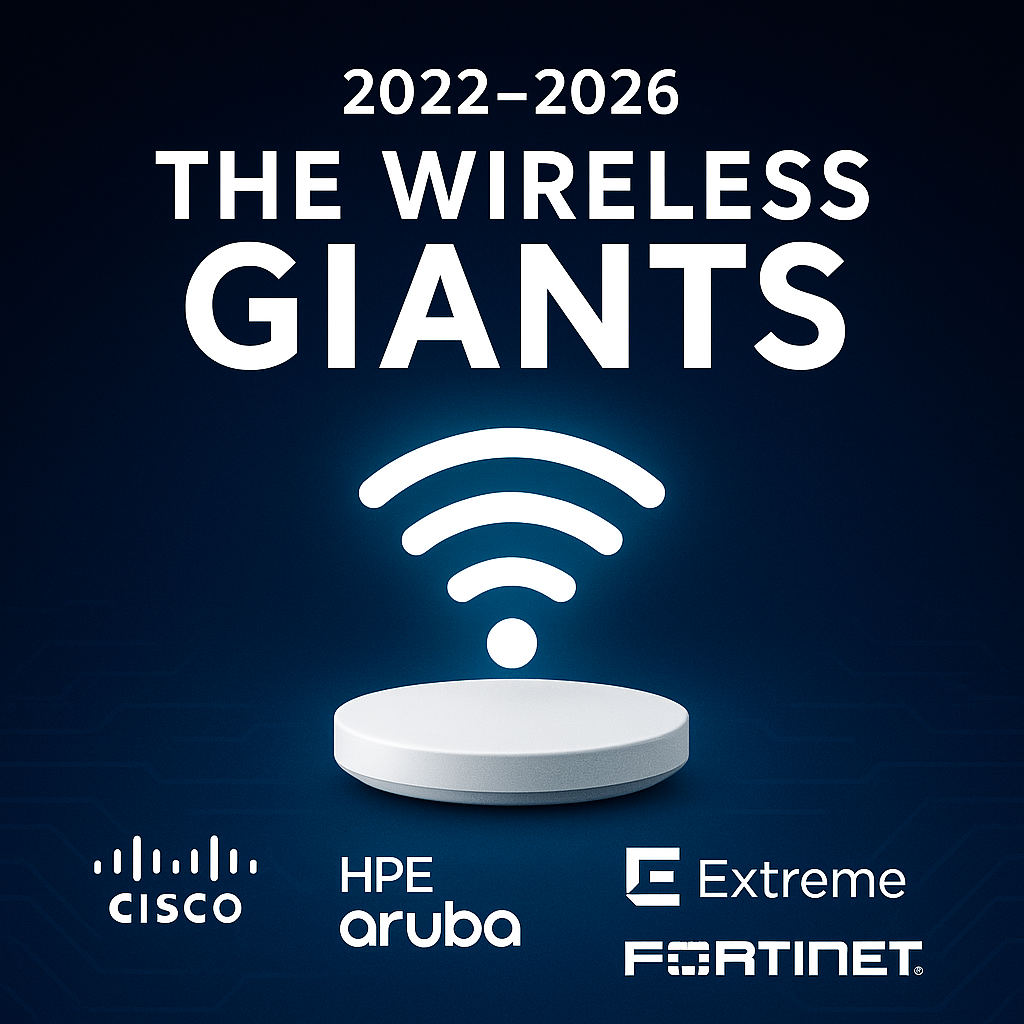
Cisco remains the great, steady constant in this phase. For global corporations, complex industries, financial institutions, regulated environments, critical infrastructures and international campuses, Cisco continues to be the natural choice. WLAN is not viewed here as a standalone technology, but as an integral part of long-established enterprise architectures. Wireless is not treated as a feature, but as a structural element of stable operations. Cisco stands less for spectacle and more for continuity. Those who seek long-term reliability continue to choose Cisco without lengthy debate.
At the same time, HPE Aruba continues to grow into its role as a modern WLAN powerhouse. Universities, technology companies, international office landscapes, hybrid working models, highly dynamic campuses. Aruba stands for wireless that feels light, natural and seamlessly embedded into daily work. Role-based access (RBA), clean radio cell design, stable roaming, high device density. WLAN here no longer feels like technology, but like part of the atmosphere of work itself. The connection with Juniper further strengthens this position. Juniper adds additional precision to large wireless landscapes and complements the access layer with highly structured control logic without changing the fundamental character of WLAN.
Juniper itself becomes more visibly present in Enterprise WLAN from 2022 onward. Especially in large locations, highly dynamic environments and networks where wireless quality must be measurable and consistent. Juniper brings its heritage from high-end networking into the wireless domain and interprets WLAN as a long-term, controllable infrastructure. Wireless is not improvised here, but planned, evaluated and continuously fine-tuned. Technology-driven organizations, large corporate campuses and international sites increasingly adopt this philosophy.
Extreme Networks further establishes itself in this phase as a campus WLAN provider for public and semi-public environments. Schools, universities, hospitals, government institutions, municipal networks and large venues. Extreme stands for wireless networks that must reliably support large numbers of users at the same time. WLAN here is no longer just an internal IT tool, but part of public infrastructure. Access becomes a fundamental supply medium. For many large education and healthcare projects, Extreme becomes a firmly established market presence from 2023 onward.
Fortinet develops into a distinctive force in the WLAN landscape between 2022 and 2026. Not as a traditional wireless vendor in the classic sense, but as a security-driven WLAN alternative. Secure WLAN is not an add-on here, but the starting point. Wireless access, identity, segmentation and protection merge into a unified model. This approach gains particular momentum in industrial environments, production, logistics, retail and the upper mid-market. WLAN here is not primarily designed as a comfort zone, but as a secure gateway into digital business processes.
At the same time, new market spaces continue to open in the semi-enterprise segment. Ubiquiti increasingly shapes hotels, agencies, co-working spaces, retail chains and small to mid-sized office environments. WLAN becomes visual, rapidly scalable and economically attractive. Wireless is not deployed as a heavyweight infrastructure, but rolled out with agility. MikroTik remains strong in ISP-related environments, in special networks, in regional projects, for service providers and for customized campus structures. These vendors do not dominate global enterprise standards, but they shape large parts of everyday wireless reality.Between 2022 and 2026, one fundamental change becomes clear. Enterprise WLAN is no longer a single-brand topic. Cisco remains the backbone of global structures. HPE Aruba shapes modern campus work environments. Juniper adds precise control logic. Extreme dominates public wireless landscapes. Fortinet anchors security directly into WLAN. Ubiquiti and MikroTik shape broad semi-professional structures. The market does not become fragmented, it becomes richer.
With WiFi 6 and WiFi 6E, this new diversity is technically supported. High device density, stable performance, clean latencies and parallel applications without noticeable friction. Voice, video, collaboration and internal systems run simultaneously as a matter of course. For users, the distinction between wireless and wired finally disappears. The network no longer exists as a physical object. It becomes space.
By 2026, Enterprise WLAN clearly shows itself as a mature discipline. No longer in need of explanation. No longer experimental. Instead, confident and established. Vendors no longer compete for basic acceptance, but for refinement. For experience. For transitions. For density. For stability in the background.In this phase, WLAN is no longer the stage. It is the ground on which everything takes place. And that is exactly where its new strength lies.