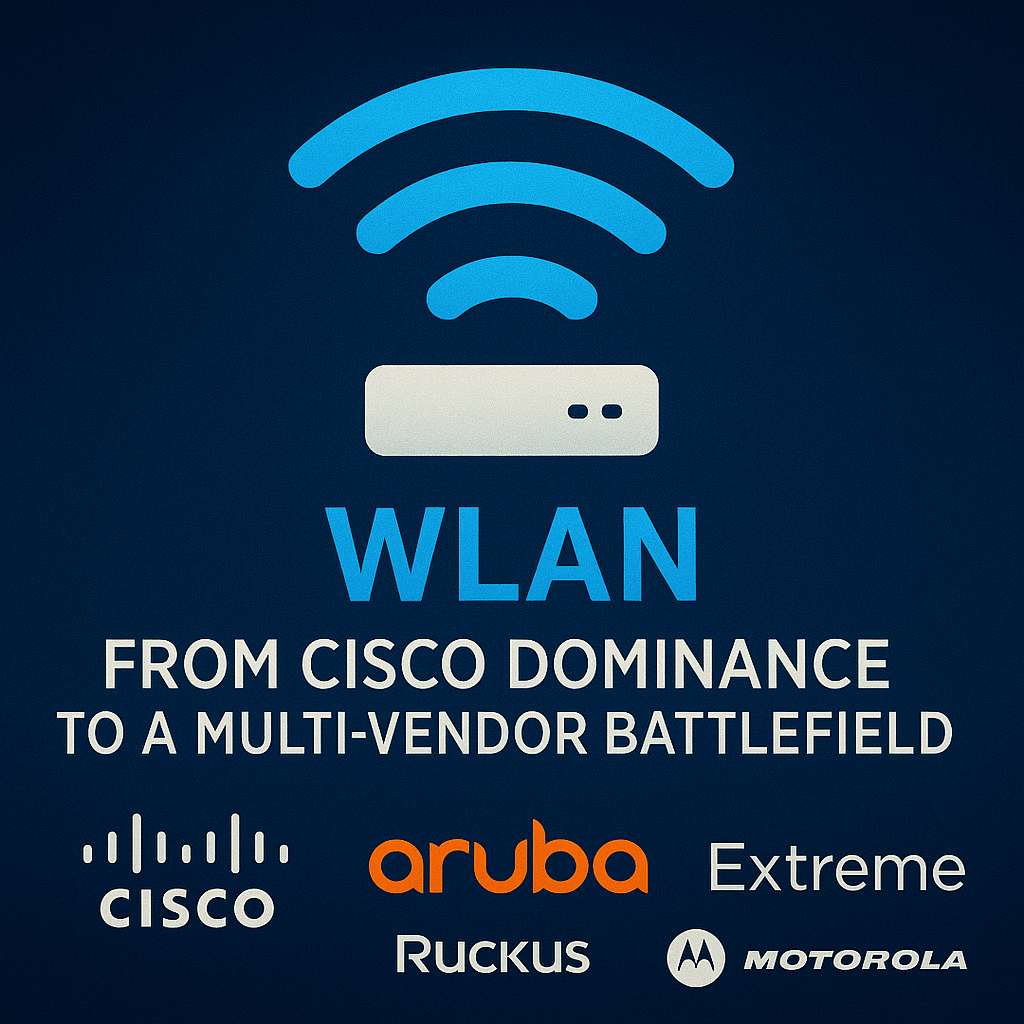
When wireless LAN finally became a mission-critical enterprise technology, one name stood at the center of that transformation from the very beginning. Cisco. In the early and mid-2000s, enterprise WLAN meant controller-based architectures, centralized management, Aironet access points and scalable campus designs. Cisco did not simply participate in this market phase, it shaped expectations. Wireless was no longer an add-on. It became a predictable, controllable and strategically deployable part of corporate infrastructure. For the first time, radio signals were treated like business assets.
At the same time, a second force quietly built momentum. Aruba Networks was founded in 2002 and focused early and consistently on mobility. While many networks at the time were still designed around ports and cables, Aruba placed the user at the center. Identity, access roles, device posture, security at the edge. This perspective resonated with a growing number of enterprises. WLAN was no longer just an extension of the wired network. It became a user-centric access fabric. Over the years, Aruba evolved into one of the defining enterprise WLAN brands and helped reshape how wireless networks were designed in corporate environments.As WLAN moved deeper into operational areas around 2006 and beyond, the market opened further. Wireless left the conference rooms and entered warehouses, production floors, hospitals, university campuses and retail environments. Wherever business processes were running, wireless connectivity followed. New vendors entered the field, each contributing a different strength to the expanding wireless ecosystem.Ruckus Wireless built its reputation as a specialist for high-density and technically demanding environments. Large venues, education campuses, public spaces and complex building structures became typical deployment areas. Intelligent antenna designs and strong radio performance made it possible to deliver stable connectivity where large numbers of users gathered. Wireless networks became performance platforms in their own right.
Motorola, through its heritage with Symbol Technologies, made WLAN an essential element of industrial mobility. In logistics, retail and mobile data capture environments, wireless was no comfort feature. It was part of the value chain itself. Scanners, handheld terminals and rugged mobile devices relied on stable radio connectivity across large operational areas. Here, wireless networks proved their role as a business enabler at the very core of daily operations.
HP entered the enterprise WLAN landscape at a time when wireless had already matured into a strategic infrastructure layer. With the acquisition of Aruba in 2015, WLAN became visibly embedded into broader IT architectures. Security, identity management, IoT connectivity, location services and data-driven intelligence all converged around wireless platforms. With HP’s global reach, Aruba grew into one of the strongest players in the enterprise WLAN world. Wireless had clearly moved beyond connectivity. It had become a digital platform.
Extreme Networks followed a different path into this market. Originating from the switching world, Extreme gradually built a comprehensive campus networking approach that integrated switching, routing and wireless governance into unified architectures. For many organizations, this holistic integration became decisive. Wireless was no longer deployed in isolation. It became an integrated layer of the overall network fabric.With every new generation of WLAN technology, the perception of wireless networking continued to evolve. In the early years, freedom of movement defined its value. Later came voice over WLAN, real-time collaboration, cloud access, mobile workforces and eventually IoT connectivity. WLAN became the universal access layer between people, machines and cloud platforms. Vendors no longer supplied access points alone. They delivered full ecosystems with centralized management, security frameworks, analytics and automation.Pricing models diversified along with use cases. While large campus environments followed traditional enterprise investment models, flexible solutions emerged for education, hospitality, retail and mid-sized businesses. Wireless networking became ubiquitously accessible. It was no longer a premium feature. It became a universal foundation.
With the rise of WiFi 5, WiFi 6 and WiFi 6E, this shift reached a new level. Higher device densities, lower latencies, stable real-time communications and seamless cloud connectivity transformed wireless networks into full performance infrastructures. In many scenarios, wireless connectivity now outperforms traditional wired access. For users, the distinction has effectively disappeared. The network simply exists.Today’s enterprise WLAN landscape is the result of years of collective innovation. Cisco, Aruba, Ruckus, Extreme, Motorola and many others have shaped wireless into what it is today. The backbone of the digital workplace. The connective tissue between users, applications and infrastructure. An invisible but omnipresent layer of modern business operations.
Wireless LAN as a business technology is not the achievement of a single vendor. It is the product of continuous competition, collaboration and evolving enterprise demand. Driven by the need for flexibility. Powered by innovation. And defined by a workforce that expects to move freely while remaining permanently connected.