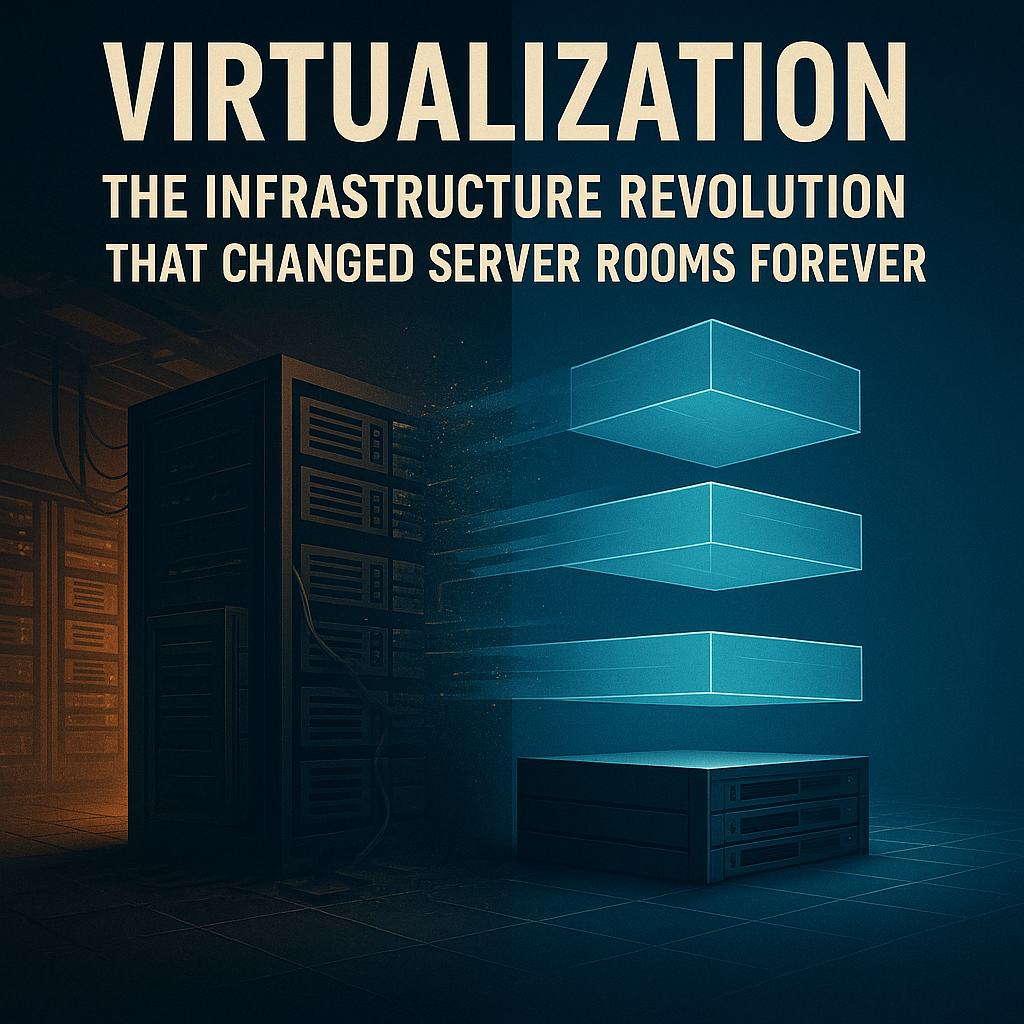
At the end of the 1990s, IT infrastructure was still rigid and physical. Server rooms were loud, hot, and packed with individual machines, each running a single operating system and usually a single application. Hardware was massively underutilized, often running at only five to fifteen percent capacity, yet every new application meant another physical server. This led to high costs, complex operations, and an infrastructure mindset focused more on risk avoidance than efficiency.
Between 1998 and 2005, server virtualization quietly changed this model. With early technologies such as VMware Workstation and later VMware ESX, it became possible to run multiple isolated systems on one physical machine. For the first time, hardware could be shared without applications interfering with each other. Control shifted away from physical servers toward software layers, and this shift marked the real beginning of modern infrastructure thinking.Virtualization also changed how oversight and responsibility worked in IT. The virtual machine became the new unit of control, not the physical server. Administrators could create, stop, copy, or move systems without entering the server room. This increased efficiency and flexibility but also introduced new responsibilities. Decisions could affect multiple systems at once, which made governance, access control, and monitoring far more important than before.
The impact on classic server rooms was significant. Fewer physical machines meant less power consumption, less cooling, and smaller data center footprints. Racks became less crowded, maintenance became more standardized, and scaling no longer required immediate investments in space and electricity. Infrastructure became more economical and more predictable, which fundamentally changed how IT budgets and capacity planning were handled.Early adoption did not start in conservative enterprises. Hosting providers, system integrators, technology-focused mid-sized companies, and development teams were the first to embrace virtualization. They valued speed, flexibility, and efficient resource usage. Larger organizations followed later, often driven by cost pressure and physical limitations in their data centers rather than pure innovation.
The real improvement brought by virtualization was not just technical. It separated software from hardware in a practical and operational way. Systems could be deployed faster, testing and migration became easier, and dependency on specific physical machines was reduced. This separation laid the foundation for everything that followed, from cloud computing to modern infrastructure automation.
Virtualization did not arrive with hype or headlines, but its impact was profound. Between 1998 and 2005, it transformed server rooms, reshaped IT operations, and prepared infrastructure for the next decades. Many of today’s concepts, from cloud platforms to hyperscalers, are built on this early shift. It was a silent revolution, but one that permanently changed how IT works.