
Before talking about the cloud, it helps to build a simple mental picture. The cloud is not a place. It is not a location where computers live. It is a mediator. In the past, an application spoke directly to a specific server. Today, it speaks to a system that decides where that application actually runs. In classical IT, the world was simple. An application ran on a server. That server sat in one place. It had fixed resources. If it was overloaded, it was overloaded. If it failed, the application failed. Everything was visible, local and finite. In the cloud, this direct relationship no longer exists. Applications do not run on servers, they run on capacity. And that capacity is managed by a central coordination layer that constantly decides where computing power is free, where storage is available and which network paths exist. Work is distributed across machines without the user ever seeing those machines.
You can think of the cloud as a global operating system. Instead of launching programs on a computer, you launch them on this operating system, and this operating system decides on which physical device those programs actually run. That is the core idea of the cloud, and that idea changed everything. In traditional IT, a system consisted of things: servers, network cables, switches, firewalls and storage systems. Each of these had to be planned, purchased, installed, configured and maintained.
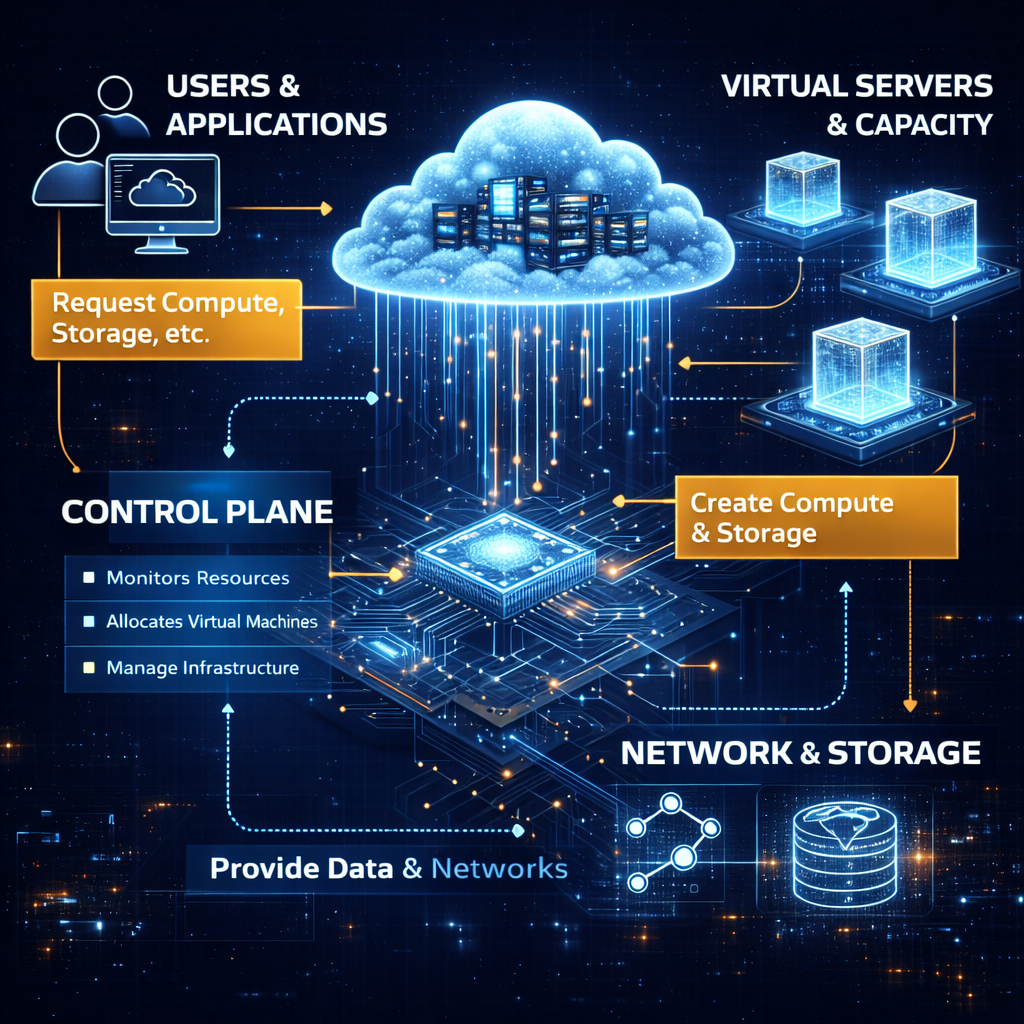
Every change meant manual intervention. Every growth step meant new hardware. Every incident required human action. The cloud does not start with hardware. It starts with an abstraction layer called the control plane. The control plane is the real heart of the cloud. It is not a single server, but a distributed management system that knows which resources exist, where they are located and how they can be used.When a company starts a new compute unit in the cloud, it does not turn on a server. It sends a state request. Software asks the control plane for a resource with specific properties, in a specific region, with specific network access and defined security rules. The control plane evaluates where free capacity exists within the global data center network, decides on which physical host the virtual unit will be launched, reserves resources, assigns networks, connects storage and starts the system automatically from a predefined image. No human touches a device. No cable is plugged in. No installation is performed. The operating system already exists. The application already exists. Systems are not built. They are instantiated.
Every resource is constantly observed. CPU load, memory usage, network traffic, latency and error rates are measured in real time. When load increases, the system detects it and reacts. New instances of the same application are started automatically. Incoming traffic is redistributed through load balancers. The system grows without anyone explicitly scaling it. When load decreases, instances are terminated again, not paused, not archived, but removed. Resources exist only as long as they are needed.
This is the essence of elasticity. Systems adapt to demand, not the other way around, and that reverses the traditional relationship between planning and operation.The same logic applies to networking. In classical environments, networking is physical: cables, ports, switches and firewalls define how systems talk to each other. In the cloud, networking is logical. Virtual networks are defined, subnets are created, security rules are described as code. Data packets are not routed through fixed physical paths but through software-defined ones. This makes it possible to design complex infrastructures in minutes that once required months of procurement, coordination and physical installation.Failure is treated differently as well. Classical IT tries to prevent failure. The cloud assumes failure will happen. It is designed around that assumption. Stability is not achieved by building perfect components but by building replaceable ones. When something breaks, it is replaced, not repaired. Systems restart themselves. Instances are recreated. Traffic is rerouted. Stability does not come from perfection. It comes from resilience.
This also changes responsibility. Decisions that used to be made by humans are now made by software. Where an administrator once decided when to add capacity, an algorithm now does. Where someone once searched for errors, a system now restarts itself. That does not mean less control. It means a different form of control: control over rules, not over events. Control over models, not over machines. IT shifts from an operational discipline to a systemic one.For companies, this brings speed, scalability and efficiency. But it also brings dependency, abstraction and new power structures. The cloud is therefore not a technical trend. It is a new way of organizing computing. It is the moment when machines stopped being things and started being parts of systems. And that is why it changed everything.
Lorem ipsum dolor sit amet, consectetur adipiscing elit. Ut elit tellus, luctus nec ullamcorper mattis, pulvinar dapibus leo.