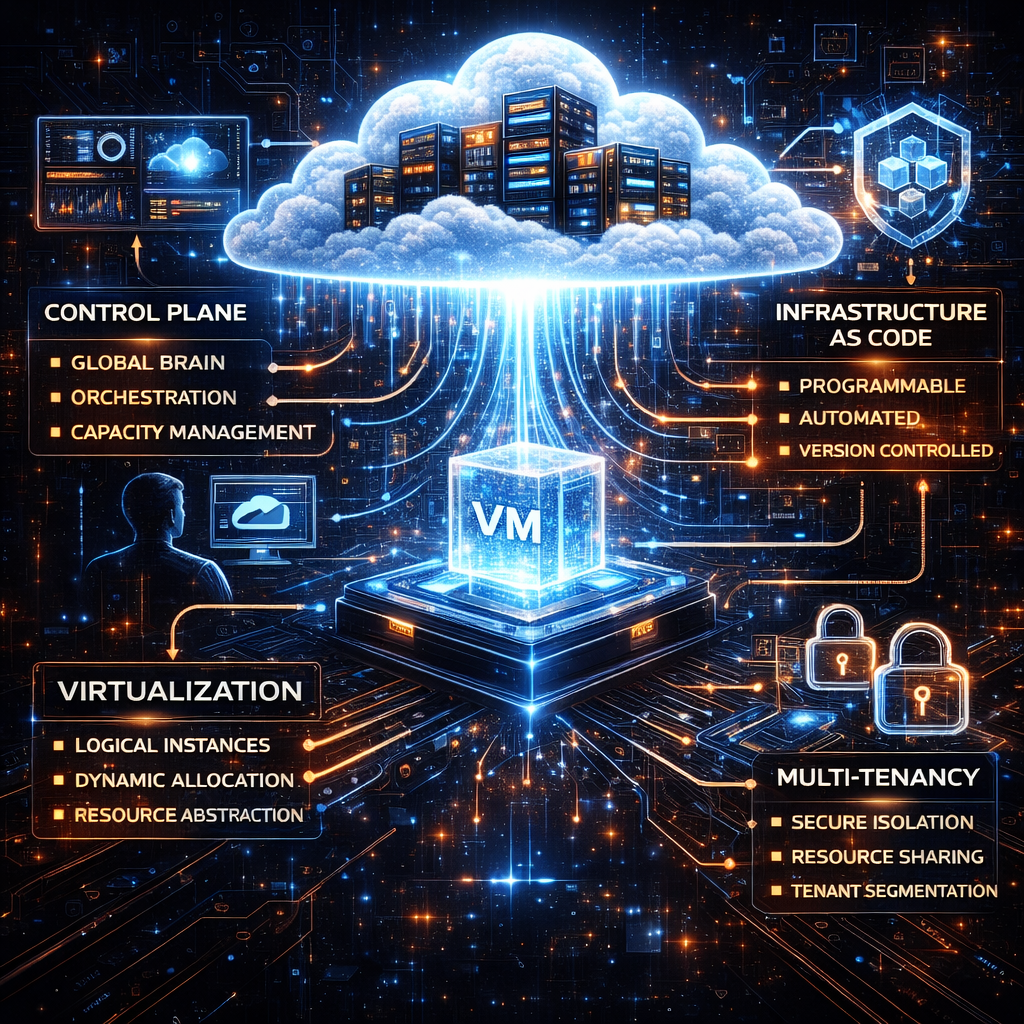
Imagine pressing a button. Not a loud button. Not a red emergency switch. Just a small blue one in a web interface. “Launch VM.”Somewhere in the world, no server starts humming, no light turns on, no technician walks into a data center. Instead, something invisible begins to move. A signal. An intention. A request for computing power.The cloud does not start with machines. It starts with a desired state.In the old world, IT was physical. You could point at servers. You could follow cables. You could walk into a room and see where your applications lived. Your system had a location.In the cloud, your system is no longer a place. It is a state inside a global coordination system. And that system is the true core of the cloud.When you start a virtual machine today, you do not say “turn on that server.” You describe what you want to exist: four CPUs, sixteen gigabytes of memory, located in Frankfurt, reachable via HTTPS, protected by these rules.That description flows into the heart of the cloud: the control plane.
The control plane is not a server and not a building. It is a distributed nervous system. A global brain that constantly knows where capacity is free, where storage exists, which networks are available and which rules apply.It behaves like an air traffic control system for computing. Millions of requests fly through it at every moment. Each one with requirements, constraints and intentions. The control plane evaluates identity, security, availability and policy, then decides where this workload will land.Only then does a physical machine somewhere begin hosting your system. Not by installing, not by configuring, but by instantiating. Like starting a process in an operating system.Your machine exists first as an entry in a database, not as hardware. It is planned before it is born.That is modern virtualization. Not many computers on one computer, but the separation of existence from location. Your application exists without being tied to a specific place. It can move, replicate, disappear and reappear without you noticing.While it runs, it is watched. Constantly. CPU usage, memory, response times, errors, network traffic. Everything is measured. Everything is evaluated.When load increases, the system reacts like a living organism under stress. New instances appear. Traffic is redistributed. The system expands without explicit human action.When load drops, the system contracts. Resources vanish. Instances are terminated. Not paused. Not archived. Terminated. The cloud keeps nothing it does not need.
That is elasticity. Not as a feature, but as a mode of existence.Networking is also no longer physical. It is conceptual. Subnets are definitions. Firewalls are policies. Routes are algorithms. Packets travel not through cables but through decisions.Failures are no longer exceptions. They are expected. Machines are allowed to die. Processes are designed to vanish. Nothing is built to last. Everything is built to be replaced.Stability no longer comes from perfection. It comes from replaceability.And this leads to the deepest shift of all: control.In the past, humans controlled systems. Today, humans define rules, and systems control themselves. The administrator is no longer a mechanic but an architect of behavior.Infrastructure as Code is therefore not just a technique. It is a power structure. Whoever controls the code controls reality. That is the cloud. Not a collection of servers, but a living coordination system. A global operating system that pumps computing power through digital arteries. To where it is needed. For as long as it is needed.And that is why it changed everything.Not because it is faster. But because it thinks differently.