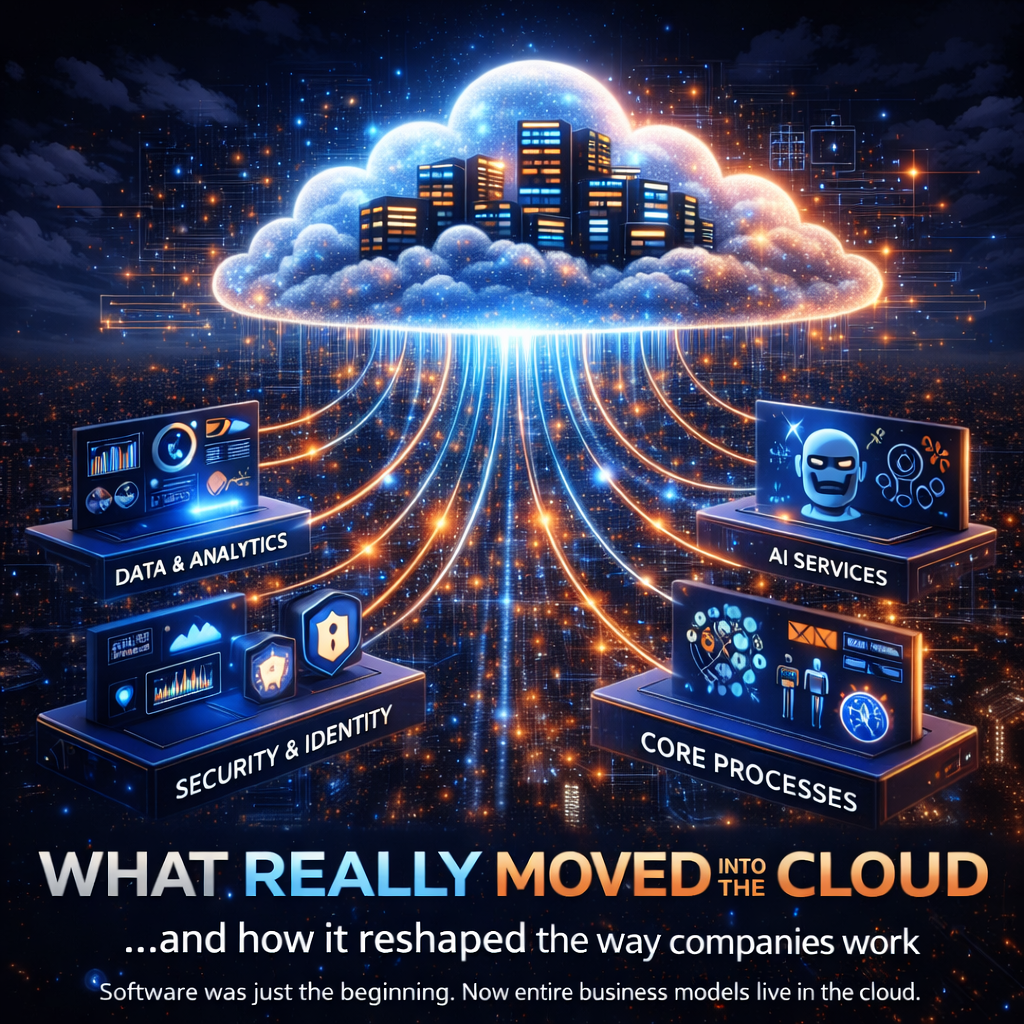
At first it was only a few tools. Then entire workflows. Today, entire business models. What companies moved to the cloud was never just software. It was responsibility. Control. And ultimately, a part of their operational identity.When the cloud first entered enterprises, it was not meant to replace everything. It was an addition. Companies moved what was easy. Email. Calendars. File sharing. Standardized functions with little strategic differentiation. No one built competitive advantage on running their own mail server. No one won markets with a better calendar system. So those things went first.The early cloud portfolio was small and pragmatic. Office 365. Salesforce. Dropbox. A handful of HR tools. A few collaboration platforms. The value proposition was simple. Less operation. Less complexity. Less responsibility. Companies bought functionality instead of infrastructure.
And that is where the first shift happened. The cloud was not introduced to enable innovation. It was introduced to remove burden. It was relief, not transformation.But relief has consequences. Suddenly software became instantly available. New tools could be tested within hours. Business units no longer waited for IT approvals. Marketing subscribed to its own platforms. HR introduced its own systems. Sales experimented with new CRMs. The cloud democratized software.
What used to be centrally planned became decentralized. This created speed, but also fragmentation. Shadow IT was no longer a violation. It became normal. Organizations realized they were no longer just users of software. They had become curators of an ecosystem.At the same time, the nature of applications changed. Traditional monolithic systems were difficult to move into dynamic environments. They were built for stability, not elasticity. So new architectures emerged. Microservices. Containers. Event-driven systems. Applications became smaller, more mobile, more replaceable. No longer one big system, but many small building blocks.That changed what was considered cloud-worthy. Not only standard tools, but core processes. Accounting. Logistics. Production. Customer data. Decision logic. Systems once considered too sensitive slowly moved outward.
“Five years ago, I would never have imagined running our core accounting externally,” says the IT director of a European industrial company. “Today I would be more concerned if it were still running in our own data center.”
The reason is not blind trust. It is comparison. Cloud providers invest billions into security, redundancy and resilience. Individual enterprises cannot match that. The question shifted from “Is it secure?” to “Is it more secure than we are?”At the same time, an entirely new class of cloud-native applications emerged. Tools that could not exist without cloud infrastructure. Global collaboration platforms. Real-time analytics. AI-based services. Systems whose value depends directly on scale.Today, enterprises use hundreds of cloud services across communication, development, sales, HR, marketing, finance, security, monitoring, data and AI. The boundary between core systems and auxiliary tools has blurred. Everything is integrated. Everything is connected. Everything is dependent.That changes power structures. In the past, IT controlled access to systems. Today, platforms control access to IT. Whoever controls APIs controls possibilities. Whoever defines platforms defines standards.
At the same time, autonomy increases. Teams choose their own tools. Innovation emerges at the edges, not in the center. This accelerates change, but complicates governance.
“We have more freedom than ever,” says a Head of Digital Transformation. “But we have to work much harder to maintain visibility.”And this is where the next phase begins. The cloud is no longer the answer. It is the assumption. The real challenge now is orchestration. Governance. Integration. Control without central control.What moved to the cloud was not only software. It was decision power. Speed. Risk. Responsibility. Companies did not migrate applications. They changed their operating system. And this operating system is not stable. It is dynamic. It forces organizations to constantly realign themselves. Processes become fluid. Structures become porous. Responsibility shifts.What used to be fixed is now negotiable.The cloud is therefore not the destination, but the environment. The space in which modern organizations operate. What they place inside it defines what they become.And perhaps that is the real transformation. The cloud did not change where software runs. It changed how organizations function.