
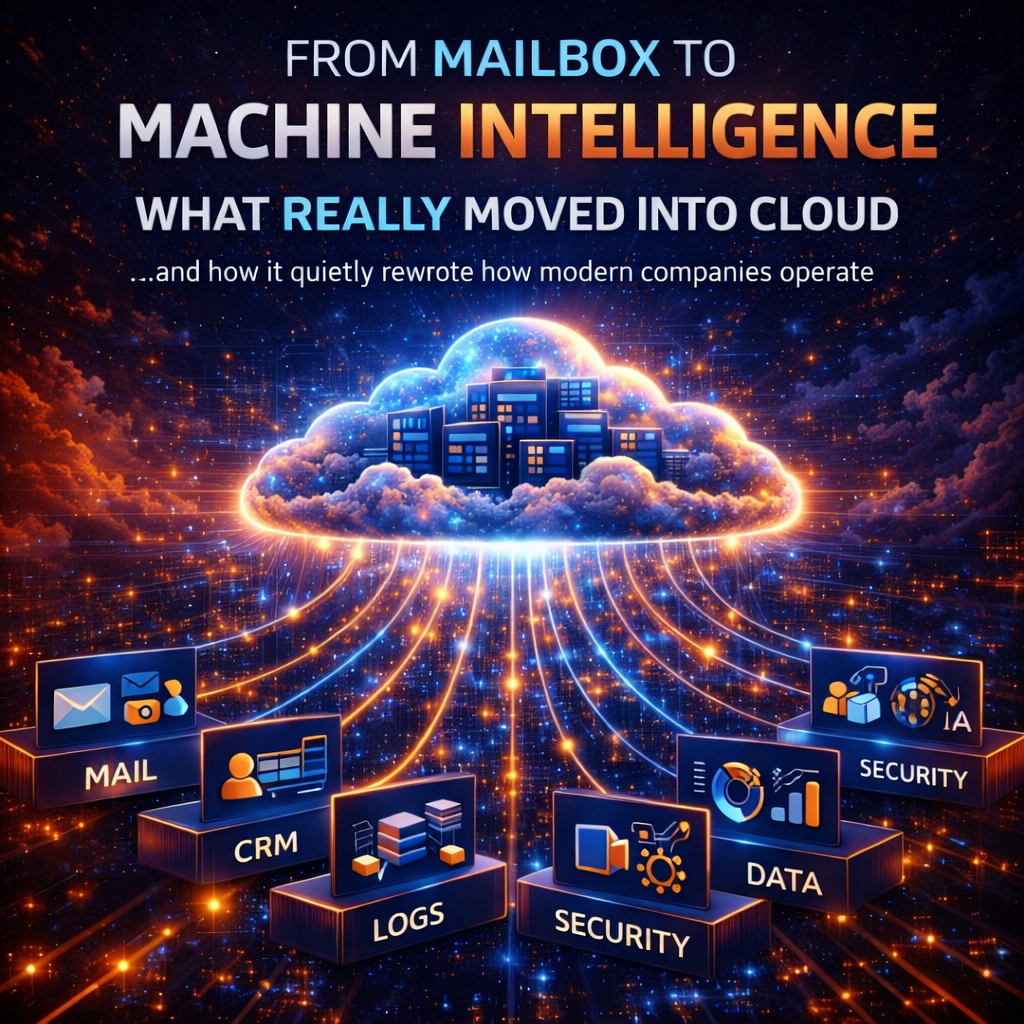
Today, when you look at a modern company, the cloud feels like a natural state. Everything is accessible, everything is connected, everything is available. CRM, accounting, security, reporting, analytics, AI models, identity management — everything lives somewhere “out there.” But this state did not appear suddenly. It did not arrive as a big transformation program or a strategic revolution. It grew slowly, step by step, almost unnoticed. And that is exactly what makes it so powerful. The cloud did not conquer enterprises. It absorbed them.It started with something very simple: relief. Companies did not move to the cloud because they wanted to innovate. They moved because they wanted to get rid of things that had become heavy. Running mail servers, managing calendars, maintaining file shares, handling VPNs, backups, patches and outages. In the early 2010s, the first things that moved to the cloud were the boring ones. Email. Calendars. File sharing. Collaboration tools. Office 365, Google Workspace, Dropbox, later Slack and similar platforms. No one competed on having a better mail server. No one created value by operating their own calendar infrastructure. So those things went first. The cloud felt like housekeeping, not transformation.
But this housekeeping changed behavior. Software became easy. New tools could be tested in hours, not months. Business units no longer had to wait for central IT. Marketing chose its own platforms. HR introduced its own systems. Sales experimented with new CRMs. The cloud became a playground. What started as relief turned into momentum. Between roughly 2015 and 2019, more central systems began to move. CRM, HR platforms, finance tools, customer support systems, parts of ERP. The cloud stopped being peripheral and became relevant.When we started Darkgate in 2019, this was already normal. Our own operations were cloud-based from day one. Our CRM lived in the cloud. Our communication, our collaboration, our monitoring and reporting tools. There was no “before” for us. The cloud was not a migration target. It was the default. And that alone says a lot about how perception had shifted. What once felt risky now felt safer. Not because companies became careless, but because comparison changed. Large cloud providers invested more in resilience, redundancy and security than most enterprises ever could. The question was no longer “Is this safe?” but “Is this safer than what we can do ourselves?”
Then the next shift began. Around 2020, the cloud stopped being just a place for processes and became a place for thinking. Data warehouses moved into the cloud. Business intelligence. Real-time analytics. Fraud detection. Risk scoring. Forecasting systems. Companies stopped just storing data and started using it. Not only looking backward, but predicting forward. Around 2022, this evolved into something deeper: machine intelligence as part of enterprise control. AI models entered demand planning, pricing, risk assessment, compliance, fraud prevention and operational optimization. The cloud stopped being infrastructure. It became a cognitive layer.At the same time, control itself moved. Identity management shifted to cloud platforms like Azure AD and Okta. Security monitoring, SIEM systems, compliance platforms and audit systems became cloud services. Enterprises started observing and governing themselves through cloud-based systems. Control was no longer local. It was continuous, distributed and algorithmic.And that is where the real transformation happened. What moved to the cloud were not applications. They were functions. First communication. Then coordination. Then transaction. Then analysis. Then decision. Then control. Step by step, the cloud became a parallel operating layer of the enterprise. A layer where processes are modeled, observed, optimized and steered.
For users, this did not feel dramatic. Each step felt logical. Each step felt like improvement. Faster. Simpler. More flexible. But together they created something new. An organization no longer built around systems, but around platforms. Around interfaces. Around services. Around data flows. Around rules.Today, in 2026, almost everything that defines a company runs in the cloud. Communication, development, sales, marketing, HR, finance, security, analytics, compliance, AI. Not because companies wanted everything in the cloud, but because each individual step made sense. Each migration solved a real problem. The cloud did not sell transformation. It sold convenience.
And that may be its greatest achievement. The cloud did not replace enterprises. It reshaped them. Quietly. Slowly. Relentlessly. From mailbox to machine intelligence. And in doing so, it did not only change where software runs, but how organizations think, decide and operate.That is why the cloud is no longer an IT topic. It is organizational architecture. It is power distribution. It is governance. It is culture.And by now, it is simply everyday life.