
Healthcare is not a market like any other. It is a system built on trust, responsibility, professional judgment and the ability to act under uncertainty. Medical decisions do not affect abstract objects but real people, their bodies, their biographies, their families and their futures. Every diagnosis, every therapy, every intervention carries ethical, legal and emotional weight that cannot be reduced to technology.
For this reason, the impact of artificial intelligence on healthcare is neither loud nor disruptive. It is quiet, gradual and structural. It does not change who decides, but how well decisions are prepared. It does not shift responsibility, but expands the horizon within which responsibility is exercised.Medicine is not a deterministic system. Symptoms are ambiguous, diseases overlap, data is incomplete, biased or delayed. Patients respond differently to the same therapies. Clinical work therefore consists less in applying fixed rules and more in navigating uncertainty. This is where artificial intelligence reveals its real value. Not as a decision-maker, but as a system for reducing uncertainty.
AI systems detect patterns in data volumes far beyond human cognitive limits. They analyze millions of findings, lab values, images, histories and reports. They identify correlations, deviations, trends and risk signals that are easily overlooked in daily clinical practice. They do not deliver truths, but signals. Not judgments, but context.This is most visible in diagnostics. In radiology, pathology, dermatology and ophthalmology, AI models analyze imaging data such as MRI, CT, X-ray and histological slides. They detect subtle changes in tissue structures, minimal shifts in density, texture or shape that may indicate early disease stages. Tumor developments become visible earlier, diabetic retinopathy is detected sooner, malignant skin changes are identified with higher sensitivity.
These systems do not replace physicians, they sharpen perception. They function as a second set of eyes, as a statistical memory, as an early warning system. They help surface rare patterns and prevent routine blindness. In high-pressure clinical environments dominated by time constraints and information overload, this is invaluable.Another central field is personalized medicine. Traditional medicine often relies on averages and standardized protocols. AI enables a finer differentiation by integrating genetic data, lifestyle factors, environmental conditions, medical history and therapy responses into individualized risk profiles. Not to make decisions, but to inform them. Therapy becomes less standardized and more contextual.AI is also increasingly present in surgery. Robotic-assisted surgery has existed for years, but the real progress lies in data integration. AI supports preoperative planning, analyzes anatomical particularities, simulates procedures and assesses risks. During operations it provides additional orientation through real-time image analysis and anomaly detection. The act of surgery remains human, but it becomes data-informed.
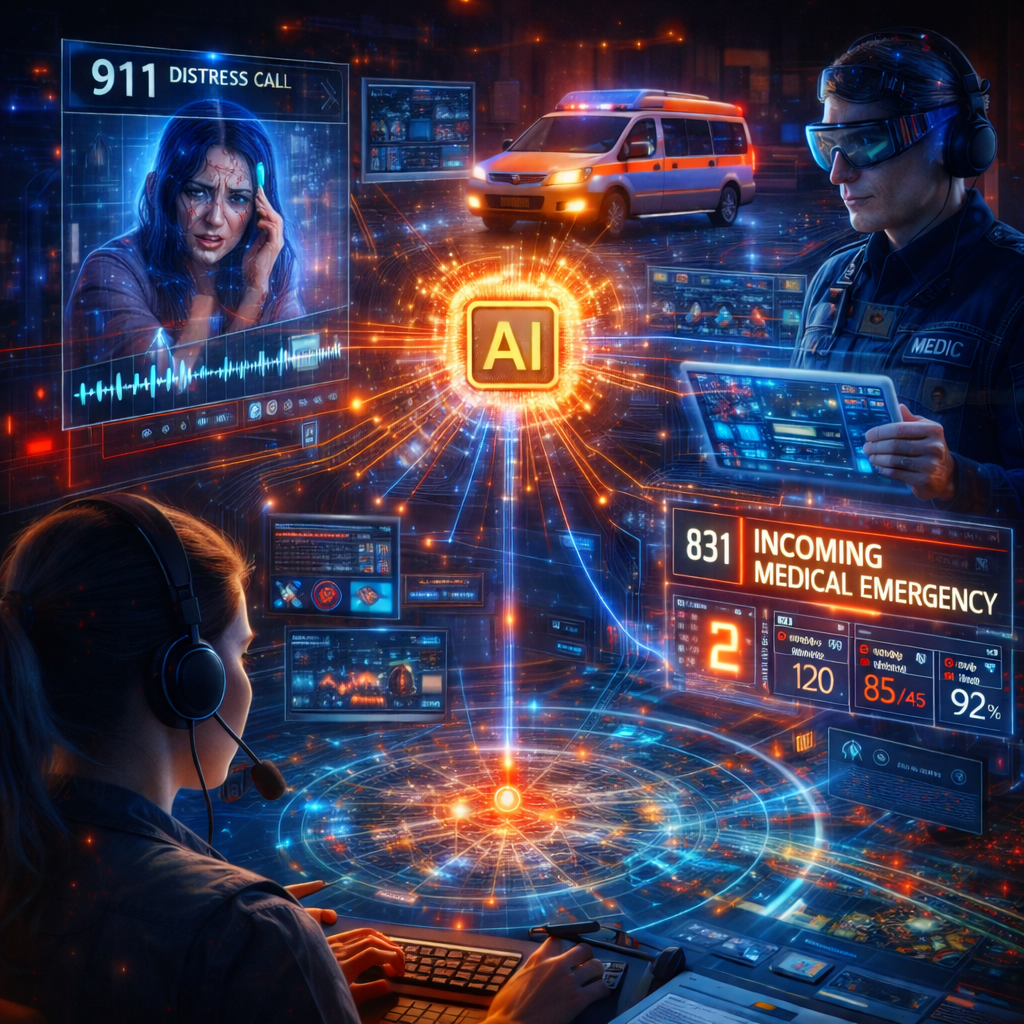
The structural value of AI becomes especially evident in emergency services. Emergency medicine operates under extreme time pressure, uncertainty and incomplete information. Decisions must be made before all data is available. Every minute matters. Here, AI can save lives not by acting, but by orienting.Support begins with the emergency call itself. AI-assisted systems analyze speech, tone, word choice and background noise. They detect stress, panic, respiratory distress or altered consciousness. They help dispatch centers assess urgency more quickly and precisely, support structured information gathering and reduce misinterpretation in extreme situations.
In this context, highly concrete systems are already being built. One of our direct contacts at a leading European IT integrator is working closely with their Chief Technology Officer and architecture teams on exactly such platforms for emergency services. These are not visions, but operational infrastructures. Systems that integrate emergency calls, mobile network data, medical information, navigation data and resource availability in real time.When a call comes in today, it is no longer just a conversation. The platform simultaneously analyzes speech patterns, identifies potential medical emergencies, locates the caller precisely using multiple data sources, factors in traffic conditions, weather, road closures and the current position of available response units. While the ambulance is on its way, a medical situation picture is already being built. Symptoms are structured, vital signs can be integrated via wearables or connected devices, risk profiles are generated. The emergency physician is prepared before seeing the patient.
At the same time, AI supports navigation itself. Not just as standard routing like Google Maps, but as a context-sensitive guidance system for emergency response. It considers which access routes are suitable for emergency vehicles, where crowds are located, which streets may be blocked and which hospitals currently have capacity. The response becomes not only faster, but situationally smarter.For responders on site, the system provides additional orientation. Known preconditions, allergies and medication plans are displayed when available. No therapies are proposed, but risks are highlighted. Dangerous combinations, rare but critical constellations and interaction risks become visible. The human decides, but with better information.After the incident, the system continues to learn. It analyzes outcomes, compares predictions with reality and identifies systemic weaknesses such as delays, bottlenecks or communication failures. Emergency medicine becomes not only reactive, but learning.Across healthcare, this shifts the system from reactive to anticipatory. From symptom treatment to risk recognition. From isolated decisions to systemic learning.
One thing remains constant. AI is not a subject, not an actor, not a responsible agent. It is infrastructure. A cognitive infrastructure that expands perception, absorbs complexity and reduces uncertainty. It does not make healthcare more autonomous, but more aware. Not faster at any cost, but more stable. Not freer, but more resilient.Healthcare is not being dehumanized, but relieved. Physicians spend less time searching, documenting and filtering, and more time with patients. Nurses are freed from administrative burden. Dispatch centers become more precise. Resources are used more effectively.
The transformation is therefore not technological, but structural. Healthcare is evolving from a delivery system into a learning system. A system that does not only react, but anticipates. Not only treats, but understands. Not only stores, but reflects.Artificial intelligence is not an external force, but a new nervous system. Not a replacement for human judgment, but its extension. It does not change the core of medicine, but its reach.And that is why its impact is so profound. Not because it is loud, but because it quietly carries complexity where it has become too heavy for human systems alone.