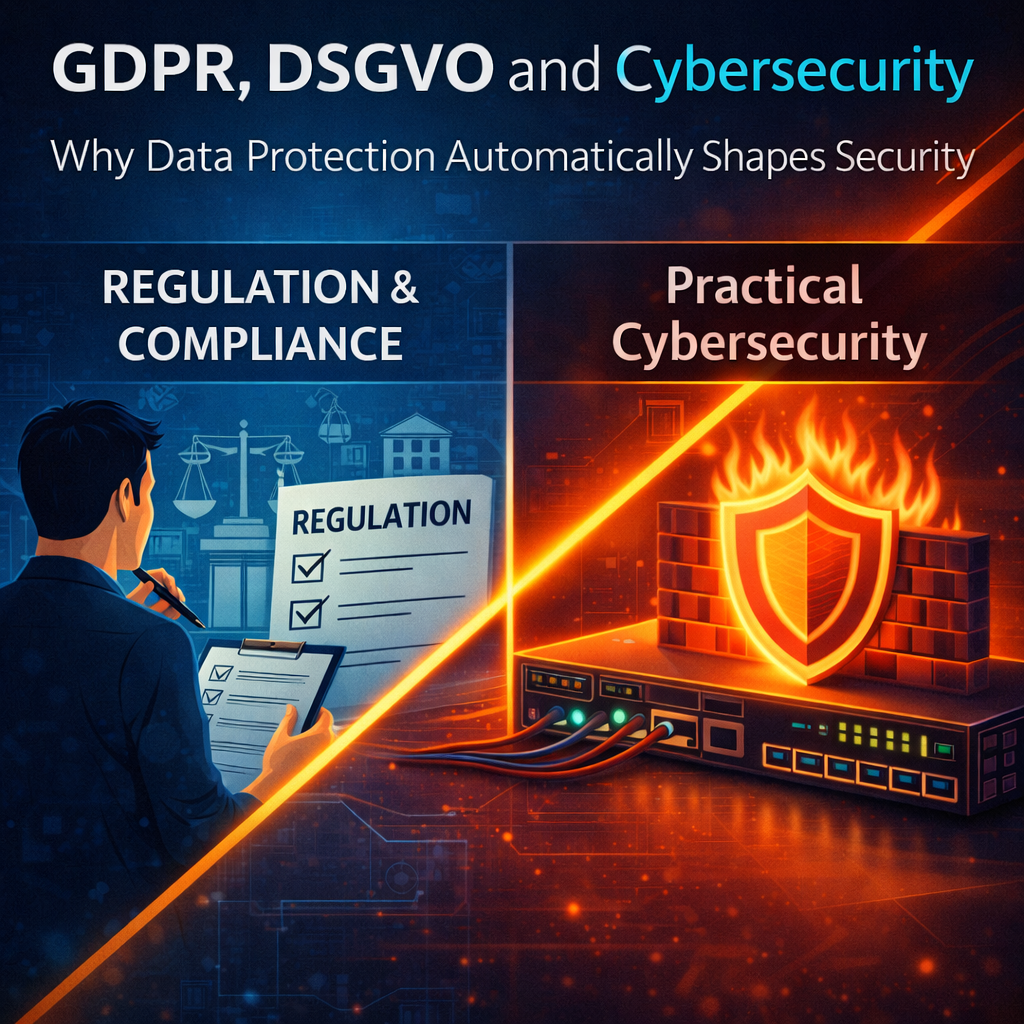
Data protection and cybersecurity are still treated in many organizations as two separate disciplines. On one side are lawyers, data protection officers and compliance teams talking about consent forms, records of processing activities and retention periods. On the other side are IT departments focusing on firewalls, patch management, network segmentation and the defense against cyberattacks. In reality, however, these two worlds have long been inseparable. Data protection influences security, and security is the fundamental prerequisite for meaningful data protection.
This intersection is exactly where we operate as the creators of DarkGate, a high-quality online magazine for technology, SaaS and cybersecurity. At the same time, we run one of the most renowned high-level recruiting agencies in the European IT and security market. While most companies only see their own internal perspective, our daily work gives us a genuine bird’s-eye view. We speak constantly with CISOs, IT managers, data protection experts, system integrators and technology vendors. Through these conversations, we experience very concretely how GDPR and cybersecurity interact in real corporate environments, far beyond theoretical frameworks or formal checklists.
At its core, the GDPR, known in German-speaking countries as DSGVO, is a legal framework designed to protect personal data. It regulates how organizations may collect, store, process and delete data and what rights individuals have in relation to companies. Yet hidden within the regulation is a central idea that is often overlooked: data can only be protected if the systems in which it is processed are technically secure. That is why Article 32 of the GDPR explicitly refers to appropriate technical and organizational measures. Translated into everyday practice, this means that a company can define the most sophisticated privacy processes imaginable, but if servers are poorly secured, passwords are weak or access rights are managed chaotically, any data protection strategy ultimately becomes meaningless. Data protection without cybersecurity is little more than paperwork.
In daily operations, this connection becomes visible at countless touchpoints. When personal data must be protected from loss or unauthorized access, this is nothing other than classic IT security. When the GDPR requires data breaches to be reported within 72 hours, incident response suddenly becomes a legal obligation. When organizations have to define who may access which information, identity and access management turns into a core data protection instrument. And when external service providers are involved through data processing agreements, their level of security often determines whether an entire privacy concept succeeds or fails. The GDPR formulates legal requirements, but their implementation almost always takes place on a technical level.
Many organizations ask themselves whether the link between GDPR and cybersecurity is primarily about formal compliance or about real technical security. The honest answer is that it is both at the same time. The GDPR is a legal framework, while cybersecurity is a technical discipline. In the practical reality of companies, these two layers constantly meet. A perfectly maintained processing record does not protect any data, but a flawlessly configured firewall alone does not create GDPR compliance either. Businesses need legal structures, clear processes and robust technical measures. Only the combination of all three creates genuine protection.
This interdependence becomes particularly obvious when real incidents occur. A lost laptop only avoids becoming a data protection disaster if it was properly encrypted. A successful phishing attack can turn into a reportable data breach within minutes. The introduction of a new cloud system suddenly requires not only technical integration but also data protection impact assessments and security concepts. What used to be separate areas are now merging more and more into a single discipline of digital resilience.
And this is no longer relevant only for large corporations. The GDPR applies to almost every organization that processes personal data, which in practice means nearly everyone. Cybersecurity was once considered a topic for big companies with dedicated IT departments. Today, however, even small and medium-sized businesses are highly digitalized, use cloud services, collaborate with external partners and process sensitive information every day. As a result, security becomes an immediate data protection requirement for them as well. The boundary between legal obligation and technical necessity is increasingly disappearing.
Of course, many companies perceive this development as a burden. In economically challenging times, additional compliance requirements can easily feel like bureaucratic obstacles. From a purely entrepreneurial perspective, this sentiment is understandable. At the same time, it is important to remember why these rules exist in the first place. Without data protection there is no trust, without security there is no data protection, and without trust there is no functioning digital economy. From this perspective, GDPR and cybersecurity are not enemies of economic development but rather its foundation.
The pressure to deal with these topics now comes from many directions at once. Legislators demand formal compliance, customers expect secure systems, business partners require proof, insurers define minimum standards and cyber attackers demonstrate every day how vulnerable digital infrastructures can be. The result is an environment in which data protection and cybersecurity together form the framework of modern business models. Organizations can hardly escape this reality anymore.
Through our daily work, we see how differently companies handle this challenge. An international corporation views data protection and security in a completely different way than a medium-sized manufacturing business. An IT integrator thinks in terms of technical architectures, while a data protection officer is shaped more by legal considerations. As the operators of DarkGate and as specialized recruiters, we have the privilege of connecting all these perspectives. We see which approaches work, where problems arise and how organizations try in practice to find the right balance between legal certainty, technical feasibility and economic reason.
The direction of the coming years is relatively easy to predict. Data protection and cybersecurity will continue to grow closer together. With new European regulations such as NIS2, this trend will accelerate even further. Companies will soon hardly be able to distinguish between classic privacy projects and pure security initiatives. Both will become part of an overarching strategy for digital stability and resilience.
In the end, one simple but crucial insight remains: anyone who takes data protection seriously must take cybersecurity seriously. And anyone who implements cybersecurity professionally will automatically fulfill a large part of their data protection obligations. This mutual influence is what makes the topic so central for modern organizations, and it is exactly why it remains one of the core themes of DarkGate. We understand the technology, we understand the regulation and, above all, we understand the market. This combination allows us not only to observe developments but to interpret and accompany them actively.
Darkgate is an independent magazine.
Our content is free and will always remain editorially independent.
If this article helped you, consider supporting our work with a small contribution.