
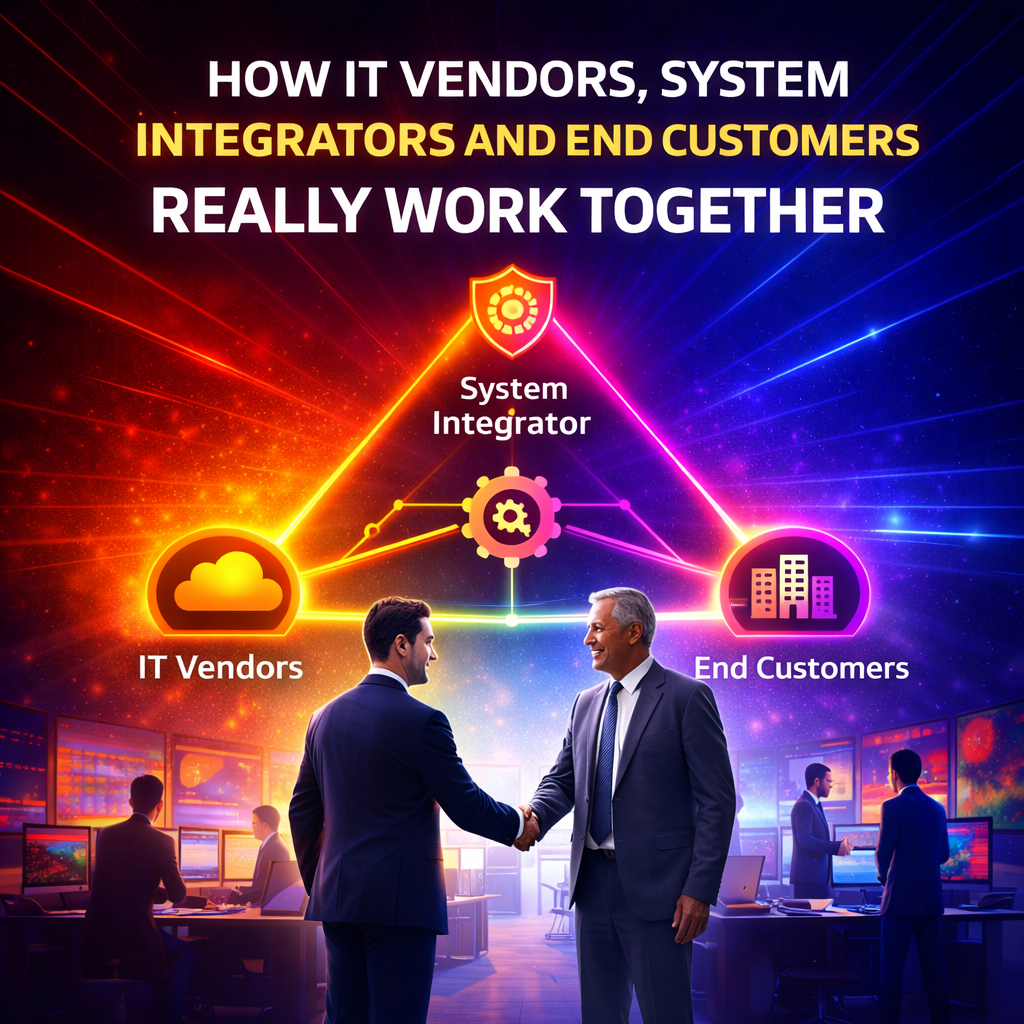
When you look at modern IT landscapes in large enterprises and advanced mid sized companies today, it quickly becomes clear that these environments are no longer built from isolated products. Networks, security platforms, cloud infrastructures, collaboration tools, identity systems, monitoring solutions, backup architectures, OT connections and increasingly AI driven components all interact like gears in a machine. What appears from the outside as a coherent IT environment is in reality the result of a carefully orchestrated collaboration between three key players in the industry: the IT vendor, the end customer and, in between them, the IT system integrator.
In another category at Darkgate, we already explored this ecosystem from the perspective of vendors and integrators. Here, in the Business and Careers section, we want to take this understanding further and focus specifically on the central role system integrators play in 2025 and 2026. Because this is where not only highly complex technical projects emerge, but also some of the most exciting career paths in the entire IT industry.On paper, the relationship seems straightforward. Vendors develop products and platforms. End customers use these technologies to digitalize, secure and scale their operations. In between stands the system integrator. In practice, however, this role is far more than a simple intermediary function. The system integrator is translator, architect, implementer, advisor, project leader, problem solver and long term partner at the same time.
While vendors develop solutions from a global product perspective, the system integrator understands the reality inside the customer environment. They sit in meeting rooms with IT managers and department heads. They walk through server rooms. They speak with security teams about real incidents. They analyze existing networks. They identify bottlenecks. They capture requirements and translate them into technical architectures that can realistically be implemented using vendor technologies.This is where the real value creation begins. The integrator does not only know what a product can do, but how it fits into an existing and often historically grown IT landscape. Planning, designing and conceptualizing solutions happens based on real constraints, not theoretical scenarios. This phase often takes place directly on site at the customer. Personal workshops, requirement assessments and architecture discussions are essential parts of the process. It is not about choosing products. It is about designing functional solutions.
In the next step, this architecture is further developed within the system integrator’s organization. Technical specialists, architects and consultants refine designs, create integration plans, test configurations in lab environments and prepare for implementation. Then follows the integration phase, which can take place remotely or directly at the customer location. Networks are redesigned, security appliances implemented, cloud connections established, identity structures rebuilt, monitoring pipelines configured and systems connected that were never originally designed to work together.But this is not where the system integrator’s role ends. In fact, this is often where the longest part of the relationship begins. Many system integrators offer maintenance contracts, managed services, SOC services, monitoring, patch management, backup supervision and continuous optimization. The integrator remains permanently involved. They know the infrastructure. They understand the history of decisions. They become an extended IT department for the customer.
In recent years, however, a term has increasingly appeared that challenges this structure. Disintermediation. This refers to the trend where end customers try to buy directly from IT vendors without involving system integrators, assuming this will reduce costs or create a more direct relationship with the manufacturer. Many account managers report that especially larger enterprises attempt to pursue this direct model.
At first glance, this approach seems logical. In reality, its limitations quickly become visible. Vendors build products, but they do not integrate complex customer environments. They do not conduct on site assessments. They do not take responsibility for local project execution. They do not operate long term service models tailored to individual infrastructures. This is exactly why many vendors still strongly prefer working with system integrators. They know that their technologies only unfold their full potential through these partners.
For vendors, system integrators are multipliers. For customers, they are trusted advisors. For both sides, they act as bridges. They provide regional presence, personal interaction and operational understanding that are essential in complex IT projects.This proximity to the customer is what makes working in the system integrator environment so unique. Consultants, architects, service account managers and technical specialists experience projects from the inside, not from a distance. They see how decisions are made. They see how architectures evolve. They see how IT landscapes develop over years. They are not only advisors. They are contributors.
For many IT professionals, this is the decisive career factor. They work with the latest vendor technologies while having direct customer access and taking responsibility for real environments. They operate at the intersection of strategy, architecture and operational implementation. This combination is rarely found in such intensity either at a vendor or at an end customer.
From our daily work at Darkgate, we see how strongly this role is valued in the market. Account managers working for leading system integrators describe strategic discussions with CIOs and IT directors. Architects talk about projects where they redesign entire network or security landscapes. Consultants explain how they manage long term service contracts where they carry responsibility for critical systems over many years.These insights show clearly why system integrators occupy a key position in 2025 and 2026. They are the operational interface between innovation and application. They bring vendor technology into real business processes. They accompany companies not only during implementation, but throughout the lifecycle of their IT environments.
Despite the trend of disintermediation, there remains significant space and demand for system integrators. Many vendors deliberately invest in strong partner ecosystems. Many customers recognize that sustainable IT transformation does not result from purchasing products alone, but from thoughtful integration, planning and ongoing support.This is exactly where the most exciting projects and the most interesting careers emerge. Anyone who wants to understand how modern IT truly works will not find the answer only at the vendor and not only at the end customer, but right in the middle of this triangle. With the system integrator.