What makes modern financial fraud so dangerous is no longer just the technical side of the attack. It is the ability to imitate trust so convincingly that even cautious, digitally experienced users begin to act against their own instincts. That is exactly what makes the latest scam patterns surrounding Trade Republic so effective. This is not the old style of phishing with broken language, suspicious links, and obvious red flags. This is a far more refined operation that combines SMS spoofing, voice-based social engineering, platform impersonation, and carefully structured psychological manipulation into a fraud scenario that feels less like an attack and more like a legitimate security process. That is precisely why it works.
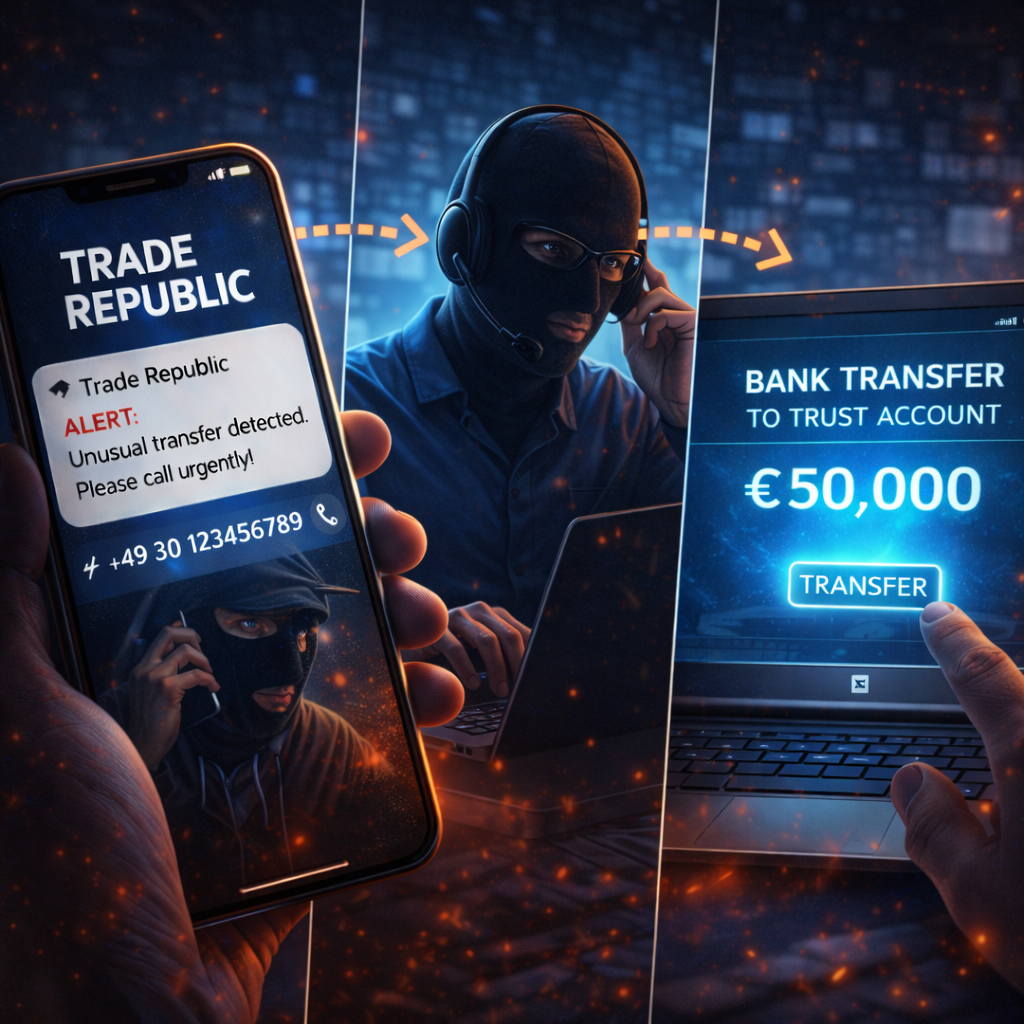
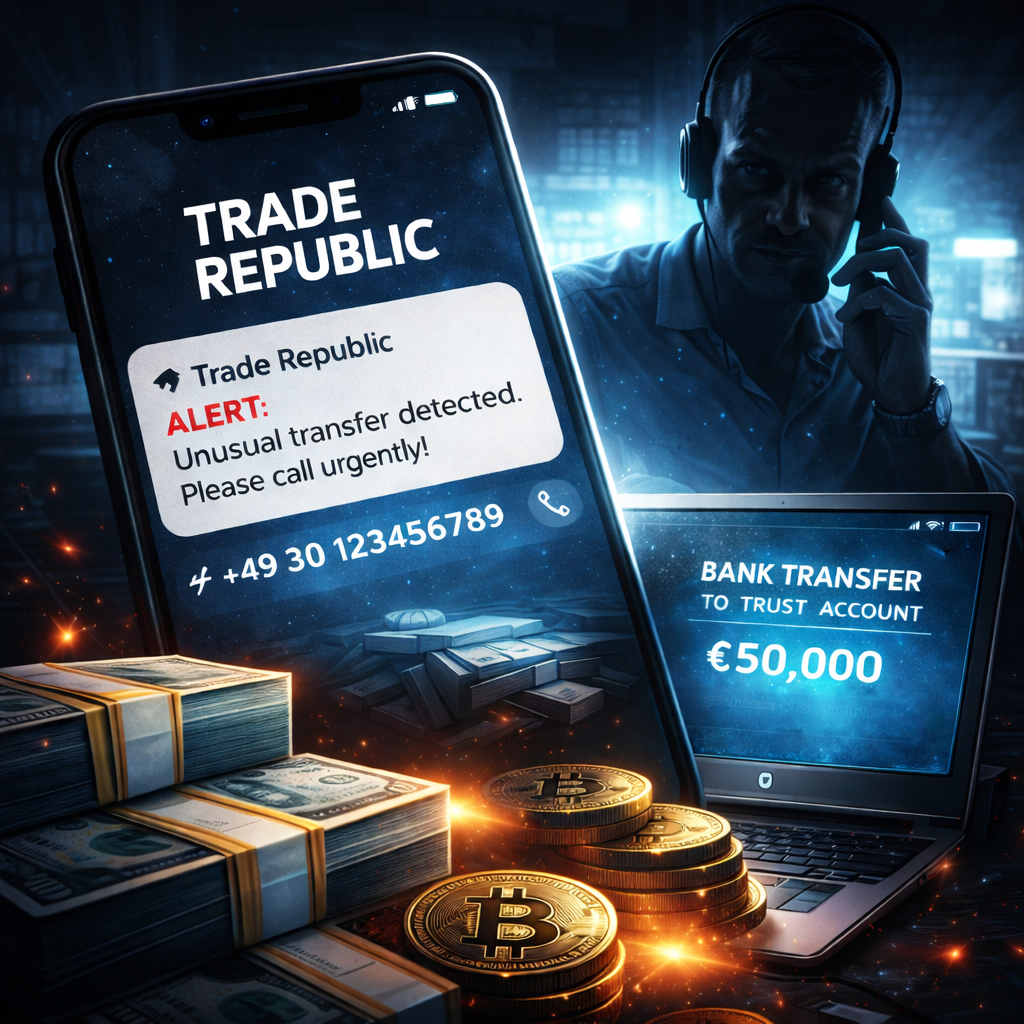
The attack often begins with a text message that appears to come directly from Trade Republic. The message may warn of an attempted transfer, suspicious account activity, or a payment that has allegedly been detected and blocked. What turns this into a high-conviction fraud setup is the fact that the SMS can appear in the exact same message thread as genuine Trade Republic notifications. For the victim, that changes everything. The moment a fraudulent message is placed inside an existing trusted communication history, the normal defensive reflex is weakened. People do not feel like they are being approached by a stranger. They feel like they are continuing an ongoing conversation with a company they already know. In technical terms, this is often driven by sender ID spoofing or SMS channel abuse, but the victim does not experience it as infrastructure manipulation. The victim experiences it as proof of authenticity.
Once the person reacts, the second stage begins. In many of these cases, the SMS includes a phone number and urges the user to call immediately. On the other end is not chaos, but structure. A recorded greeting may welcome the caller in the name of Trade Republic. The caller is then passed to supposed employees or security agents who speak calmly, professionally, and with enough operational language to sound believable. This is where the fraud shifts from simple smishing into full-scale voice phishing, often called vishing, but even that term is too small for what is happening here. These operations increasingly resemble organized fraud pipelines, where scripts, escalation logic, emotional framing, and sometimes even AI-supported voice workflows are combined to create a controlled narrative. The victim is not merely tricked. The victim is managed.
What follows is one of the most important elements of the scam. The fraudsters do not always claim that the money is already gone. In many cases, they say the opposite. They tell the victim that an attempted transfer was recognized and stopped in time, sometimes allegedly by an internal AI-driven security mechanism. This is a powerful psychological move because it creates relief before fear. It tells the victim that the platform is competent, that danger has been identified, and that there is still a chance to secure the funds. Only then comes the hook. The account, they explain, is no longer safe. To protect the balance, the user must now cooperate with the security team and transfer the assets into a newly created secure holding account, trust account, or protected temporary destination until the issue is resolved. At this point the fraud has fully inverted the logic of banking security. The victim believes they are preventing theft when, in reality, they are being guided into completing the theft themselves.
This model falls into a category known as Authorized Push Payment Fraud, often abbreviated as APP fraud. That term matters because it explains why these scams are so devastating. In APP fraud, the victim voluntarily authorizes the payment, even though that authorization was obtained through deception. From the system’s perspective, the transfer may look valid. It was initiated by the account holder, approved by the account holder, and sent using the normal pathway. That makes recovery more difficult and, in many cases, turns the emotional aftermath into something even worse. Victims often struggle not only with financial loss, but also with self-blame, because technically they were not hacked in the traditional sense. They were manipulated into becoming the final execution point of the attack.
The strength of this fraud lies in how many layers of trust it hijacks at once. First there is the trust created by the familiar SMS thread. Then there is the trust attached to brand language, support structures, and security terminology. After that comes urgency, but not the crude kind. This is not always the loud panic message that says act now or lose everything. It is often a calmer and more sophisticated urgency, the kind that sounds administrative, procedural, and therefore more credible. Then comes the illusion of control. The victim does not feel passive. They feel involved in an active security response. That sense of participation is incredibly dangerous because it suppresses suspicion. People tend to question less when they believe they are part of a coordinated solution.
The role of AI in this space should be described carefully. It is easy to exaggerate it, but it should not be underestimated either. Not every voice in these scams is AI-generated and not every fraud ring is using advanced real-time voice cloning. But AI does not need to be magical to be effective. It can assist in building cleaner scripts, optimizing conversation trees, generating realistic support language, and helping low-skilled operators sound far more convincing than they otherwise would. In some cases it may be used for synthetic greetings, accent smoothing, or dynamic response suggestions during calls. The real danger is not a science fiction AI takeover. The real danger is that AI lowers the operational threshold for professional-looking fraud.
Trade Republic is not unique in being used as a lure. The broader pattern applies to banks, fintech platforms, broker apps, payment providers, and digital wallets across the market. Any platform with a recognizable brand, fast-moving financial flows, and app-based communication is an attractive target. What matters for attackers is not only where money sits, but where users are conditioned to act quickly and trust digital prompts. That is why fintech-focused scams are becoming so effective. Users are already accustomed to push notifications, fraud alerts, confirmations, identity checks, and app-driven security steps. Fraudsters are simply borrowing the language of legitimate financial UX and turning it into a weapon.
From a Darkgate perspective, this shift is not theoretical. The operators behind Darkgate are deeply embedded in the cybersecurity hiring landscape through one of the most established Cybersecurity Recruiting agencies with strong exposure to financial services, fintech environments, and banking infrastructures. In direct exchange with clients across these sectors, it has become increasingly clear that the demand is evolving. Organizations are no longer focusing exclusively on traditional Fraud Analysts or Fraud Specialists who strengthen systems and detection mechanisms. Instead, there is a growing demand for Human Risk Specialists, professionals who specifically understand the behavioral layer of attacks and how individuals become the primary entry point in otherwise secure environments. The reasoning is straightforward. As systems become more hardened, standardized, and resilient, attackers shift their focus toward the human layer where decision-making, trust, and perception can still be influenced.
This development is directly reflected in hiring strategies. Financial institutions and digital platforms are actively expanding their fraud defense capabilities to include roles that sit at the intersection of psychology, communication, and security. These Human Risk profiles are designed to analyze how fraud narratives are constructed, how trust is built under pressure, and how users can be guided or misled in real-time interactions. It is no longer enough to detect anomalous transactions after they occur. The goal is to understand and interrupt the behavioral sequence that leads to those transactions in the first place. This marks a fundamental shift in cybersecurity, where the protection of assets is no longer only a technical challenge, but increasingly a human-centric one.
The defensive lesson is brutally simple. No legitimate provider will ever tell you to move your own money to a so-called safe account in order to protect it from compromise. That concept should be treated as a hard stop. The moment someone instructs you to transfer assets to a new account for security reasons, the conversation should be considered hostile. It does not matter how professional the caller sounds, whether the number appeared in a familiar message thread, or whether the explanation contains technical language. A real platform does not secure customer funds by asking the customer to perform a rescue transfer under guidance from a phone agent. That is the scam.
The correct response in such a situation is to stop interacting through the channel that contacted you. Do not call numbers contained in text messages. Do not trust caller ID alone. Do not continue a conversation simply because it feels operationally coherent. Instead, exit the flow completely and verify the situation independently through the official app or the official website you access manually yourself. If necessary, wait, pause, and speak to someone else before taking action. One of the simplest but most effective defenses against social engineering is interruption. Fraud depends on momentum. The longer the victim stays inside the attacker’s narrative, the more likely the attacker is to win. Breaking that narrative even for five minutes can be enough to expose the absurdity of the request.
What this kind of Trade Republic fraud really shows is that the frontline of cybersecurity has moved. In many cases, attackers no longer need to defeat hardened infrastructure directly. They can get better returns by attacking trust, timing, and user perception instead. That is the uncomfortable truth behind the current wave of financially themed impersonation fraud. The system may be technically secure, the app may be legitimate, and the login may remain uncompromised, yet the user can still lose everything because the attack happens in the space between authenticity and performance. The fraudster does not need to break into the platform if he can successfully perform the platform well enough to make the victim act.
That is why this scam deserves attention far beyond one brand name or one isolated story. It reflects a broader transformation in cyber-enabled fraud, where the most effective attacks are no longer the most technically complex, but the most psychologically elegant. They imitate process, not chaos. They present themselves as help, not threat. They borrow the language of protection in order to deliver loss. And that is exactly why the next phase of digital defense will not be won by technology alone. It will also depend on whether users understand one uncomfortable but critical rule: the moment a security process asks you to move your money somewhere else, you are no longer inside a protective system. You are inside the attack.