
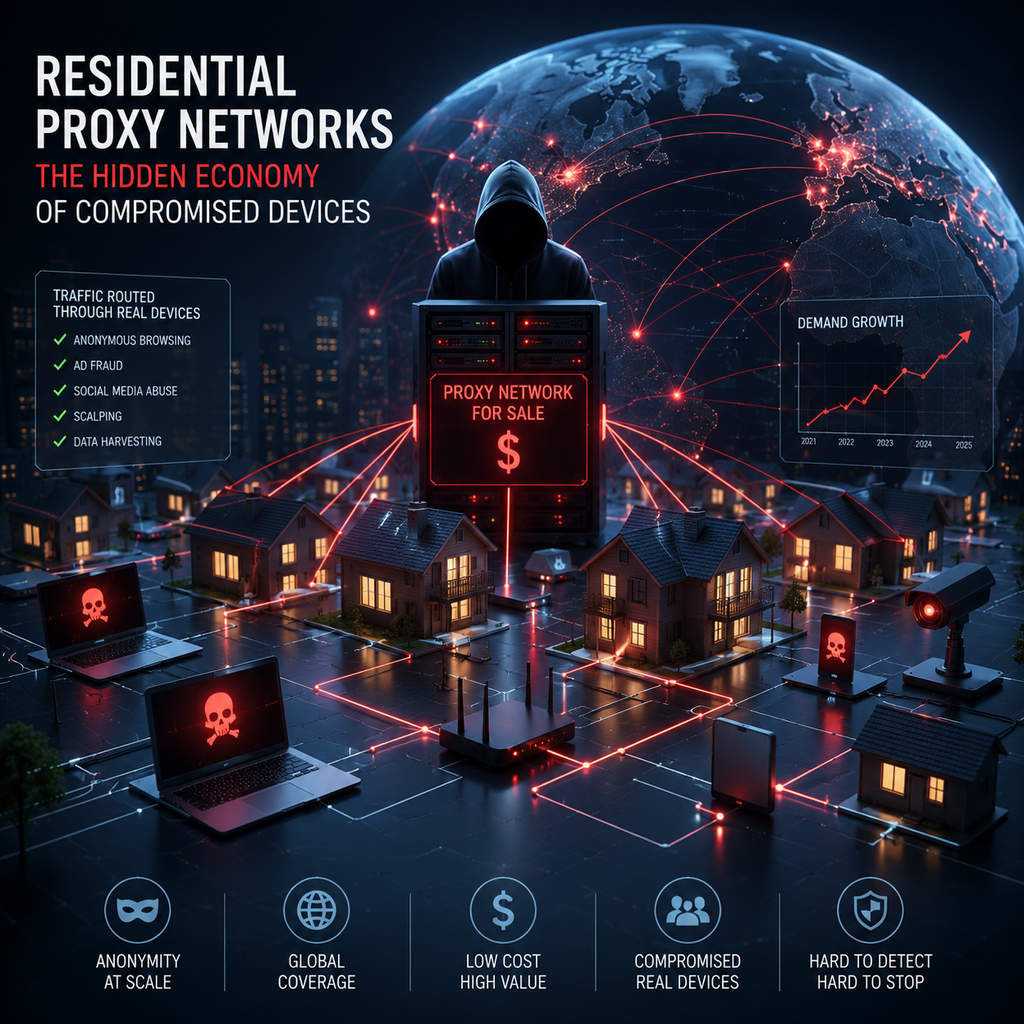
Residential proxy networks have long been considered a niche topic within the cybersecurity landscape. Legitimate providers enable organizations to conduct geographically distributed application testing, market research, or access publicly available data from different regions. Alongside this legitimate market, however, a parallel ecosystem has steadily emerged in which compromised endpoints themselves have become a valuable commodity. Recent threat intelligence research suggests that cybercriminals are increasingly operating sophisticated business models where infected computers, smartphones, and IoT devices are no longer used solely for data theft or ransomware attacks, but instead serve as long-term infrastructure that can be continuously monetized.
The economic rationale is straightforward. Residential IP addresses typically appear far more trustworthy than traffic originating from data centers or cloud providers. By connecting thousands of compromised consumer devices into a residential proxy network, attackers create an infrastructure capable of anonymizing internet traffic, disguising automated activities, bypassing geographic restrictions, and supporting a wide range of cyber operations. Rather than relying on one-time attacks, these networks generate ongoing value by treating compromised devices as reusable infrastructure.
From a technical perspective, many of these operations no longer depend on highly sophisticated exploits. Instead, they increasingly rely on social engineering, trojanized software installers, lookalike domains, search engine manipulation, and other techniques that exploit user trust rather than software vulnerabilities alone. The malware itself often remains intentionally discreet. Unlike traditional malware designed to steal credentials or encrypt files, modern proxy components frequently prioritize persistence, allowing compromised devices to remain operational for extended periods without attracting attention.
For enterprise security teams, this development changes the overall risk landscape. From a CISO’s perspective, protecting sensitive corporate information is no longer the only objective. Organizations must also consider whether their endpoints could unknowingly become part of a criminal infrastructure. This complicates incident response, digital forensics, and attribution while simultaneously creating potential compliance challenges and reputational risks if corporate assets are abused to facilitate malicious activity.
The technical response is evolving accordingly. Endpoint protection remains an essential layer of defense, but many security architects argue that it is no longer sufficient on its own. Modern detection strategies increasingly combine Endpoint Detection and Response (EDR), Extended Detection and Response (XDR), DNS security, threat intelligence, network telemetry, and Zero Trust principles. Rather than focusing exclusively on identifying individual malware samples, security teams are placing greater emphasis on detecting abnormal communication patterns, persistent outbound connections, and behavioral anomalies across the broader enterprise environment.
For IT integrators and system houses, the market presents both opportunities and challenges. On one hand, demand for security consulting, detection engineering, and managed security services continues to increase. On the other hand, cybersecurity projects are becoming significantly more complex. Presales engagements often require more extensive workshops, architectural assessments, and strategic consulting before implementation begins. Customers increasingly expect integrated security strategies instead of isolated product deployments, requiring providers to invest additional time and expertise that does not always translate into proportionally higher margins.
Managed Security Services may benefit from this shift. Traditional infrastructure projects are often completed once deployment has finished, whereas modern detection capabilities require continuous monitoring, threat hunting, and incident response. As a result, Security Operations Centers (SOCs) and managed detection capabilities are becoming increasingly important components of enterprise cybersecurity strategies. At the same time, budget realities remain a significant consideration. Many organizations lack the financial resources or specialized personnel needed to build these capabilities internally, making outsourced security operations an increasingly attractive option, particularly for mid-sized enterprises.
From a CEO’s perspective, however, cybersecurity investments continue to present a familiar challenge: demonstrating measurable business value before an incident occurs. Security initiatives often deliver their greatest return through prevented attacks rather than immediately visible outcomes. In uncertain economic conditions, this makes investment decisions more difficult. Industry analysts therefore observe growing interest in integrated security platforms capable of consolidating multiple capabilities within a single ecosystem. Vendors actively promote this platform approach, while some organizations remain cautious about increasing long-term vendor dependency and potential lock-in effects.
The workforce implications are equally significant. Although implementation specialists remain essential, organizations are placing greater emphasis on recruiting and developing security architects, detection engineers, threat analysts, and incident response professionals. Many enterprises are prioritizing the upskilling of existing technical teams over aggressive external hiring. Whether internal reskilling alone will satisfy growing demand for advanced cybersecurity expertise remains an open question.
Regional differences also continue to shape adoption. Markets such as the United Kingdom and the Netherlands generally demonstrate higher maturity in Managed Security Services than many organizations across the DACH region, where project-based engagements still dominate parts of the market. Nevertheless, regulatory requirements, cyber resilience initiatives, and evolving compliance frameworks are steadily pushing cybersecurity discussions beyond technical departments and into executive leadership.
For smaller and mid-sized IT service providers, the outlook is nuanced. Specialized cybersecurity services create new business opportunities, but they also require sustained investment in certifications, staff development, Security Operations capabilities, and advanced technical expertise. Not every organization will be able to absorb these investments equally. As a result, industry observers suggest that further specialization, strategic partnerships, and market consolidation among IT integrators may continue over the coming years.
Residential proxy networks therefore represent more than another malware trend. They illustrate how cybercrime is increasingly adopting sustainable business models in which long-term infrastructure often becomes more valuable than individual attacks. For enterprises, this reinforces the need to view cybersecurity not as a collection of isolated technologies, but as a continuous business capability requiring coordinated investment across people, processes, and technology.





