Some developments in cybersecurity begin quietly. They don’t arrive with a dramatic product launch or a sudden industry shift. Instead, they take shape gradually, almost imperceptibly, until one day they define the direction of an entire market. The convergence of security signals identity, endpoint, and network belongs precisely to this category. It isn’t a new buzzword, not a short-lived hype, and certainly not a single product discipline. It is a paradigm shift that has been unfolding for years, and it is now becoming visible in a way that forces organizations to rethink their entire SOC strategy.
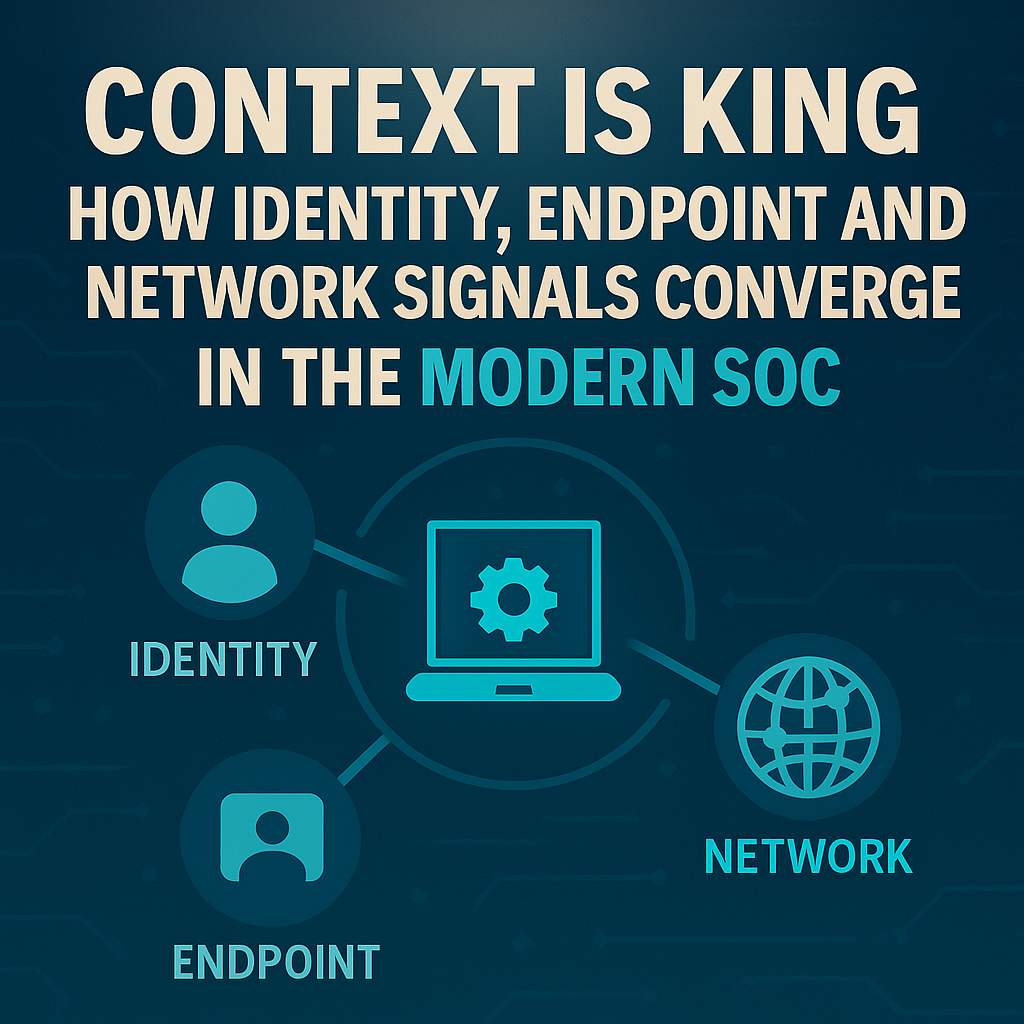
This topic is not merely academically interesting for Darkgate. The founders operate one of the most recognized IT recruiting agencies in the DACH region, working daily with leading system integrators, supporting roles that sit at the heart of this change: SOC analysts, security engineers, XDR specialists, identity architects. In every job briefing with these integrators, the pattern repeats. The SOC is evolving and its new currency is context. What makes this especially compelling is how seamlessly this development connects to all previous Darkgate articles. Whether discussing the evolution of SIEM platforms, the growing relevance of ITDR, or the shifting role of identity in enterprise security, every one of these themes ultimately points toward the same outcome. A modern SOC can only identify sophisticated attacks when it stops evaluating signals in isolation. The fusion of identity signals, endpoint telemetry, and network insights under one analytical roof is the core foundation of what is becoming the “Converged SOC.”
Talking to SOC teams provides immediate clarity on why this convergence is necessary. The attack surface has changed dramatically in recent years. In the past, organizations were defending servers, ports, and protocols. Today, they defend identities, cloud workloads, SaaS access points, API flows, and distributed workloads across multiple regions. A login that looks harmless may become suspicious once combined with unusual endpoint behavior and abnormal outbound network communication. Only when these signals are aligned does a clear pattern appear. And only then does a SOC understand that this is not a technical anomaly but the beginning of an attack chain.This is exactly where traditional models start to fail. A SIEM alone is too rigid and rule-bound to detect these evolving patterns. EDR solutions, while powerful, lack the historical and behavioral understanding of identities. And network telemetry only becomes meaningful when it is enriched with information about who initiated a flow and why. XDR emerged from this gap, but XDR was merely the first step. The true leap happens only when these signals are not simply correlated but interpreted together.
More and more organizations realize that identity is the anchor of modern attacks. It is the dimension through which privileges escalate. It is the handle attackers use to move laterally. And it is the single most important factor for determining whether a behavior is benign or risky. Yet identity alone is insufficient. Identity without endpoint telemetry is blind. Endpoint telemetry without network insights is incomplete. Only when all three perspectives are fused does a SOC gain a realistic understanding of intent.Consider a scenario drawn from countless job briefings:
A user logs in from an unusual device, but the EDR reveals nothing critical. Minutes later, a new process appears—unremarkable on its own. Shortly after, network traffic is observed toward destinations the user has never accessed. None of these indicators alone would trigger escalation. Together, they form a coherent storyline: a developing intrusion. Organizations capable of detecting such patterns do so not because of a single tool but because their systems can create context in real time.This evolution has already reshaped hiring patterns across the industry. Traditional roles like “SOC Analyst Level 2” or “Incident Responder” are transforming. Companies are no longer seeking specialists who operate in silos pure log analysts, pure network engineers, or pure EDR operators. They want people who understand how these domains intersect. Professionals who can interpret identity signals, endpoint behavior, and network telemetry as an integrated risk model. This transformation represents not only a technical shift but an organizational one and it influences how SOC teams are structured, trained, and staffed.
This proximity to the actual market reality is precisely why Darkgate dives so deeply into these topics. It is not enough to explain how SIEM has evolved or why identity has become essential. These developments are not parallel trends. They are facets of the same trajectory. A modern SOC is no longer defined by tools but by its ability to understand intent. And intent becomes visible only when signals converge.Technology vendors see the same trend. Platforms that were strictly separated just a few years ago are opening up. EDR vendors integrate identity analytics. SIEM vendors ingest EDR and ITDR signals. Network platforms incorporate behavioral intelligence. What used to be isolated technology stacks is transforming into a unified analytical fabric. And when you look at real SOC workflows, not just marketing diagrams, it becomes clear: convergence is not optional. It is inevitable.
A Converged SOC is more than an architectural philosophy. It is the logical response to an adversary who no longer operates in isolated domains. Attacks today are fluid. They pivot across identities, endpoints, and networks. And any SOC that intends to detect them must mirror that fluidity. In this environment, context is not a feature it is the core strategy. Only those who understand context can understand intent. And only those who understand intent can act before damage occurs.Darkgate will continue exploring this direction because it cuts across all major security disciplines. It is the natural continuation of every article we’ve published on SIEM, XDR, ITDR, and the rising dominance of identity. The future of the SOC is converged—and it begins the moment organizations allow their signals to communicate.