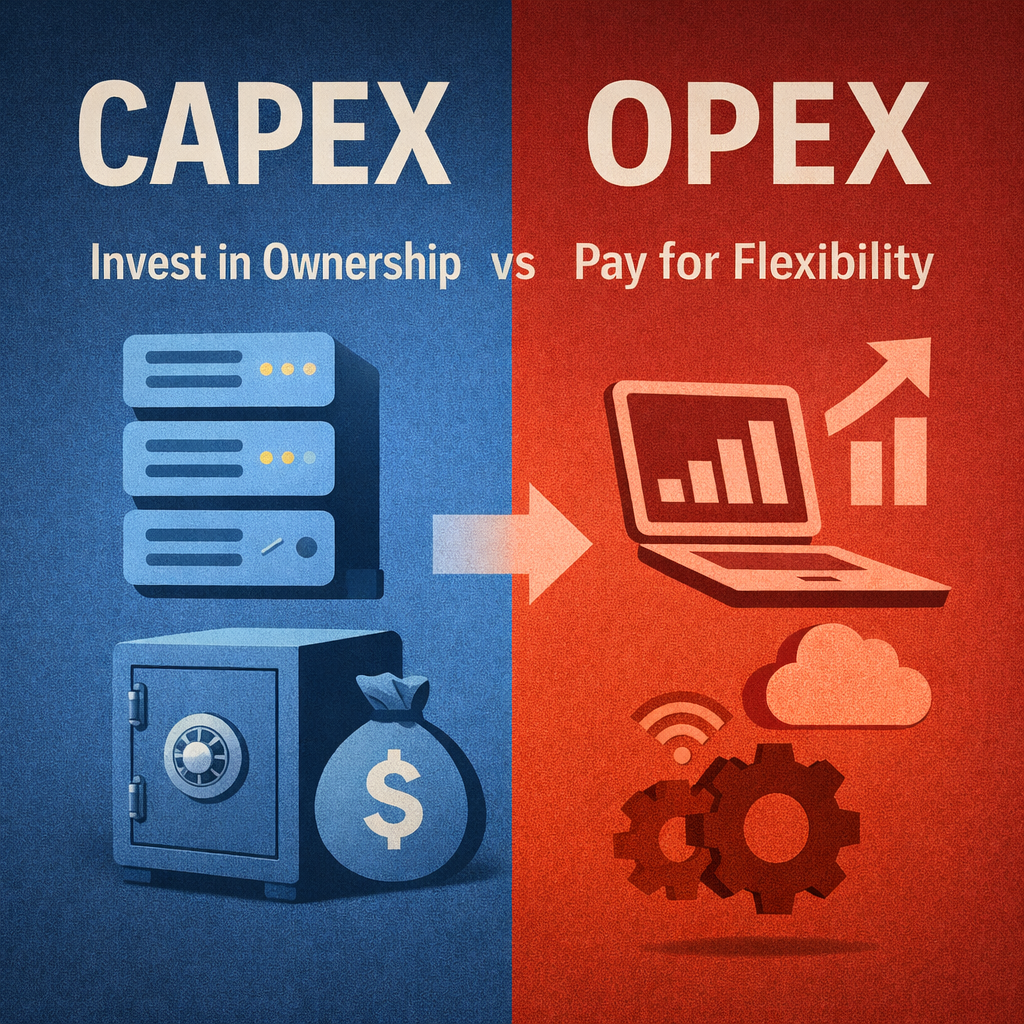
For a long time, IT infrastructure meant one thing above all else: ownership. Servers lived in on-premises data centers, networks were purchased, licenses paid once and depreciated over many years. This mindset remained stable for decades and seemed unquestionable. After the financial crisis of 2008, however, something began to shift. Not abruptly, not dramatically, but gradually. CapEx-driven IT, based on heavy upfront investments, started to come under pressure. Companies increasingly asked themselves why they should tie up large amounts of capital while business models, technologies and requirements were changing at an ever faster pace.Between 2008 and roughly 2014, CapEx was still the dominant paradigm. IT departments planned infrastructure far ahead, often three to five years into the future. Hardware was intentionally oversized to absorb growth. Budgets were approved once, depreciation schedules carefully calculated. Control and perceived security were the main priorities. Owning infrastructure meant stability. At the same time, this model was rigid. Changes were expensive, expansions complex, and poor investment decisions difficult to correct. Infrastructure became a fixed anchor while the business environment grew increasingly dynamic.At the same time, the world outside the data center was changing. Applications were developed faster, markets became more volatile and customer expectations rose. Projects were launched on short notice, scaled quickly or discontinued just as fast. In many organizations, a quiet tension emerged between business and IT. Business units demanded speed and flexibility, while IT delivered stability and long-term planning. CapEx no longer aligned with this reality.
From around 2015 onward, OpEx began to gain significant traction. Not overnight, but unmistakably. Cloud platforms, SaaS providers and managed services suddenly offered something that had previously seemed unrealistic: infrastructure as a recurring operating cost. Payment shifted from ownership to usage. Monthly, flexible and scalable. For many decision-makers, this initially felt unfamiliar. Infrastructure without ownership seemed risky. But economic pressure and operational reality ultimately drove the transition.OpEx represented more than a change in accounting. It introduced a new way of thinking. Instead of large upfront investments, costs could be distributed over time. Projects could be launched without securing millions in advance. Capacity could scale up or down without ordering new hardware. Especially in areas such as Unified Communications, collaboration platforms and later cloud-native applications, the advantages became quickly apparent. Performance could be consumed when needed and released when it was no longer required.During this period, similar observations surfaced repeatedly in conversations with organizations. In the past, companies invested first and then figured out how to use the infrastructure. Today, they decide what they need first and pay for it accordingly. This shift may sound simple, but it is fundamental. It changes decision-making processes, responsibilities and internal power structures. IT evolves from an infrastructure owner into a service provider.
Naturally, this transformation was not without friction. Finance departments had to adapt to ongoing operational costs. Procurement lost the clear comparability of hardware price lists, as services replaced physical assets. At the same time, new dependencies emerged. Once organizations moved toward OpEx, returning to ownership was no longer straightforward. Control shifted from physical assets to contracts and service agreements.This is where subscription models appear as the logical next step. Subscriptions are the operational form of OpEx. They combine technical flexibility with financial predictability. Monthly or annual payments, clearly defined services and transparent scalability became the norm. What had long been standard in consumer markets entered enterprise IT. Software, infrastructure, security and even networks became subscription-based.In practice, it quickly became clear that subscriptions are more than a pricing model. They fundamentally change the relationship between vendors and customers. Providers must deliver continuous value, not just close a sale. Customers evaluate services constantly rather than periodically. The ability to cancel becomes a strategic factor. At the same time, responsibility increases on both sides. Services must operate reliably, as failures are immediately visible and directly paid for.At Darkgate, we have observed this transformation closely for years. As the operators of Darkgate and as one of the most renowned tech recruitment agencies with international reach, we see how this economic shift directly impacts role profiles. Job briefings today go far beyond technical expertise. Understanding service models, cost structures and operational responsibility has become essential. Engineers are increasingly expected to explain not only how a solution works, but why it makes economic sense.From day-to-day experience, it is also clear that many organizations now operate hybrid models. CapEx has not disappeared. Critical core systems, regulatory requirements or specific performance demands still justify ownership. At the same time, everything that must remain flexible is increasingly shifted into OpEx structures. This coexistence is not a contradiction, but a sign of maturity in infrastructure strategy.
The transition from CapEx to OpEx was not driven by technology alone, but by economics. Cloud, Unified Communications, edge computing and real-time workloads accelerated the shift, but they did not initiate it. The real catalyst was the realization that rigid investment models no longer align with dynamic business realities. Subscription models are not the end of this journey, but the most visible expression of it.The next logical step is to explore this service economy in greater depth. How subscription models influence architectural decisions, how they redefine vendor relationships and why they reshape the job market more profoundly than any individual technology. CapEx versus OpEx was the beginning. The service economy is the consequence.