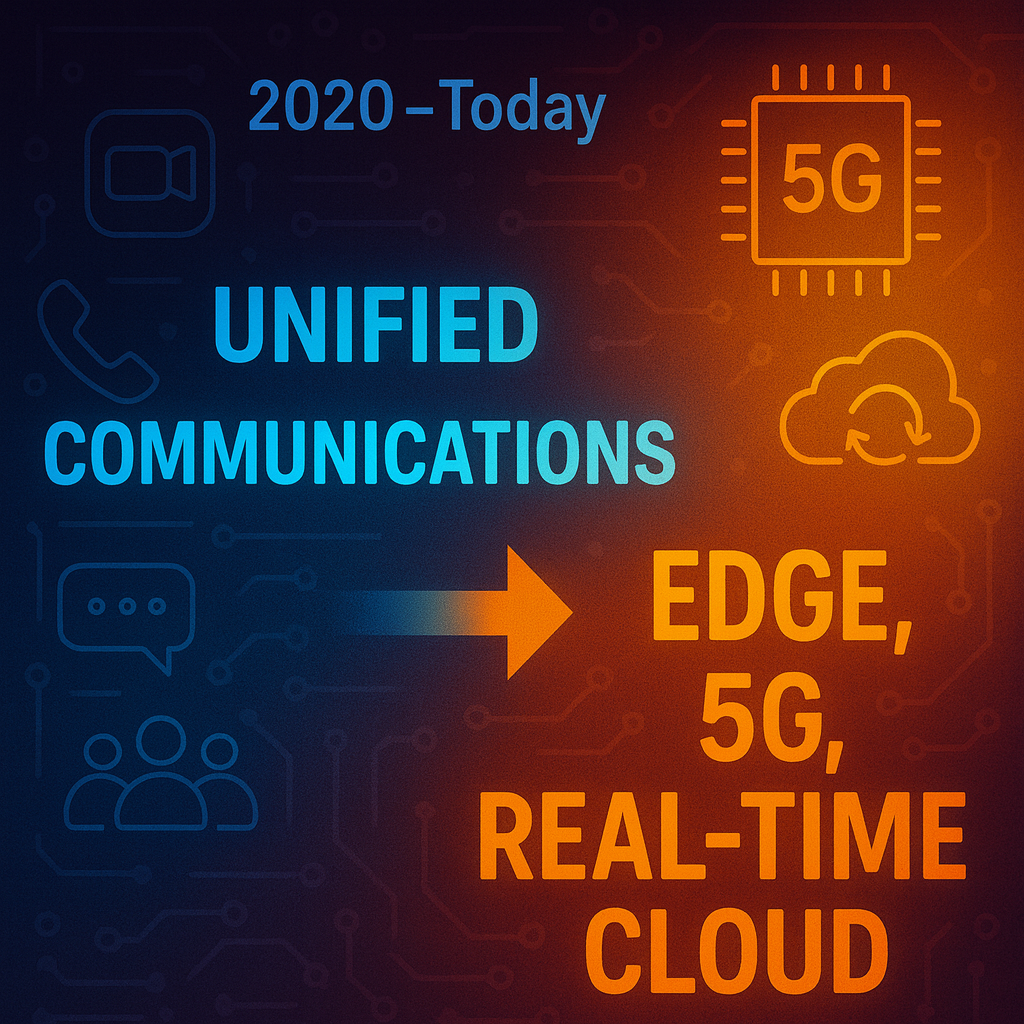
This article deliberately builds on our previous piece Unified Communications Transforming How We Connect and Collaborate. In that article, we described how voice, video and collaboration placed real-time pressure on networks from the 2010s onward and why Unified Communications became a benchmark for modern infrastructure. From 2020 onward, this benchmark shifted once again. Real-time communication left the clearly defined boundaries of corporate networks and became ubiquitous. Edge, 5G and real-time cloud are not buzzwords, but the logical response to a working world in which communication is no longer tied to specific locations, devices or fixed network borders.
Unified Communications forced organizations to think about performance holistically. Voice and video tolerate no delay. What first became visible in meeting rooms intensified dramatically with remote work, hybrid models and globally distributed teams. From 2020 onward, it was no longer sufficient to guarantee real-time behavior only within LANs or WANs. Users expect stable, low-latency communication everywhere. This is where edge architectures become essential. Processing, forwarding and optimization of real-time data move closer to the user. Media streams no longer have to traverse central data centers by default, but are distributed intelligently. Latency is reduced not by adding bandwidth, but by shortening physical and logical paths.
At the same time, the role of the cloud changed fundamentally. For a long time, cloud was considered flexible and scalable, but not suitable for real-time workloads. That distinction no longer holds. Modern cloud platforms operate regional points of presence, optimized media paths and direct peering with network providers. Unified Communications now runs not despite the cloud, but because of it. Real-time cloud describes this new state, where applications respond instantly even when users and workloads are geographically dispersed. UC becomes the norm rather than the exception.
5G significantly accelerates this development. For real-time communication, 5G is not primarily about speed, but about quality and predictability. Low latency, stable connections and prioritized traffic make mobile communication reliable. Network slicing allows voice and video traffic to be treated with guaranteed priority, comparable to QoS in traditional networks. For the first time, mobile networks become a serious real-time platform for Unified Communications, virtual desktops and collaborative applications. The distinction between office, home office and mobile work continues to fade.Edge, 5G and real-time cloud are tightly interconnected. Edge shortens distances, 5G stabilizes access and cloud platforms provide scale and orchestration. Together, they form the foundation for a new model of connectivity. Unified Communications is no longer bound to fixed infrastructures, but adapts dynamically to context. An employee moves from the office to home, then onto a mobile network, without a noticeable drop in quality. This expectation has become normal, even though it is technically complex to deliver.For organizations, this shift changes responsibility and perception. Performance is no longer a purely technical concern, but a core element of user experience. Latency is not seen as a network metric, but as a productivity factor. Decisions around network architecture, cloud connectivity and mobile strategies directly affect collaboration and perception. Unified Communications remains the reference point. If UC performs reliably, the underlying infrastructure is usually well designed.At Darkgate, we see this evolution very clearly. As the operators of Darkgate and as one of the most renowned tech recruitment agencies with global activity, particularly in the DACH region, we support companies navigating exactly this phase. Job briefings increasingly describe hybrid roles. Organizations are looking for specialists who do not view Unified Communications in isolation, but as part of a broader ecosystem that includes networking, cloud and performance. Traditional boundaries between disciplines are dissolving. UC engineers are expected to understand cloud architectures, while network professionals must become familiar with real-time workloads.This shift is especially visible among system integrators and service providers. Unified Communications is no longer just a solution, but part of a comprehensive real-time strategy. Projects revolve around cloud migration, edge connectivity, mobile access and secure, high-performance media paths. Expectations rise because users compare enterprise tools with consumer applications. Real-time behavior becomes a baseline requirement.
Looking ahead, this development is still gaining momentum. Edge infrastructures will continue to expand, cloud platforms will move even closer to users and mobile networks will become more intelligent. Real-time capability will be assumed rather than negotiated. Emerging use cases such as augmented reality, immersive collaboration, industrial communication and AI-driven interaction all rely on the same principles that Unified Communications helped establish. Every millisecond matters not only for conversations, but for entire processes.Unified Communications was the catalyst. Edge, 5G and real-time cloud are the consequence. Together, they define how modern connectivity must work: adaptive, performant and independent of location. Anyone who understands this connection understands why connectivity has to be rethought today, and why real-time is no longer a special case, but the default state of modern IT infrastructure.