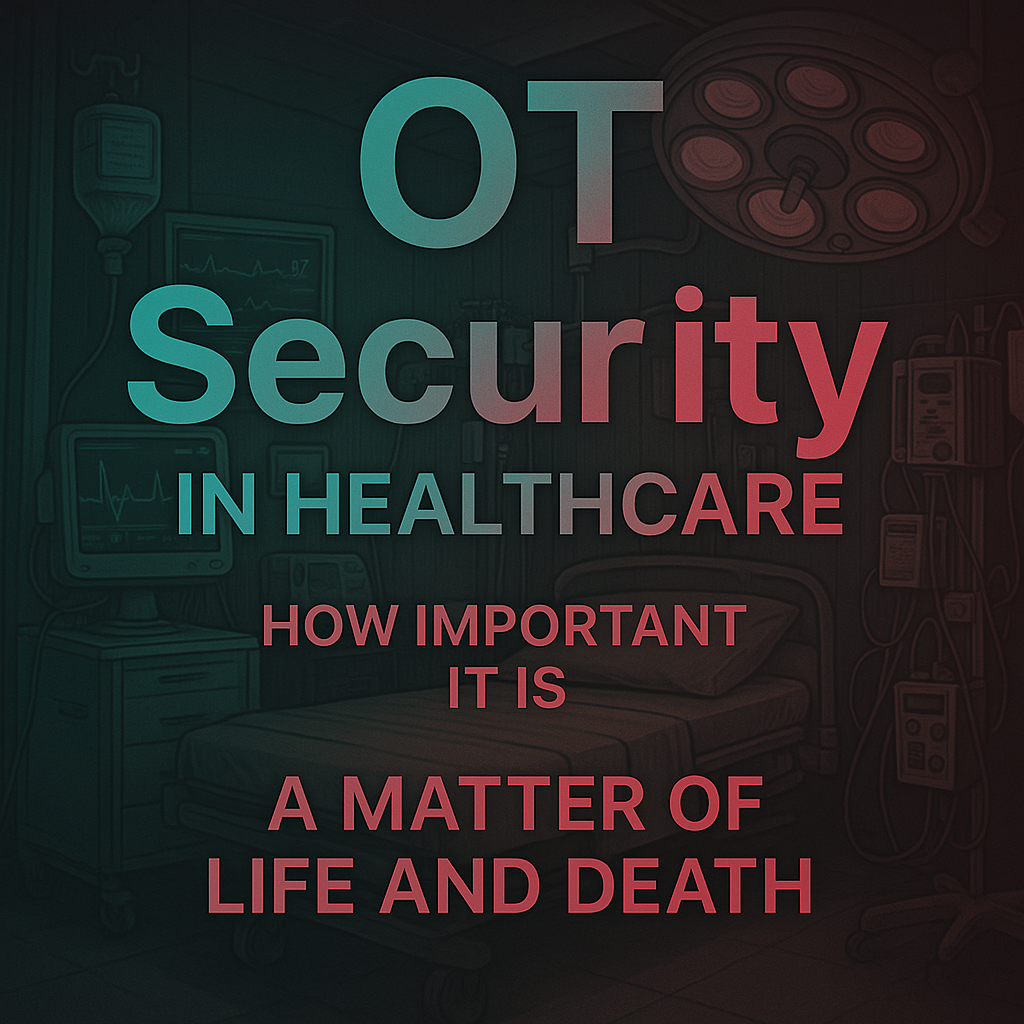
There are areas of cybersecurity that don’t fully reveal their gravity until you step inside them. OT security is one of them. And in healthcare, it stops being a purely technical domain and becomes something far more fundamental. A malfunctioning ventilator is not an outage. A frozen OR robot is not a glitch. A ransomware incident in a hospital is not a routine IT problem. It is a direct, measurable threat to human life.
At Darkgate, operated by one of the most recognized international recruiting boutiques in the security and infrastructure space, we see this reality from the inside. Every week, we speak with the people who secure real-world clinical environments: CISOs of major hospital groups, OT architects in intensive care facilities, integrators safeguarding radiology suites, surgical automation, patient telemetry, and entire clinical supply systems. Our vantage point is immediate and uncensored. And it shows one thing clearly: the convergence of OT, MedTech, and critical infrastructure has created a security dependency far deeper and more fragile than most outsiders realize.
The turning point for us came in 2021, when we were commissioned by the largest IT integrator in the world, a company with Japanese roots and a global footprint, to find an OT Security Consultant for its German operations. It was the moment we understood the magnitude of this field.
We needed to identify people who could speak two worlds at once: the language of cybersecurity and the language of medical devices. Professionals who understood how a CT scanner communicates, how an infusion system is controlled, how diagnostic equipment interacts with clinical networks, and at the same time how fragile these environments are. In conversations with doctors, clinical engineers, OT specialists and integrators, one observation became painfully clear: the responsibility in this field is unlike any other in security. OT in healthcare is not about uptime. It is about continuity of care.
Hospitals today operate systems most people never think about, yet rely on every day. Operating room automation, ventilators and ICU systems, infusion and medication pumps, radiology and imaging equipment, laboratory robotics, sterilization systems, building automation, climate control for surgical environments, water treatment, emergency power, central alarms, patient monitoring and telemetry. All of these systems are interconnected. And that makes them vulnerable. A senior security architect of a university medical center said something that stayed with us:
“We no longer have a clear separation between medical devices and IT. Everything is IT now.”And that sentence describes the heart of the problem. In most industries, OT protects production. In healthcare, OT protects lives.
Attacks on hospitals have already demonstrated the consequences. Ransomware can disable emergency departments. Manipulated infusion pumps can alter medication flow. Blocked radiology systems can delay critical diagnoses. Air handling failures can disrupt sterile operating environments. Lab automation outages can halt urgent testing. Even building automation failures can compromise ICU climate control. And these are not theoretical.
Health authorities have documented that more than half of all medical devices in active use worldwide contain exploitable vulnerabilities, many of them unpatched because updates cannot simply be applied during patient care.One CISO told us bluntly:
“Some of our devices were built before modern ransomware even existed. And they’re still running in the network every day.”The technical complexity behind healthcare OT makes these issues even harder to solve. Legacy devices with proprietary protocols. Systems running outdated firmware that cannot be rebooted without clinical interruption. Regulatory restrictions that prevent modifications. Network topologies that were never designed with cybersecurity in mind. Medical equipment that fails when simply scanned with the wrong tool. And vendor dependencies that can delay security patches for months or even years.OT security in healthcare is not a field. It is a balancing act. Between risk and safety. Between security and clinical availability. Between what should be done and what can realistically be done in the middle of patient care.For us as the operators of Darkgate and as a leading recruiting firm in this niche, this creates a responsibility that goes beyond the typical talent search. Because hiring for this domain requires more than verifying technical depth.
It requires finding people with the ability to carry the weight of clinical risk. People who understand that clicking the wrong button can disrupt an intensive care unit. People who recognize that patching a system in the wrong moment can compromise a surgery. People who know how to communicate risk in a high-stakes environment where doctors, nurses, patients and families rely on their judgment without ever knowing they exist.
We have learned that the most successful candidates in this domain are those who combine technical excellence with emotional intelligence. They understand protocols, segmentation, threat detection, response workflows and industrial systems. But they also understand something just as important: responsibility.Healthcare OT will become one of the most defining security challenges of the next decade. Not because hospitals are becoming more digital. But because patient care itself depends more and more on machines, automation and resilient real-time data. The threat landscape will intensify. The talent shortage will grow. And the connection between IT, OT and medical engineering will become inseparable.The question is not whether healthcare will need stronger OT security. It already does. The real question is whether organizations, integrators and governments can move fast enough to protect a sector where downtime is never just downtime.A cyberattack on a factory stops production. A cyberattack on a hospital stops care.And that is a difference the industry can no longer afford to ignore.