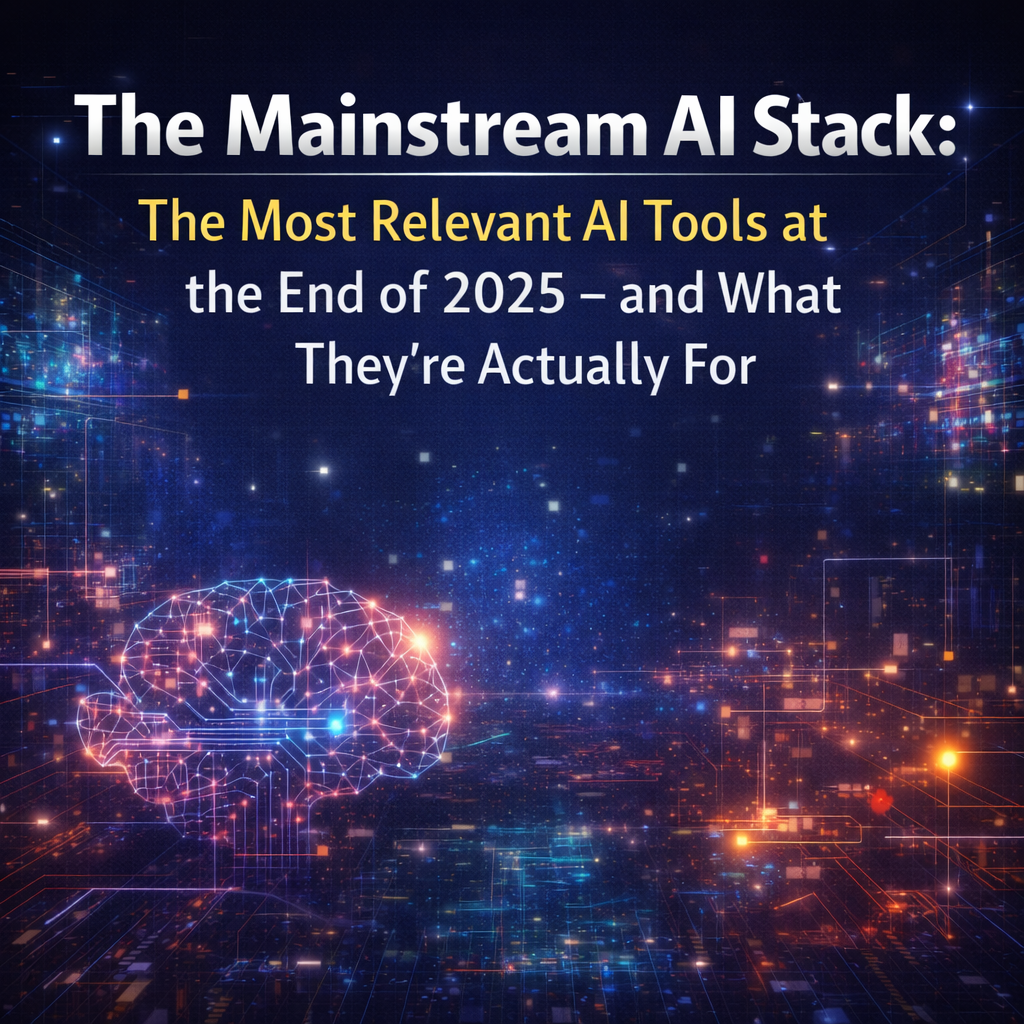
Artificial intelligence is no longer a special topic in 2025, no longer an innovation project and no longer an isolated IT experiment. It has become an everyday working layer that quietly covers almost all digital activities. Not in the form of one large system that replaces everything, but as a collection of specialized tools, each supporting small parts of work, creativity, communication, or organization. People no longer work “with AI” in an abstract sense they work with concrete tools that make certain things faster, easier, or possible in the first place.
At Darkgate, we observe this development from two perspectives. On the one hand, we operate one of the most respected recruiting agencies in the IT and technology sector and began working productively with AI on the very first day ChatGPT became publicly available. On the other hand, we closely track how the AI tool landscape evolves, which applications establish themselves, and what people actually use them for. This article therefore does not aim to provide a deep technical comparison, but rather a practical overview of the most widely used AI tools, what they are used for, and who typically uses them.
Artificial intelligence is no longer a special topic in 2025, no longer an innovation project and no longer an isolated IT experiment. It has become an everyday working layer that quietly covers almost all digital activities. Not in the form of one large system that replaces everything, but as a collection of specialized tools, each supporting small parts of work, creativity, communication, or organization. People no longer work “with AI” in an abstract sense — they work with concrete tools that make certain things faster, easier, or possible in the first place.
At Darkgate, we observe this development from two perspectives. On the one hand, we operate one of the most respected recruiting agencies in the IT and technology sector and began working productively with AI on the very first day ChatGPT became publicly available. On the other hand, we closely track how the AI tool landscape evolves, which applications establish themselves, and what people actually use them for. This article therefore does not aim to provide a deep technical comparison, but rather a practical overview of the most widely used AI tools, what they are used for, and who typically uses them.
ChatGPT (OpenAI) is for many people the entry point into the world of AI. It is used to write texts, structure thoughts, explain complex topics, generate code, draft concepts, or simply act as a thinking partner. Students use it for learning, knowledge workers for structuring, entrepreneurs for strategy thinking, and developers as a daily co-pilot. Its strength lies in its breadth — it can do many things well enough to serve as a first cognitive layer between people and information.
Claude (Anthropic) is especially valued where longer texts, careful reasoning, and structured analysis are required. It is often used to work through documents, contracts, strategy papers, or conceptual drafts because it is calm, consistent, and strongly text-oriented. Claude feels less like a creative partner and more like a patient, structured co-thinker.
Gemini (Google) is particularly strong in environments that already rely on Google Workspace. It supports research, summaries, presentations, and working with large volumes of information. Its main advantage lies in integration rather than in isolated creative use.
MidJourney is the most well-known tool for high-quality AI image generation. It is used to create visual moods, concepts, illustrations, and designs — from marketing visuals to editorial graphics and early product ideas. It is less about precision and more about inspiration and visual exploration.
Leonardo AI is primarily used in game design, product visualization, and concept art. It allows more controlled work with styles and references and is well suited for developing consistent visual systems.
Canva AI is the pragmatic entry point into visual AI. It is aimed at people without a design background who still need to create presentations, social media content, or simple marketing materials. It lowers the barrier to entry and makes visual work accessible.
Sora (OpenAI) represents the next step in generative media: video. Text becomes moving scenes, ideas become short films, and concepts become visual simulations. It is used for prototyping, explainers, creative experiments, and increasingly for marketing formats.
HeyGen enables the creation of avatars that present content without a human standing in front of a camera. This is particularly useful for training, international communication, and scalable video production.
ElevenLabs makes voice malleable. Text becomes speech, and voices become digital assets. Podcasts, voice-overs, accessibility formats, and multilingual content can be created without studios or professional speakers.
n8n is not a creative tool but a structural one. It connects systems, orchestrates workflows, and integrates AI into operational processes. It is typically used to automate information flows and reduce manual handovers.
Make and Zapier serve similar purposes but are more strongly aimed at non-developers who want to connect processes without writing code.
Lovable and Replit lower the barrier to building software. People describe what they need and receive a first working version of an application. This changes who can participate in product creation.
This article aims to do one thing above all: to draw a map. A map of the tools people actually use today — not as a future vision, but as present reality. Artificial intelligence in 2025 is no longer something that is coming. It is something that is quietly already working.
is for many people the entry point into the world of AI. It is used to write texts, structure thoughts, explain complex topics, generate code, draft concepts, or simply act as a thinking partner. Students use it for learning, knowledge workers for structuring, entrepreneurs for strategy thinking, and developers as a daily co-pilot. Its strength lies in its breadth — it can do many things well enough to serve as a first cognitive layer between people and information.
Claude (Anthropic) is especially valued where longer texts, careful reasoning, and structured analysis are required. It is often used to work through documents, contracts, strategy papers, or conceptual drafts because it is calm, consistent, and strongly text-oriented. Claude feels less like a creative partner and more like a patient, structured co-thinker.
Gemini (Google) is particularly strong in environments that already rely on Google Workspace. It supports research, summaries, presentations, and working with large volumes of information. Its main advantage lies in integration rather than in isolated creative use.
MidJourney is the most well-known tool for high-quality AI image generation. It is used to create visual moods, concepts, illustrations, and designs — from marketing visuals to editorial graphics and early product ideas. It is less about precision and more about inspiration and visual exploration.
Leonardo AI is primarily used in game design, product visualization, and concept art. It allows more controlled work with styles and references and is well suited for developing consistent visual systems.
Canva AI is the pragmatic entry point into visual AI. It is aimed at people without a design background who still need to create presentations, social media content, or simple marketing materials. It lowers the barrier to entry and makes visual work accessible.
Sora (OpenAI) represents the next step in generative media: video. Text becomes moving scenes, ideas become short films, and concepts become visual simulations. It is used for prototyping, explainers, creative experiments, and increasingly for marketing formats.
HeyGen enables the creation of avatars that present content without a human standing in front of a camera. This is particularly useful for training, international communication, and scalable video production.
ElevenLabs makes voice malleable. Text becomes speech, and voices become digital assets. Podcasts, voice-overs, accessibility formats, and multilingual content can be created without studios or professional speakers.
n8n is not a creative tool but a structural one. It connects systems, orchestrates workflows, and integrates AI into operational processes. It is typically used to automate information flows and reduce manual handovers.
Make and Zapier serve similar purposes but are more strongly aimed at non-developers who want to connect processes without writing code.
Lovable and Replit lower the barrier to building software. People describe what they need and receive a first working version of an application. This changes who can participate in product creation.This article aims to do one thing above all: to draw a map. A map of the tools people actually use today not as a future vision, but as present reality. Artificial intelligence in 2025 is no longer something that is coming. It is something that is quietly already working.