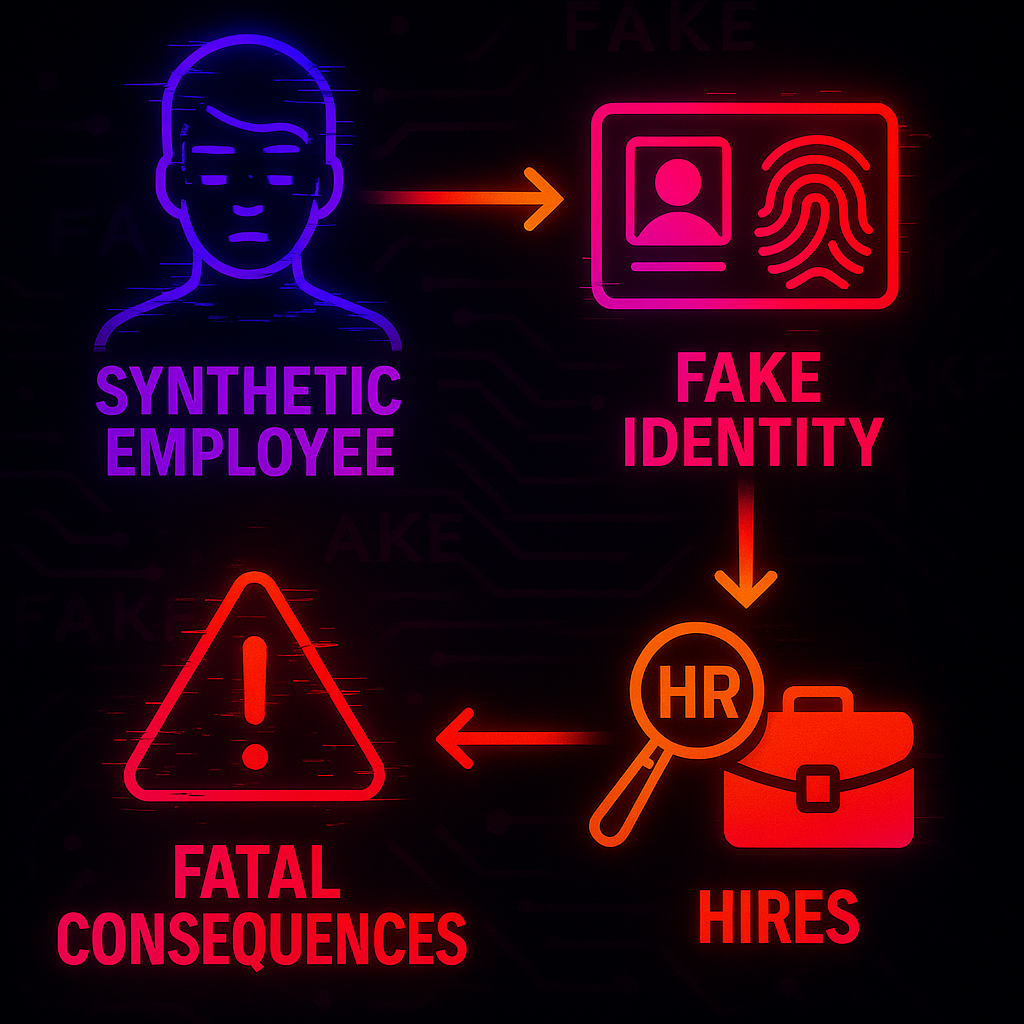

Early deepfake attacks once felt like technical novelties. A manipulated face in a video call, a cloned voice giving instructions, a forged document passing an automated verification check. These incidents were disruptive, but they still appeared contained. What is emerging now is far more significant. The focus is no longer on single identities or one-off fraud attempts. The next phase involves fully artificial employees who operate inside companies for months, perform daily tasks, join meetings and interact with colleagues without ever having existed as real people.
This development is not driven by a sudden leap in adversarial AI. It is the predictable consequence of how modern work has changed. Remote and hybrid organizations have become the norm. Teams are distributed across continents. HR processes are automated and digital-first. Generative AI shapes communication, documentation, code and even candidate screening. In this environment, the traditional link between a worker and a physical person weakens. Many colleagues never meet in person. For some roles, no one expects them to.Creating a synthetic employee is far easier than most security leaders imagine. Attackers can generate professional profiles with convincing employment histories, technical skills and social footprints. CVs produced by large language models often appear more polished than real ones. Fake portfolios and knowledge demonstrations can be created in minutes. A deepfake avatar shows up in interviews with natural movements, lifelike lighting and expressive reactions. A cloned voice speaks with confidence. The entire presentation appears coherent, professional and credible.
Once the artificial employee is onboarded, the deception becomes self-sustaining. Generative models can produce emails, diagrams, analyses, project updates and even code that fits perfectly into day-to-day workflows. Weekly calls can be attended with limited camera use, poor connectivity or audio-only participation, none of which is unusual in remote teams. Overloaded managers accept this without suspicion. Distributed teams rely on trust by necessity, not by choice.For attackers, this creates an advantage that traditional intrusion methods could never offer. A synthetic employee gains full access to the systems required for their role: internal platforms, development environments, documentation, ticketing tools and communication channels. They appear legitimate because every step of their onboarding was legitimate. If detection occurs, the identity can simply vanish. The employee resigns, becomes unavailable or is quietly removed. No human remains to investigate. The attacker sinks back into anonymity.
The threat extends beyond deliberate sabotage. Harm can occur even when the artificial employee behaves as expected. Poor-quality work, misunderstood requirements or delays may not raise red flags. Teams often attribute these symptoms to the usual challenges of remote collaboration. Miscommunication, cultural differences or performance fluctuations are common and rarely investigated deeply. The idea that the colleague never existed is outside the operational imagination of most organizations.As autonomous AI agents evolve, the synthetic employee becomes even harder to distinguish from a human. These agents can respond to messages, adjust meeting notes, trigger workflows, commit code or maintain documentation on their own. They operate as independent entities shaped by models optimized for corporate communication. To the company, they are simply another remote contributor. To the attacker, they are a persistent foothold with near zero operational risk.
Traditional verification mechanisms begin to fail under these conditions. Background checks rely on digital artifacts that can be fabricated. Reference calls can be routed to synthetic personas. ID documents can be forged with astonishing precision. Even video interactions, once considered a high-assurance step, no longer guarantee that a human is present. Personality, expertise and emotional cues can all be simulated. What was once considered proof of authenticity is now just another media format that can be generated.The consequences for internal security are profound. A fake cloud architect can subtly influence architectural decisions. A synthetic developer can introduce dependencies that later serve as infiltration vectors. A fabricated compliance specialist can approve processes that undermine safeguards. Every action appears normal because the actor was accepted as normal from day one.
The deeper issue is psychological. Remote and hybrid work environments have normalized distance and reduced the natural human signals that once reinforced trust. Without physical presence, identity becomes representation rather than embodiment. Representation can be manufactured. And once manufactured, it becomes extremely difficult to challenge.The synthetic workforce is therefore not only a technological threat but a structural one. It challenges the assumption that every contributor inside an organization must be a real human being. Security tools are not designed to assess human authenticity. HR teams focus on documents and workflows, not on verifying that a person exists beyond their digital footprint. Entire companies may already be operating with the wrong model of identity.
What emerges is a future in which real and artificial workers can coexist undetected. Some will be malicious, others merely artifacts of automation. Companies must develop new methods to determine authenticity, not just identity. They will need behavioral verification, dynamic cognitive tests and continuous presence checks that go beyond superficial biometrics.The synthetic employee is not dangerous because it infiltrates an organization. It is dangerous because it performs well enough that no one thinks to question it. The real threat is not the creation of fake workers, but the gradual acceptance of entities that do not exist. Once that line is crossed, the difference between a trusted colleague and a generative model becomes a matter of assumption and assumptions are exactly what attackers exploit.