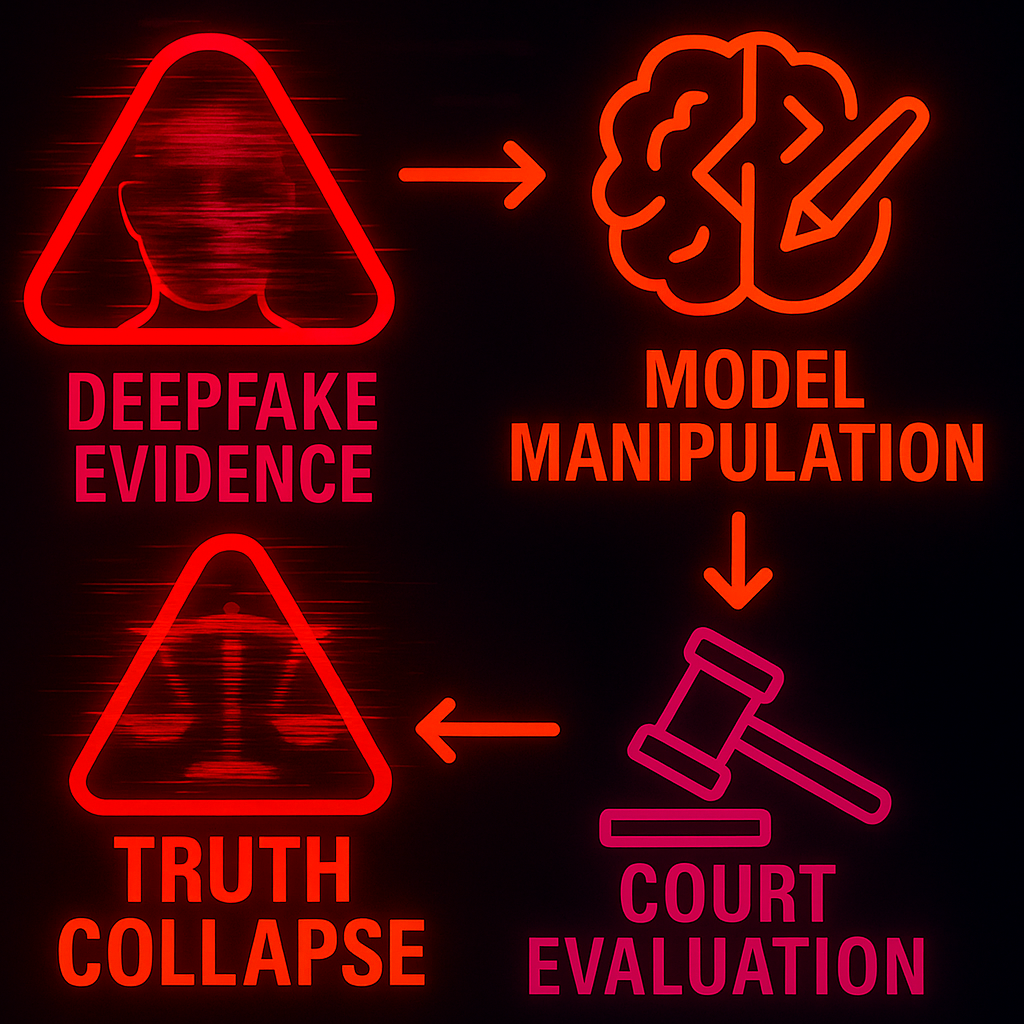

For years, the public conversation around deepfakes revolved around manipulation at the visual layer. Faces altered, voices cloned, videos fabricated or edited with such precision that the human eye could no longer distinguish what was real from what was synthetic. But the real turning point arrives when attackers stop trying to deceive people and start trying to deceive the systems that were designed to protect those people. This is the moment when deepfake technology transforms from a deceptive tool into a strategic weapon that strikes at the heart of public institutions. It is here that courts, investigators, regulatory bodies and governments face the most destabilizing challenge since the digitization of evidence began.
This new chapter, which we at Darkgate classify as counterforensics, is not a theoretical evolution. It is emerging inside real cases, confidential briefings and situational analyses we receive daily from the cybersecurity, AI and digital forensics teams we support. Because we are deeply embedded in the global talent landscape of advanced AI, cyber defense and security analytics, we see the inside of environments that most people only read about. In conversations with investigators, CTOs, chief security architects and forensic specialists, one theme appears again and again: attackers are no longer satisfied with producing convincing deepfakes. They are now designing those deepfakes specifically to poison the forensic AI models meant to catch them.The implications for public institutions are profound. Courts rely on digital evidence more than ever. Law enforcement agencies process thousands of hours of video surveillance, mobile recordings and captured communications every week. Regulatory bodies document compliance violations through digital traces. Intelligence agencies examine visual material to attribute attacks, confirm events and assess geopolitical developments. In all these domains, forensic AI has become not only a tool but a backbone. It filters, classifies, prioritizes and validates information at scales no human could ever achieve.
And precisely this backbone is now being targeted.
Attackers have discovered that it is often more effective to manipulate the interpreter than the message. If a model can be pushed, nudged or trained into believing that authentic evidence is fake, or that fabricated evidence is authentic, the consequences are far more catastrophic than a single convincing deepfake. It means that the institution responsible for deciding what is true and what is false is forced to operate in a world where truth itself becomes unstable.We have been briefed on cases where synthetic datasets, poisoned training samples or adversarial noise patterns were intentionally embedded into the kinds of media investigators rely on most. In one striking example, a forensic model began misclassifying genuine video recordings as synthetic because an attacker had introduced a trigger pattern that only appeared in real footage captured by specific devices. The model learned to associate reality with forgery. As a result, an entire category of authentic evidence was flagged as manipulated, while fabricated videos that omitted this trigger passed as legitimate.
Imagine the effect this has in a courtroom. A key video that documents a crime is now labeled “inauthentic” by a forensic system previously considered trustworthy. A defense attorney seizes the opportunity, arguing that digital evidence cannot be relied upon. Judges, already under pressure from overflowing case files and technical complexity, face conflicting interpretations between human analysts and machine classifiers. The prosecution loses its strongest leverage. A criminal case collapses not because the evidence is missing, but because the model tasked with evaluating it has been intentionally led astray.Or consider national security investigations. Intelligence agencies rely on pattern analysis, image authentication and temporal consistency checks to confirm whether an event occurred as claimed. If adversarial actors generate media that contains backdoor triggers—imperceptible pixel arrangements, micro-frequency distortions, invisible text layers the forensic pipeline may tilt in a specific direction. A geopolitical incident can be reframed, downplayed or dismissed entirely because the AI system trusted to verify authenticity has been quietly subverted.
The consequences extend beyond individual cases. Trust in institutional processes erodes. Regulators fear that enforcement decisions may be overturned because the evidence trail can be contested. Law enforcement loses confidence in its tools. Public agencies become hesitant to take action based on digital material, knowing that any determination can be challenged by accusations of algorithmic error or manipulation. A systemic doubt spreads: If the forensic model can be fooled, who decides what is real?This is where the battle shifts from technology to legitimacy. For decades, the justice system evolved around the premise that evidence could be authenticated through chain of custody, expert testimony and objective technical evaluation. Counterforensics undermines that foundation. In a world where attackers can design deepfakes that actively push forensic models off their axis, the question is no longer whether a given video is real. The question becomes which authority, human or machine, is still capable of establishing truth at all.
Public institutions are beginning to realize how exposed they are. Investigators report growing cases where suspects claim that incriminating videos are deepfakes, even when they are not. Courts struggle to determine whether forensic AI outputs should be treated as definitive, advisory or potentially compromised. Government agencies are quietly drafting new internal frameworks for AI-assisted evidence validation, recognizing that old assumptions no longer hold. The mere possibility of counterforensic interference creates a strategic advantage for attackers: sow doubt, collapse trust, and weaponize uncertainty.For those of us working closely with the cybersecurity and AI sectors, the shift is unmistakable. What was once a problem of detecting manipulation has become a problem of defending the concept of truth itself. And the insights we gather from our engagements with leading integrators, forensic labs, AI companies and investigative bodies confirm a clear trajectory: the future of deception will not depend on how convincing a deepfake looks, but on how effectively it can shape the judgments of the systems meant to detect it.
This is why Darkgate publishes this series. We work with some of the most advanced security, intelligence and AI organizations across the world, and the briefings we receive show us how quickly the threat landscape evolves. We are often stunned by what is already possible, and even more by what is coming. But we share these insights because preparation is the only path to resilience. Institutions, governments and legal systems can only defend what they understand. And understanding begins with acknowledging that attackers no longer aim to mislead people – they aim to mislead the mechanisms by which society decides what is true.The fight ahead will not be won by sharper detection models alone. It will require new legal frameworks, new investigative protocols, new notions of evidentiary trust and new forms of interdisciplinary expertise. If we fail to adapt, courts, governments and investigative agencies may soon find themselves navigating a world where the truth is not hidden, but actively rewritten by machines designed to deceive the very systems built to protect it.