While the global cloud landscape is increasingly consolidating around a small number of large U.S.-based hyperscalers, a different kind of cloud economy has emerged in parallel across the DACH region. It is smaller, quieter, and far less visible yet highly relevant for many organizations. Not because it is technologically superior, but because it is legally, politically, and structurally better aligned with the specific realities of European markets.
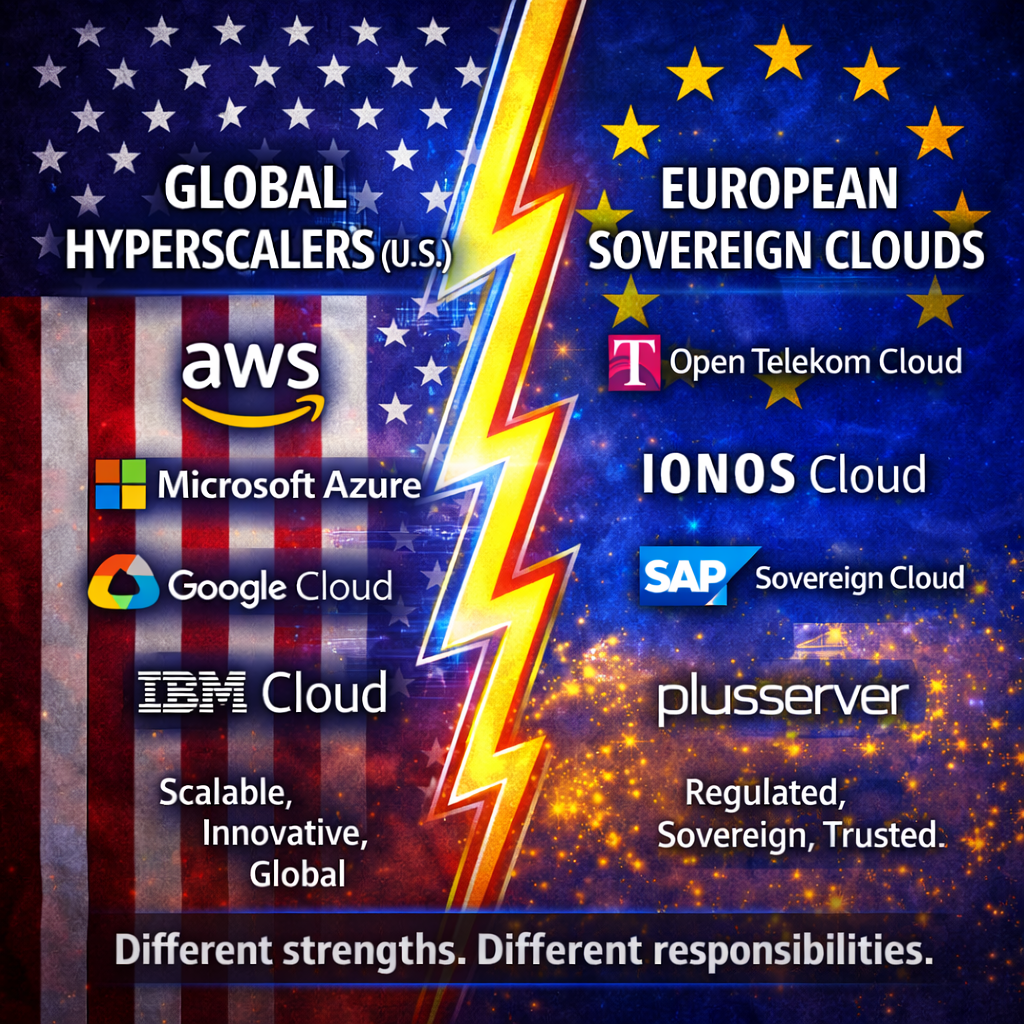
AWS, Microsoft Azure, Google Cloud, and IBM dominate the market from a technological perspective. They define standards, drive innovation, set the pace of development, and shape entire ecosystems. They invest billions into new platform services, AI infrastructure, global networks, and developer tooling. They enable new digital business models, new forms of scale, and new categories of software. They are the engine of digital scale, and they will remain so.But it is precisely this strength that creates a counter-movement in Europe. As digitalization increases, so does dependence — not only on technology, but on legal systems, jurisdictions, geopolitical interests, and economic concentration. Questions such as where our data is stored, which legal system governs it, who may theoretically access it, and what happens in the event of political, legal, or trade conflict are no longer abstract governance discussions. They are operational questions that influence architecture, risk management, procurement, compliance, and ultimately corporate strategy.This is where smaller providers from Germany, Austria, and Switzerland become relevant.IONOS Cloud, Open Telekom Cloud, SAP Sovereign Cloud, plusserver, noris network, and various regional GovCloud initiatives do not exist because they can scale better than hyperscalers, but because they reduce risks that hyperscalers cannot structurally eliminate. They offer legal clarity through European data residency. They are not subject to the U.S. Cloud Act. They enable clearer GDPR responsibility without third-country complications, as well as national control mechanisms and political alignment with European digital strategies.
They also offer something that is difficult to quantify technically but extremely important organizationally: predictability. Stable legal frameworks, transparent contractual structures, and closer proximity to regulators and policymakers create a different type of risk profile — one that is often easier to explain to boards, auditors, supervisory authorities, and public stakeholders.This makes them attractive to public authorities, critical infrastructure operators, energy providers, financial institutions, healthcare organizations, defense-related entities, public administration, and highly regulated industries. In these domains, cloud adoption is not primarily an efficiency question — it is a trust question. It is about accountability, auditability, legal resilience, and long-term institutional stability.While hyperscalers optimize efficiency, European providers optimize responsibility. While hyperscalers accelerate innovation, European providers stabilize structures. While hyperscalers build ecosystems, European providers build trust.That is both their raison d’être and their structural limit.
What they cannot provide is what defines hyperscalers: global scale, rapid product innovation, massive developer ecosystems, enormous investment capacity, and platform breadth. They will not set global standards. They will not operate AI infrastructure at global scale. They will not become dominant platforms for new digital business models and they do not need to.Their role is not to replace hyperscalers, but to complement them, constrain them, and balance them. They are not a technological counterweight, but a regulatory and political one. They introduce friction into an otherwise purely efficiency-driven system and that friction is not a weakness, but a form of systemic stability.
For companies, this means that cloud becomes increasingly hybrid not only technically, but structurally. Not everything moves into the global platform. Some systems remain deliberately local, sovereign, national, or European not out of nostalgia, but out of responsibility. Architecture becomes a reflection of governance. Infrastructure becomes a reflection of legal and political context.Cloud therefore does not become less global, but layered.That is the point many decision-makers are now beginning to understand: digitalization is no longer a purely technical project. It is a structural project. A legal project. A governance project. And increasingly, a geopolitical project.The smaller cloud providers of the DACH region are therefore not competitors to the global cloud they are its corrective. They will not dominate the market, but they will shape it. And in a world where technological power is increasingly becoming political power, that is not a minor detail. It is a decisive factor.
Conceptional image digitally created for editorial illustration. All trademarks and brand names are the property of their respective owners