Work used to be reactive. Something happened and someone responded. A request arrived and someone handled it. A ticket was created and someone worked through it. Information was stored and someone searched for it later. Even the most modern tools did not fundamentally change this logic. They made work faster, more visible, more structured, but the underlying pattern remained the same. Action followed stimulus. Work reacted to events.
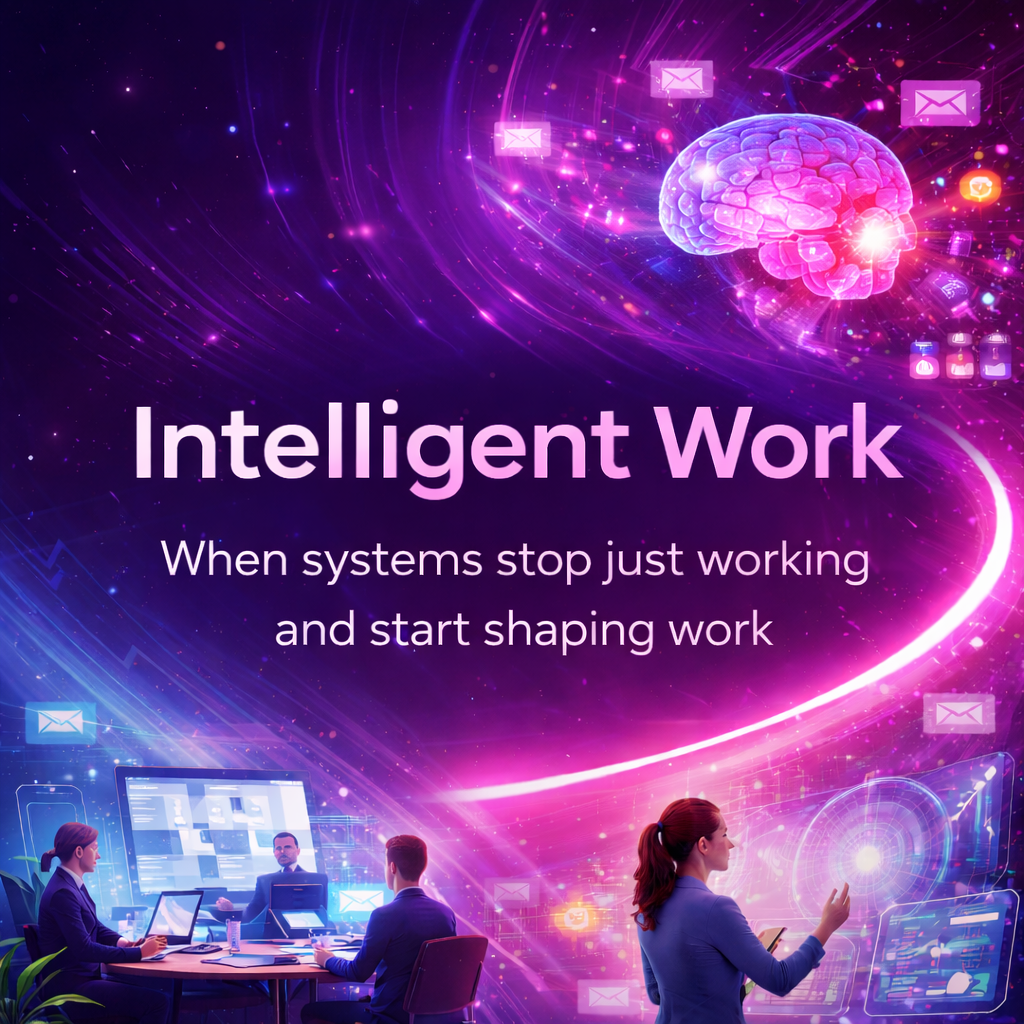
Intelligent Work begins where this logic slowly shifts. Not because everything becomes automated, and not because machines suddenly replace people, but because systems start preparing work instead of merely recording it. They sort before we search. They prioritize before we decide. They connect before we notice. They suggest before we ask. They do not take decisions away, but they shape the conditions under which decisions are made.
A project manager no longer opens a system and sees a raw list of hundreds of open tasks, but a structured view of what matters today, what is blocked, what is waiting for input, and what is becoming critical. A sales manager does not scroll through endless CRM entries, but sees which customers have been active recently, which opportunities have been untouched for too long, and where a conversation might actually make sense. An IT team does not just react to incidents, but sees early patterns, rising signals, and emerging dependencies. The system does not think for them, but it thinks along with them.
This is what Intelligent Work looks like in practice. Not as technology, but as a new way work is shaped.Work is no longer primarily driven by what is possible, but by what becomes visible. Not by what exists, but by what is highlighted. Systems become a quiet layer of coordination in the background, creating order before chaos appears, not through control, but through structure. One head of infrastructure described it very simply when he said that their work had not become smaller, but it felt calmer, less hectic, less searching, more guided.
That guidance does not come from managers or dashboards alone. It comes from the way information is presented, from the sequence in which things appear, from the relationships that become visible, from the signals that emerge naturally. Responsibility becomes clearer not because someone is watched, but because dependencies become visible. Who is waiting for what. Where something is stuck. Where a decision is missing. Where work is slowing down.
In earlier models, much of this remained implicit. People had a feeling for how things were going. A sense for where problems might be. An intuition for when something felt wrong. Intelligent Work turns this intuition into information, and information into actionability. This does not reduce responsibility, it changes it. It shifts responsibility from constant monitoring to conscious intervention.A team lead once described this shift by saying that he used to spend most of his time figuring out what was going on, and now he sees what is going on and can focus on what to do about it. That difference may seem small, but it is profound. It frees attention. It reduces cognitive load. It gives people back mental space.
Productivity in this context is no longer about speed, output, or intensity. It is about clarity. About fewer context switches, fewer interruptions, fewer unnecessary decisions. It is about reducing friction rather than increasing pressure. About enabling flow rather than forcing pace.This is why Intelligent Work is not simply the next technical step after the Modern Workplace. It is a different phase altogether. The Modern Workplace moved work into digital environments. Intelligent Work begins to make those environments work-ready. Not just as storage, but as guidance. Not just as platforms, but as context. Not just as infrastructure, but as orientation.
It is important to understand that Intelligent Work is not identical with artificial intelligence. AI can amplify it, but it is not its essence. Intelligent Work is first and foremost a design question. How work is structured. How information flows. How decisions are prepared. How responsibility is distributed. AI becomes meaningful only when these foundations exist.Without structure, intelligence does not create clarity, it creates faster confusion. Without context, suggestions do not create insight, they create noise. Without intentional design, systems that think along do not support people, they overwhelm them.
This is why the real challenge of Intelligent Work is not technological, but organizational. It is not about choosing tools, but about shaping work itself. About defining what matters. About deciding what should be visible. About determining which decisions belong to humans and which can be supported by systems.
Artificial intelligence will deepen this shift. It will make systems more predictive, more contextual, more responsive. It will further move work from execution to judgment, from handling to deciding, from reacting to shaping. But it will only do so in a healthy way if the underlying logic of work is consciously designed.Intelligent Work is therefore not a destination. It is a direction. A movement away from reactive work toward anticipatory work. Away from overload toward clarity. Away from speed toward meaning. It is not about working more, but about working with less friction and more intention.Systems can think along. But they need to be taught what thinking along means.And that is the work that now begins.