For a long time, productivity was understood as a personal trait. It was about how disciplined people were, how well they managed their time, how fast they executed tasks. Tools were seen as helpers, not as the defining force behind productivity itself. That perspective has changed fundamentally over the last decade, and this change did not come from one innovation or one platform, but from a slow shift in where work actually happens. As work moved into digital tools, productivity stopped being primarily an individual matter and became a system property. It is no longer defined by how quickly someone works, but by how smoothly work flows, not by effort, but by friction, not by activity, but by clarity.
This shift is what the Modern Workplace enabled. Platforms such as Microsoft 365, collaboration tools, workflow engines and automation layers did not just digitalize work, they made it visible. Processes became traceable, dependencies became explicit, knowledge became accessible, coordination became structured, and the result was not that people worked harder, but that they worked with less waste. A CTO from a global manufacturing company recently described it very clearly by saying that productivity used to be about performance and is now about design, that if you design the flow well, productivity emerges almost automatically. We hear similar statements often at Darkgate in our conversations with Chief Technology Officers, Heads of Infrastructure and Digital Transformation Leads, where the discussion rarely revolves around individual tools and much more around how those tools work together, not whether a system works, but whether it supports the way people actually work, not whether something is technically possible, but whether it reduces friction.
Microsoft 365 is a good example of this shift. It did not just move email and documents to the cloud, it moved work into a shared digital space. Teams connects communication with context, SharePoint connects information with process, Power Automate connects events with actions, Power BI connects data with decisions, and productivity here is not about output per hour, but about fewer handovers, fewer searches, fewer interruptions. An IT Director in the financial sector once put it very simply by saying that their productivity did not increase because people type faster, but because they spend less time figuring out where things are, who is responsible and what the next step should be, and this is a quiet but profound change because productivity becomes a feature of the system, not just of the people inside it.
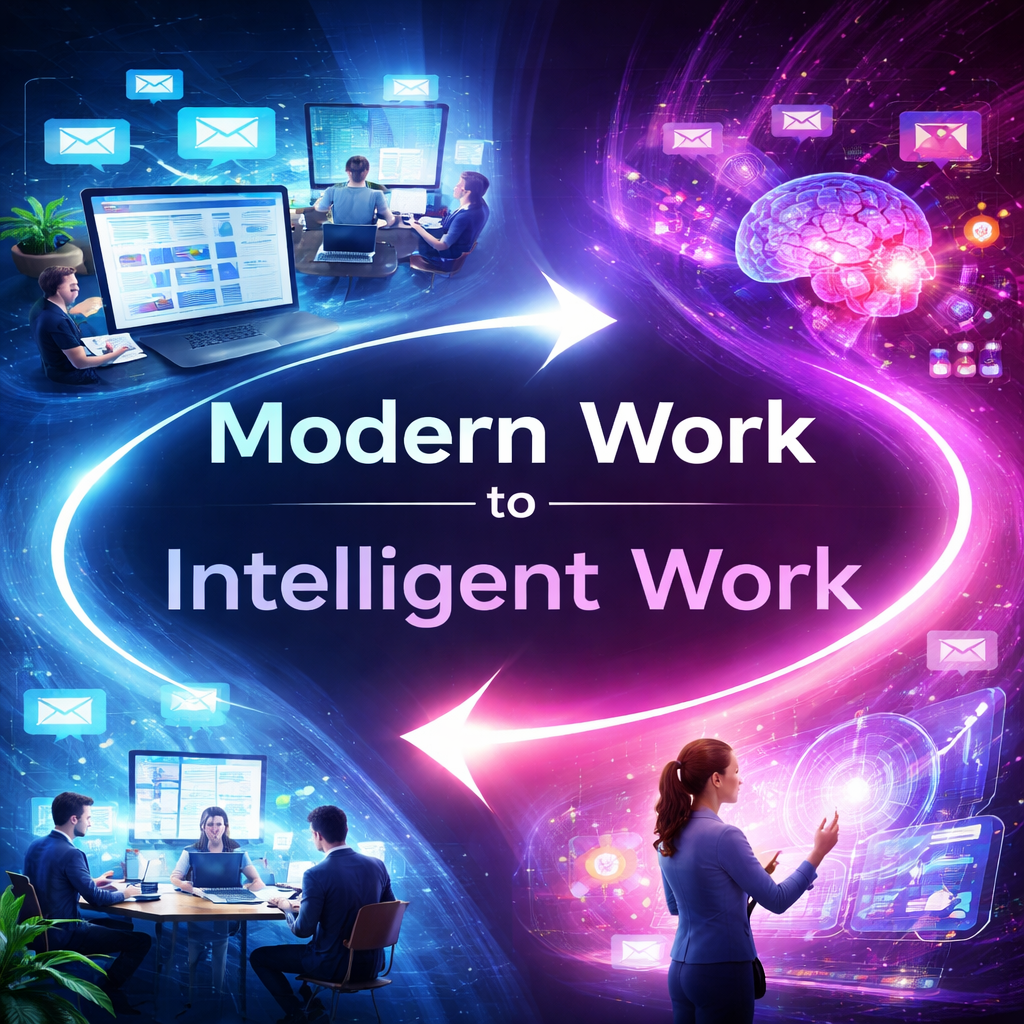
But this is not where the evolution stops. Since around 2022, a new layer has started to form on top of these tool landscapes, a layer of automation, integration and intelligence, where processes are not just digital anymore, but self-coordinating, where information is not just available, but suggested, where work is not just supported, but anticipated. This is the transition from Modern Work to Intelligent Work, and artificial intelligence is not another tool in the stack, but a new logic across the stack. It reads along, detects patterns, prioritizes, summarizes and recommends, and it shifts work away from execution and toward judgment. A Chief Digital Officer in the healthcare sector described it to us by saying that their systems are taking over more and more of what used to require human attention, and that human attention moves to where judgment and responsibility are needed.
This changes productivity again. It is no longer about speed, but about decision quality, not about volume, but about relevance, not about activity, but about impact, and this creates new questions for organizations about how much automation is helpful, where AI supports and where it replaces responsibility, which decisions should be delegated and which should remain human. Productivity becomes a design challenge at leadership level, not a training issue for employees, but an architectural issue for organizations, and this is where IT, integrators and leadership take on a new role, not as providers of technology, but as curators of work logic, as designers of environments, as translators between human work and machine support. A CIO of a global logistics company once summarized this by saying that the most important decision they make is not which tools they introduce, but how they define what good work actually is.
That question is more open today than ever before. The Modern Workplace built the infrastructure, Intelligent Work begins to give that infrastructure direction with priorities, with context, with suggestions, with relief, and productivity becomes quieter, less visible, less frantic, but more effective. Perhaps that is the most important change, that productivity is no longer experienced as pressure, but as relief, not as acceleration, but as clarity, not as optimization, but as enablement. At Darkgate, we observe this evolution every day, not from a distance, but in direct exchange with the people shaping it, CTOs, IT leaders, architects and integrators who do not talk about trends, but about their operational reality, and that reality is very clear, work has changed, productivity has changed, and we are only at the beginning of what becomes possible when systems do not just function, but start to think along. From Modern Work to Intelligent Work is not a technological leap, it is a shift in meaning, and it will shape the future of work more deeply than any single tool ever could.