Between 2019 and today, the IT job market has changed more deeply than in the decade before. Not because of one new technology, not because of one new platform, and not because of one new programming language, but because the nature of work itself has changed. And when work changes, roles change with it. For us as a recruiting agency, this period marked a clear shift. Not because demand suddenly increased, but because the kind of profiles companies were looking for fundamentally transformed. Organizations stopped searching mainly for administrators, technicians, or classical system engineers. Instead, they began looking for people who could shape work, people who understood technology and organization at the same time.
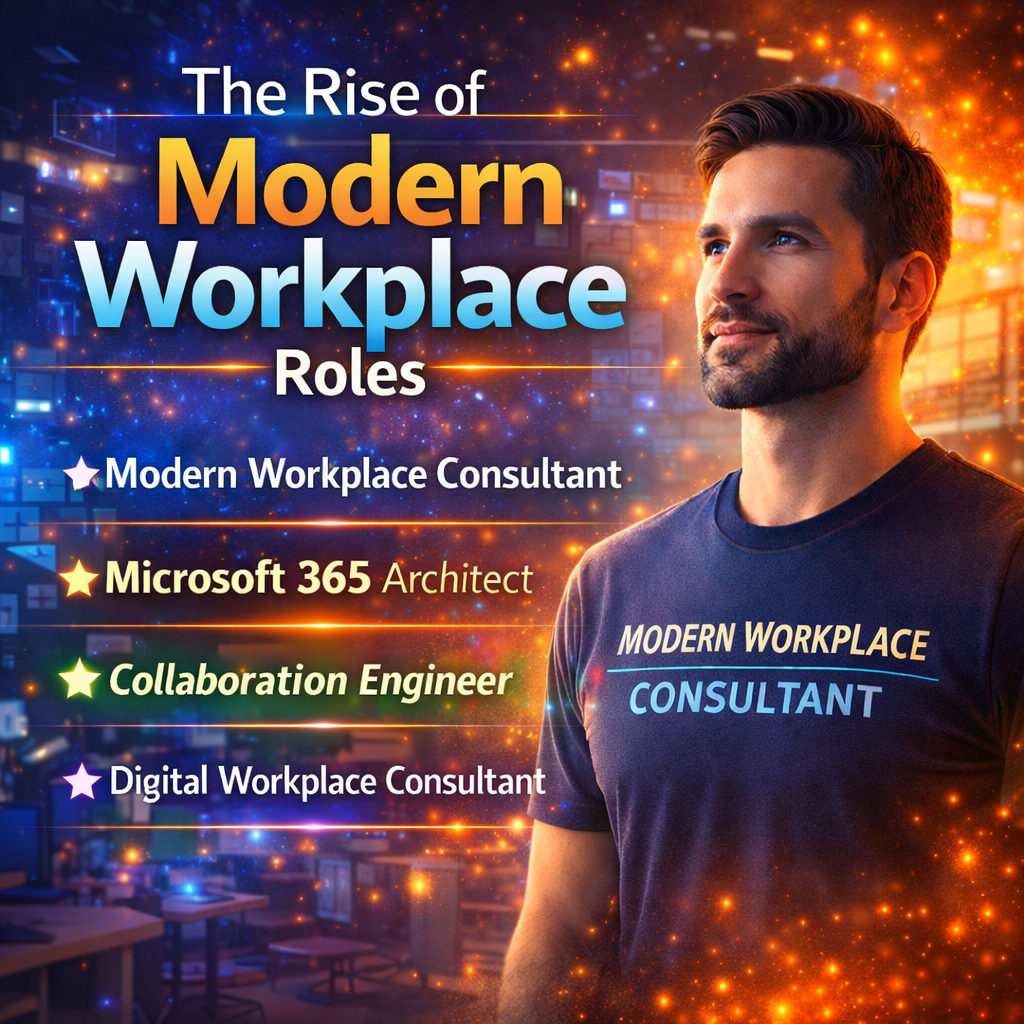
This is how what we now call Modern Workplace roles slowly emerged. At first, the titles appeared only occasionally. Modern Workplace Consultant, Digital Workplace Architect, Collaboration Engineer, Cloud Workplace Specialist. Over time it became clear that this was not a short-term trend, but the formation of a new professional category. Especially from 2019 onwards, the development accelerated. Work became more distributed. Teams worked across locations and time zones. Customers expected faster reactions and more transparency. Leaders wanted better visibility into ongoing work. Employees wanted less friction and more clarity in their daily routines. These expectations could no longer be met by technology alone. They required design, translation, and continuous adjustment.
Modern Workplace professionals sit exactly at this intersection. They are neither classical IT specialists nor pure organizational consultants. They understand platforms like Microsoft 365 deeply, but they do not think in terms of features. They think in terms of collaboration, flow, and structure. They look at Teams, SharePoint, OneDrive, Planner, Power Automate, and Power Apps not as tools, but as building blocks for how people work together. They spend much of their time talking to departments, observing workflows, identifying friction, and translating human realities into digital structures.
This is why these roles are fundamentally dialog-driven. The most important skill is not technical depth alone, but the ability to listen, to ask the right questions, to recognize patterns, and to sense where something is not working yet. From this understanding, concepts emerge that connect people, processes, and platforms into something coherent. A Modern Workplace Consultant rarely begins with a solution. They begin with a conversation.
Over time, different role variations formed around this core. The Microsoft 365 Consultant focuses strongly on the platform ecosystem, shaping collaboration models in Teams, information architectures in SharePoint, automation in Power Automate, and lightweight applications in Power Apps. The Modern Workplace Architect thinks on a broader level, designing the overall structure of digital work environments, deciding how tools interact, how identity and access are managed, and how security and governance are embedded. The Collaboration Engineer implements and integrates these designs technically, ensuring performance, stability, and security. The Digital Workplace Consultant focuses more on change, guiding organizations through adoption, training, and cultural shifts.
In smaller system houses, these responsibilities are often combined in one person. In larger integrators, they become distinct roles. What unites them is their focus. They do not work on systems. They work on work. They are not there to implement technology, but to enable functioning collaboration.
For IT integrators, these profiles became a response to changing customer expectations. Clients no longer wanted projects, they wanted partnerships. They no longer wanted implementations, they wanted guidance. They no longer wanted tools, they wanted better work. This required integrators to rethink their own positioning. From infrastructure providers to workplace architects. From technical experts to organizational enablers. From project delivery to continuous engagement.
At Darkgate, as a recruiting agency deeply embedded in this market, we observed this shift very closely. In conversations with department heads, CTOs, and transformation leads, similar themes appeared again and again. “We have the licenses, but not the structure.” “We have the tools, but not the clarity.” “We need someone who understands both technology and how our people actually work.” These were not IT problems. They were workplace problems.
That is why we decided to dedicate a separate space to these roles. Not because they are fashionable, but because they are foundational. Modern Workplace roles are not a trend. They are a structural response to the fact that work no longer happens primarily between people, but inside systems, platforms, and digital spaces. And these spaces have to be shaped. Thoughtfully. Carefully. Continuously.
They have to be not only efficient, but meaningful. Not only scalable, but usable. Not only innovative, but stable. The people who can hold all of that together will remain essential.This is why the importance of these roles will continue to grow. Not because new tools keep appearing, but because work keeps becoming more complex, more distributed, more interdependent. The need for people who can design clarity inside that complexity will only increase.
And this is also where we see our own role. Not only in filling positions, but in understanding and articulating what these roles actually are. Not only in connecting candidates and companies, but in helping the market understand itself.The rise of the Modern Workplace roles is not a hype cycle. It is a reflection of a deeper change in how work is structured and experienced.And it is still unfolding.