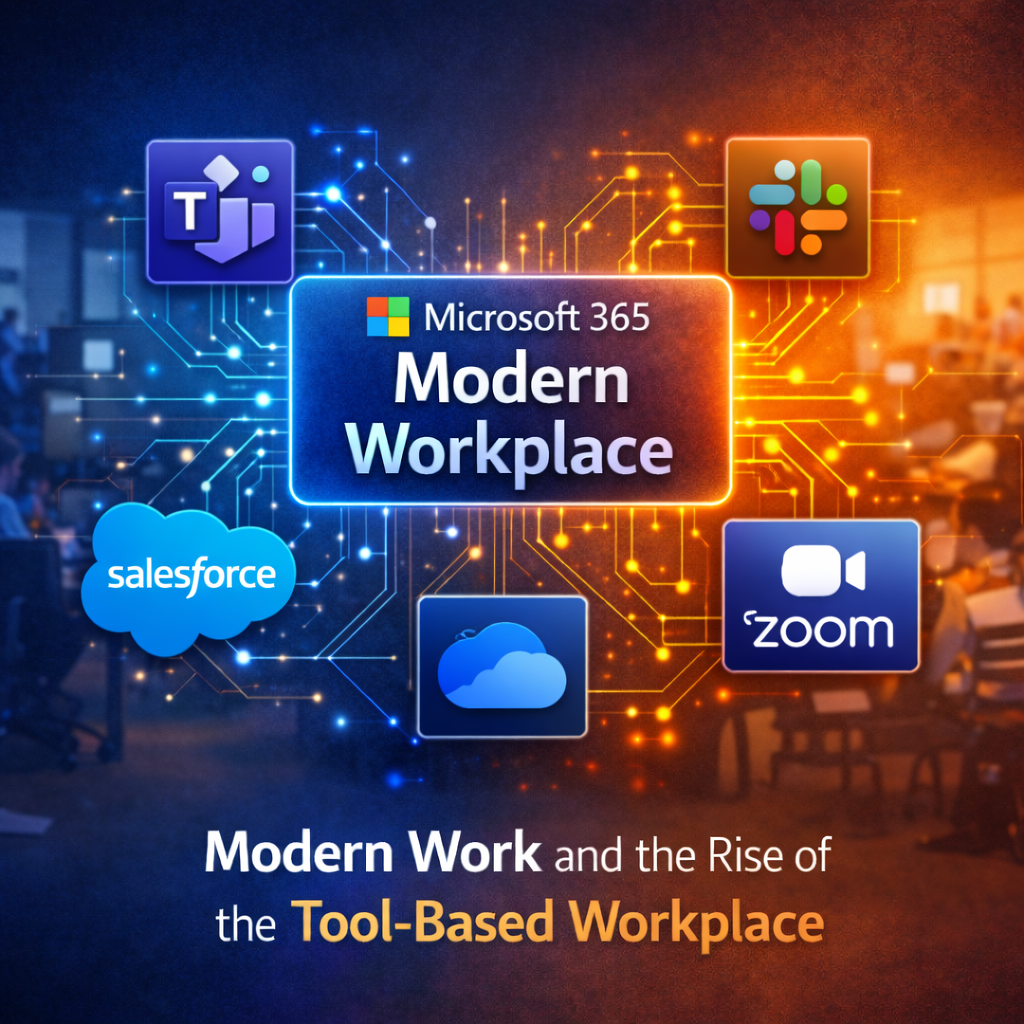
The term “Modern Work” did not appear overnight. It was not a single invention or a sudden trend, but rather a name that slowly emerged for something that was already happening inside organizations. Around 2015, the nature of work began to shift in a noticeable way. Not because of one specific technology, but because of a new combination of cloud services, collaboration platforms, and more flexible working models. Work became more digital, more distributed, more transparent — and it gradually moved into tools.
What is now called the “Modern Workplace” started as a practical need. Teams wanted to collaborate more easily, share information faster, work independently of location, and make progress visible. Email, file servers, and meetings were no longer enough to handle growing complexity. Organizations began to look for new ways to support everyday work, not just with infrastructure, but with environments in which work could actually happen.From 2016 and 2017 onward, this need became more structured. Platforms such as Microsoft Office 365 (later Microsoft 365), Google G Suite (now Google Workspace), Slack, Jira, Confluence, Trello, and Asana were no longer introduced as isolated tools, but as part of a broader workplace strategy. Companies stopped buying software and started designing work environments.
Microsoft 365 quickly became a central element of this shift. Not because it was hook the most innovative product, but because it connected many functions into one integrated ecosystem: email with Exchange Online, files with SharePoint and OneDrive, collaboration with Teams, task management with Planner, knowledge with OneNote, automation with Power Automate, analytics with Power BI, and later low-code development with Power Apps. For many organizations, Microsoft 365 was the first time work felt like a connected digital space rather than a set of separate systems.This was also the moment when the role of IT integrators began to change.
Traditionally, IT system houses focused on infrastructure. They built networks, implemented systems, ensured stability, security, and availability. But as tools became central to how organizations operate, customers no longer asked only for working systems. They asked for working collaboration.A company did not want a CRM system, but better cooperation between sales and marketing. It did not want a ticketing platform, but faster service and happier customers. HR did not want an applicant tracking system, but a better candidate experience. Leadership did not want dashboards, but clarity.As a result, IT integrators became translators between business needs and technical possibilities. They were no longer just implementers, but architects of digital work environments. Their portfolios expanded beyond infrastructure into SaaS platforms, integrations, automation, identity and access management, security, governance, and managed services.
At the same time, new roles emerged in the market. Companies began looking for Microsoft 365 Consultants, Modern Workplace Consultants, Collaboration Architects, and Digital Workplace Specialists. These were profiles that combined technical knowledge with organizational understanding. People who could explain not only how to configure tools, but why certain structures made sense, how digital workflows should reflect real work, and how transparency, automation, and collaboration should be balanced.At Darkgate, as one of the well-established recruiting agencies in the IT and digital space, we observed this shift very closely. In regular conversations with department heads, CIOs, and CTOs, similar patterns appeared again and again. “We have the licenses, but we don’t use the potential.” “Our people are overwhelmed by the number of tools.” “We need someone who understands both the technology and how our teams actually work.” These were not technical problems. They were organizational ones.
Modern Work was never primarily a technology project. It was a translation project between work reality and digital possibility.Integrators became that translation layer. They helped organizations turn abstract goals into concrete tool landscapes. They designed team structures, defined governance models, ensured security and compliance, integrated tools into existing systems, and trained users. They stayed involved as long-term partners, not only to operate systems, but to continuously adjust them as organizations evolved.
This also created new challenges. As more work moved into tools, issues like identity management, data protection, compliance, reliability, and change management became central. The Modern Workplace had to be not only usable, but trustworthy. Not only flexible, but stable. Not only innovative, but resilient.Between 2020 and 2026, the focus matured further. Modern Work was no longer about introducing tools, but about shaping sustainable digital environments. Microsoft 365 remained a core platform, but it was increasingly complemented by ecosystems: Jira and Confluence for project work, ServiceNow for IT service management, Salesforce for sales, Notion for knowledge, Miro for ideation, Zoom for communication. Work spread across platforms, and these platforms had to be orchestrated.IT integrators became the orchestrators of this complexity.They no longer designed networks, but workspaces. They no longer planned server landscapes, but collaboration models. They no longer delivered systems, but environments in which people could work productively.
Today, in 2026, the Modern Workplace is no longer a project. It is the default. Nobody asks whether remote work is possible, but how to do it well. Nobody asks whether tools are needed, but which combination makes sense. Nobody asks whether IT matters, but how it supports work.The workplace is no longer defined by a building or a desk, but by a digital space.What remains is the responsibility to shape that space consciously. Not only for efficiency, but for clarity. Not only for speed, but for sustainability. Not only for performance, but for people.
And this is where IT integrators continue to play a crucial role. Not by chasing trends, but by providing orientation. Not by selling tools, but by enabling work. Not by focusing on technology, but by shaping environments in which organizations can grow, adapt, and function.Modern Work is not a state. It is a process.And it is still unfolding.